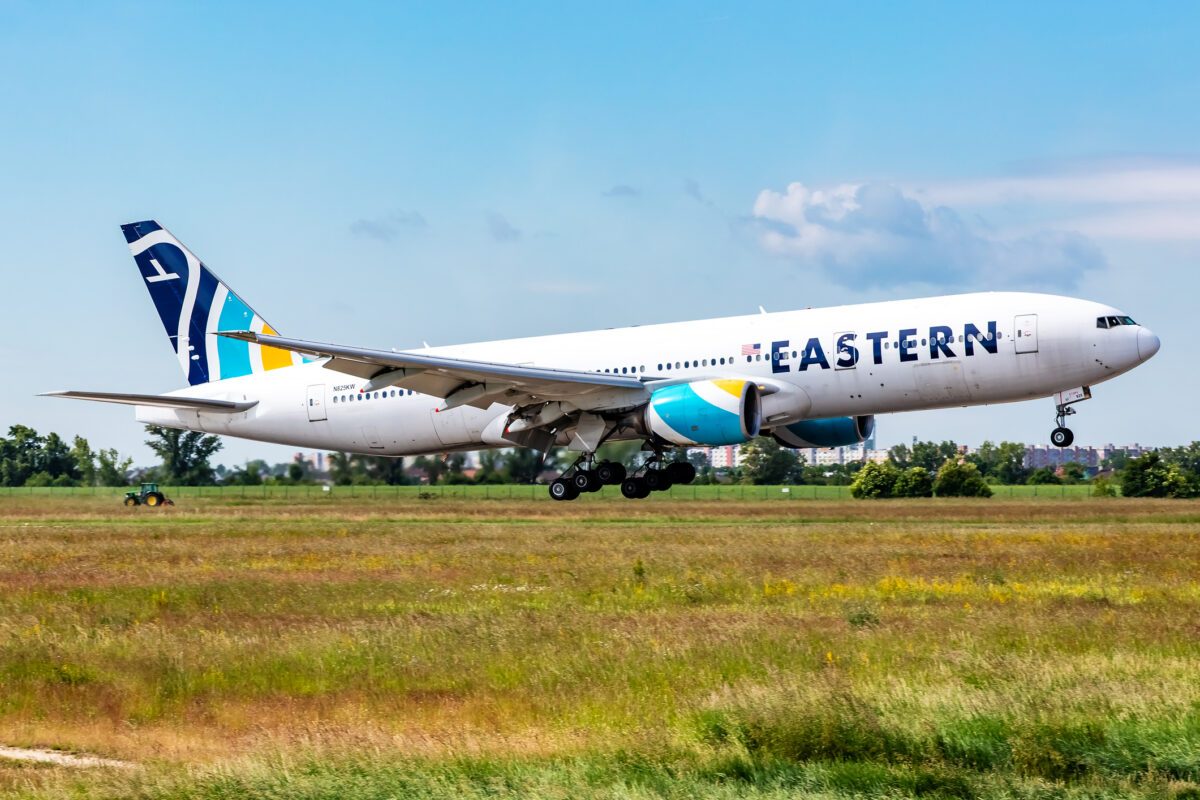
Surinam Airways plans to introduce an Eastern Airlines-operated Boeing 777-200ER on its route between Paramaribo (PBM) and Amsterdam Schiphol (AMS), giving the carrier a dedicated long-haul aircraft in its own colors while retaining an external operating partner.
The aircraft is scheduled to enter service in December 2026. Surinam Airways chief executive Johan Sandie disclosed the plan during a September 22 interview with the Surinamese government’s Communication Service, which said Eastern had become the airline’s new partner on the Amsterdam route under a two-year arrangement.
Eastern’s involvement began September 27, ahead of the planned introduction of the Surinam Airways-liveried 777. The arrangement gives the flag carrier a path toward a more consistent long-haul product without immediately rebuilding the flight-operations structure required to place a 777 on its own air operator certificate.
Read our stories in your inbox
Two aviation newsletters. Zero fluff.
A Dedicated Aircraft for the Amsterdam Route
Amsterdam is the core of Surinam Airways’ long-haul operation. Its published timetable lists three weekly flights in each direction, using PY993 from Amsterdam and PY994 from Paramaribo. The current schedule has departures from AMS on Wednesdays, Fridays and Sundays, with corresponding overnight services from PBM.
The airline’s published mid-Atlantic schedule gives the westbound journey a block time of nine hours and 30 minutes. Eastbound flights are scheduled at about nine hours, depending on the operating day.
A Boeing 777-200ER is well matched to that mission. Boeing lists the variant with a range of up to 7,500 nautical miles and typical two-class seating for 300 to 375 passengers. The PBM–AMS sector uses only part of that range capability, providing ample performance margin for payload, weather and diversion planning on the Atlantic crossing.
Eastern describes its own 777-200ERs as high-density aircraft configured with 379 economy seats. Its published fleet information identifies the type as its principal long-haul passenger platform, while the company says it is expanding a fleet that includes both Boeing 777s and 767s.
Whether the aircraft assigned to Surinam Airways retains Eastern’s full 379-seat layout will determine the scale of the capacity change. Even without a cabin reconfiguration, dedicated Surinam Airways branding will make the operation less visibly dependent on rotating short-term providers and should give the airline greater continuity in sales, airport presentation and passenger communications.
Eastern Provides the Operating Platform
Eastern is a U.S. Part 121 carrier specializing in charter and leased widebody operations. The company lists six Boeing 777-200ERs in its fleet and has completed ETOPS certification for its long-range twin-engine operation.
That certification is central to an efficient Paramaribo–Amsterdam service. Extended diversion approval allows a twin-engine aircraft to follow practical transatlantic routings while remaining within the authorized flying time of suitable alternate airports. Eastern said in 2025 that its fleet had received ETOPS approval, following certification flying that included a Boeing 777 mission to Shannon.
For Surinam Airways, using Eastern’s aircraft and operating approvals also reduces the immediate certification burden associated with introducing another widebody directly. The carrier can concentrate on scheduling, distribution, ground handling and the customer-facing elements of the product while its partner supplies the long-haul operating platform.
Sandie placed the agreement within a broader effort to improve operational stability and arrange more effective backup coverage. The airline has experienced repeated changes among the aircraft providers supporting its Amsterdam service, making fleet consistency an important part of the new agreement.

EU Restrictions Shape the Structure
The operating arrangement also addresses the regulatory position facing Surinamese carriers in Europe. The European Commission added all airlines certified in Suriname to the EU Air Safety List in June 2025, citing deficiencies in the country’s regulatory oversight rather than an aircraft-specific finding against Surinam Airways.
The restriction remained in force in the European Commission’s June 2026 update. EU rules nevertheless allow a listed airline to serve the bloc using wet-leased aircraft from an operator that is not subject to the ban, provided the applicable safety standards are met. The Commission also states that such an aircraft may carry the branding of the airline selling the service.
That framework explains the operational value of the Eastern partnership: Surinam Airways can maintain its commercial presence at AMS and place its identity on the aircraft, while the flight operates through an eligible foreign carrier.
Suriname’s Civil Aviation Safety Authority has been working with the European Union Aviation Safety Agency on corrective measures. CASAS said EASA completed the third and final technical-assistance visit in August, resulting in a corrective action plan intended to support the country’s eventual removal from the safety list. The authority cautioned that delisting depends on implementing the measures and a subsequent European Commission assessment.
A Second Boeing 777 Chapter
The December introduction will return the 777-200ER to a prominent place in Surinam Airways’ long-haul strategy. The airline previously selected the type to replace its four-engine Airbus A340 operation and received PZ-TCU in December 2019.
Surinam Airways’ historical financial disclosures show that the earlier aircraft required a lengthy certification process. The company’s published accounts describe the former 777 program as entering commercial service on a non-ETOPS basis in 2020, an operational limitation that weakened the economics of deploying a twin-engine aircraft across the Atlantic.
The Eastern agreement approaches the requirement differently. Instead of first developing an in-house 777 and ETOPS capability, Surinam Airways is drawing on an established external operator with the aircraft, crews, maintenance system and long-range approvals already in place.
Bottom Line
The planned 777 gives Surinam Airways something more valuable than a change of aircraft type: the prospect of a stable, identifiable long-haul platform. A dedicated jet in the airline’s colors should improve product consistency on a route where changes of operator and equipment have complicated both customer expectations and operational planning.
Eastern gains a multiyear assignment for part of its growing 777 fleet, while Surinam Airways avoids the immediate cost and certification risk of recreating its earlier in-house widebody operation. The decisive test will be whether the partnership delivers dependable aircraft availability and backup coverage across the full two-year term, particularly during peak travel periods between Suriname and the Netherlands.
The longer-term question remains regulatory. If Suriname successfully completes its corrective action plan and leaves the EU Air Safety List, Surinam Airways will have more freedom to determine whether its next widebody should remain externally operated or return to its own certificate. Until then, the Eastern 777 provides a workable bridge between maintaining the Amsterdam market and rebuilding the foundations for greater operational independence.
Keep reading FlyMag
Get the Daily Brief in the morning or the Route Watch weekly recap on Fridays. Or both.