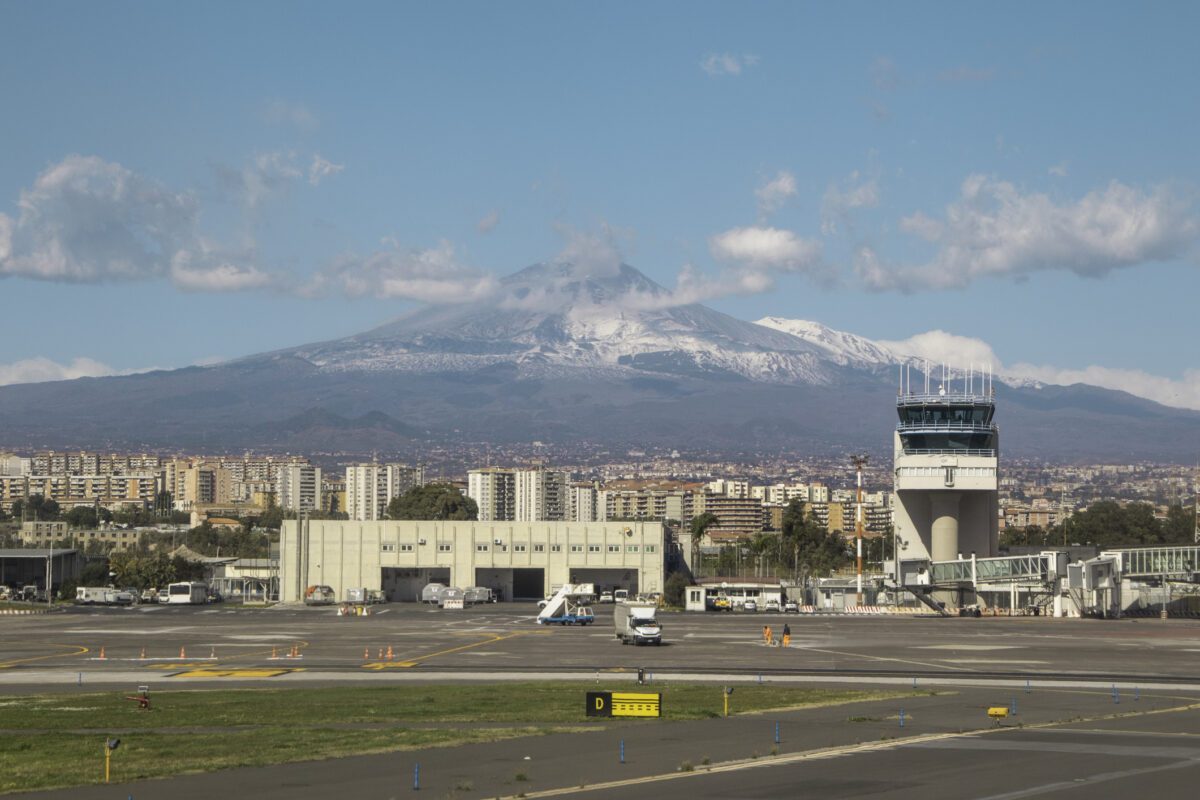
Brussels Airlines diverted a Saturday service from Brussels Airport (BRU) to Palermo (PMO) after volcanic ash from Mount Etna forced the suspension of flight operations at Catania (CTA).

Flight-tracking records show SN3131, operated by Airbus A319 OO-SSU, reached Palermo instead of its scheduled destination on September 26. The aircraft had been due to continue from Catania to Brussels as SN3132, arriving at BRU at 9:15 p.m. local time.
That return sector was canceled, leaving roughly 140 passengers in Sicily. Brussels Airlines said the affected travelers were expected to return on Sunday or Monday as it adjusted its operation around the closure.
Read our stories in your inbox
Two aviation newsletters. Zero fluff.
The distinction between the two flight numbers is important: SN3131 was the outbound Brussels-Catania service that operated instead to Palermo. SN3132 was the Catania-Brussels return flight that could no longer depart once the aircraft and crew were positioned at PMO and CTA was closed.

Red Aviation Alert Issued for Etna
Italy’s National Institute of Geophysics and Volcanology issued a red Volcano Observatory Notice for Aviation at 6:33 UTC on Saturday. The September 26 VONA said ash emission was continuing, with the volcanic cloud estimated at 4 kilometers above sea level and moving south.
INGV said the phenomenon was visible through its thermal and visual surveillance camera network. The red code is an operational alert indicating an eruption with significant ash emission is underway or imminent; it does not, by itself, prescribe a blanket closure. Airspace and airport restrictions depend on the ash cloud’s position, forecast movement and effect on approach paths and the aerodrome.
At Catania, authorities initially imposed arrival restrictions before suspending both arrivals and departures. The shutdown was extended until at least noon on Sunday, September 27, with the timing subject to reassessment as the ash plume and surface contamination developed.
For CTA, the operational problem is not limited to airborne ash. Deposits on the runway, taxiways, aprons and aircraft stands must be assessed and, where necessary, removed before movements can resume safely. The airport’s published operating rules require airlines and handlers to protect parked aircraft and ground equipment during ashfall, including the use of engine and pitot covers.

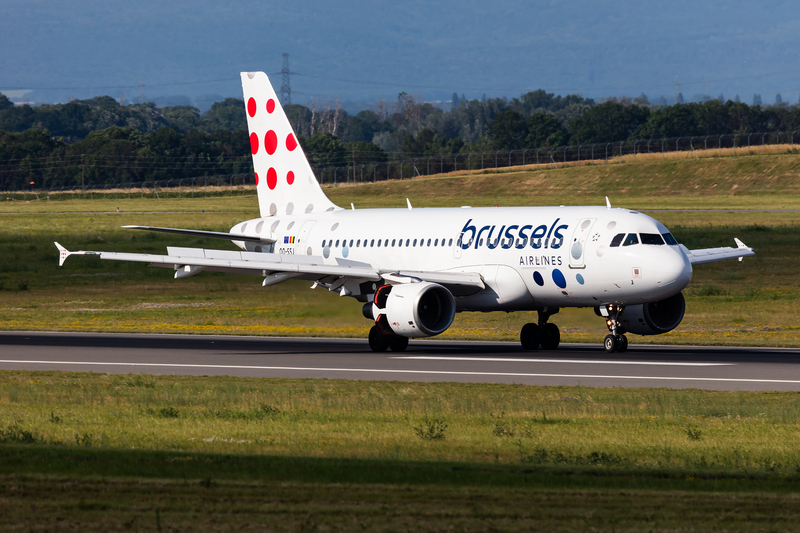
Near-Full Airbus A319 Repositioned at Palermo
OO-SSU is an Airbus A319-111 powered by CFM56 engines. Brussels Airlines’ published A319 specification lists 141 seats, meaning the reported passenger total of around 140 would represent an almost full cabin.
The airline lists the type with a range of 3,200 kilometers, comfortably sufficient for the roughly 1,700-kilometer sector between Brussels and eastern Sicily. Its capacity is well matched to thinner European leisure and business routes where an A320 may provide more seats than required, although Brussels Airlines is progressively replacing older A319s with larger A320neo aircraft.
Diverting the inbound flight to Palermo preserved the aircraft’s arrival in Sicily but did not provide a straightforward recovery for the return passengers. Catania and Palermo are on opposite sides of the island, and transferring passengers or crews between the airports requires a lengthy surface journey. Ground transport also becomes constrained when several airlines divert simultaneously.
The disruption therefore extended beyond the cancellation of one sector. The airline had to manage passengers already waiting at CTA, customers arriving at PMO instead of Catania, baggage and ground handling at the diversion station, and the subsequent positioning of the aircraft and crew.

Brussels Airlines Adjusts Sunday Operation
Brussels Airlines’ published schedule normally pairs SN3131 and SN3132 on the Brussels-Catania route. The carrier canceled a planned Sunday departure to Catania and arranged for another Sicily rotation to operate through Palermo, allowing passengers to move by road between PMO and the Catania area.
Recovery options depend on more than the reopening time at CTA. Aircraft and crews must be brought back into sequence, while working-time limits, airport slots and handling capacity can prevent an immediate return to the original schedule. An airport reopening at midday does not mean every canceled flight can be reinstated that afternoon.
The September 26 event followed repeated Etna-related restrictions at Catania during August and September. Days before the latest closure, Italy’s civil aviation authority and INGV said they were working toward a more detailed technical agreement for the management of volcanic ash. Their September 21 statement specifically cited the effect of recent Etna ash episodes on CTA operations.
Catania is one of the European airports most routinely exposed to volcanic ash, giving operators established diversion and recovery procedures. Palermo, Comiso and Trapani can absorb some displaced traffic, but each alternative creates ground-transport, handling and aircraft-positioning complications that persist after the immediate airspace restriction is lifted.
Bottom Line
The diversion illustrates why Palermo is operationally useful but not interchangeable with Catania. It gives an inbound aircraft a viable landing point in Sicily and can keep a rotation from returning directly to Brussels, yet the distance between the airports makes the passenger recovery expensive and time-consuming. That trade-off becomes sharper when the return load is already assembled at CTA and the inbound aircraft lands at PMO.
Brussels Airlines’ A319 was almost fully occupied, leaving little spare capacity for reaccommodation on the carrier’s next scheduled services. Recovery will therefore depend on a combination of extra seats, rerouting through Palermo and the restoration of stable operations at Catania rather than a simple restart of the canceled rotation.
The next operational test is whether CTA can reopen and remain open without further ashfall affecting the movement area or approach sectors. Repeated closures can quickly turn a local airport restriction into a multi-day network problem as aircraft, crews and passengers accumulate in different parts of Sicily.
Keep reading FlyMag
Get the Daily Brief in the morning or the Route Watch weekly recap on Fridays. Or both.