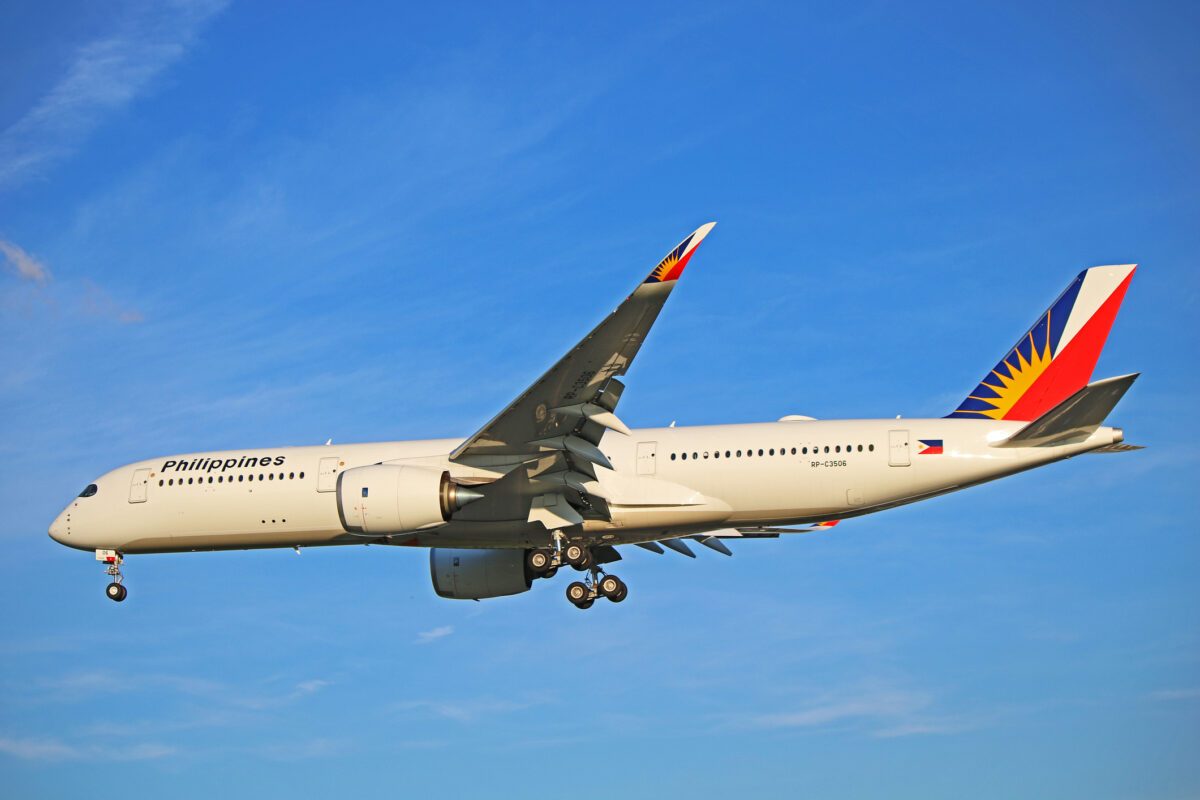
Philippine Airlines has made the Airbus A350-1000 the daily scheduled aircraft between Manila (MNL) and San Francisco (SFO), extending the carrier’s latest long-haul product across all seven weekly frequencies on one of its principal transpacific routes.

The assignment applies to PR104 from Manila and PR105 from San Francisco from November 1, 2026. Philippine Airlines confirmed the daily deployment in an October 29 schedule announcement, positioning SFO as a core A350-1000 market rather than a route receiving only selected flagship frequencies.
Read our stories in your inbox
Two aviation newsletters. Zero fluff.
Daily A350-1000 Schedule to San Francisco
PR104 departs MNL at 11:15 p.m. and reaches SFO at 7:45 p.m. local time on the same calendar day. The return PR105 leaves San Francisco at 10:40 p.m. and arrives in Manila at 5:35 a.m. local time.
The November 1 timetable appears one hour earlier in San Francisco than the schedule published through October 31. That change reflects California’s return to standard time rather than a material shift in the flight’s UTC timing. Daylight saving time in the United States ended at 2 a.m. on November 1 in 2026, while the Philippines does not make a seasonal clock change.
Putting the A350-1000 on every frequency gives PAL a consistent premium product in both directions. It also concentrates the type on a route where the aircraft’s combination of passenger capacity, belly cargo volume and long-range performance can be used without requiring the extreme range for which PAL originally selected it.
The A350-1000 is the largest aircraft in the A350 family. Airbus lists an overall length of 73.78 meters and equips the variant with Rolls-Royce Trent XWB-97 engines. The manufacturer’s A350-1000 specifications give the aircraft a range of about 9,000 nautical miles and typical three-class capacity of 375 to 400 passengers. PAL’s 382-seat layout sits near the middle of that range.
Three Cabins and 382 Seats
Philippine Airlines has configured its A350-1000 with 42 Business Class suites, 24 Premium Economy seats and 316 Economy Class seats. Business Class uses a 1-2-1 arrangement, giving every passenger direct aisle access. The fully flat suites have sliding privacy doors, a feature absent from the carrier’s earlier-generation long-haul business-class product.
PAL markets the suites as “Mabuhay Studios.” The airline’s official fleet and product publication lists 20-inch 4K displays and wireless charging in Business Class. The separate Premium Economy cabin has legrests, footrests, personal storage, in-seat power, USB-A and USB-C connections, and 13.3-inch 4K screens.
Economy accounts for more than four-fifths of the aircraft’s capacity. PAL specifies a 32-inch seat pitch, adjustable headrests, device holders and USB charging in the cabin. The airline also offers inflight Wi-Fi, seat power and 4K entertainment screens across the aircraft.
The mix is significant on San Francisco. The 42-suite forward cabin gives PAL a substantial premium inventory for corporate traffic and higher-yield connecting passengers, while the 316-seat Economy cabin supports the large visiting-friends-and-relatives market between Northern California and the Philippines. Premium Economy provides a smaller intermediate cabin of 24 seats rather than consuming a large portion of the aircraft’s overall capacity.
A Growing North American Flagship Fleet
PAL received its first A350-1000 in December 2025, and the aircraft entered commercial service between Manila and New York (JFK) on January 6, 2026. The carrier expanded the fleet during 2026, taking its fourth aircraft, RP-C3513, on September 2. PAL said when announcing that delivery that the type was already serving San Francisco, New York and Toronto Pearson (YYZ).
The fourth aircraft was part of PAL’s original firm order for nine A350-1000s. Airbus said at the first aircraft’s delivery that the nine-jet program was intended to add long-haul capacity and support further North American flying.
PAL subsequently signed a memorandum of understanding for nine additional A350-1000s in July 2026. If finalized, the agreement would double its total orders for the variant to 18 aircraft. The proposed follow-on order retains the same 382-seat, three-class specification and underlines the carrier’s plan to make the -1000 the backbone of its long-haul expansion.
San Francisco’s move to a daily A350-1000 schedule is therefore more than a short series of promotional flights. It establishes a regular West Coast assignment for a fleet conceived both for PAL’s longest missions and for high-volume North American trunk routes.
Bottom Line
The immediate gain for San Francisco passengers is product consistency. Travelers booking any day of the week can expect PAL’s enclosed Business Class suite, dedicated Premium Economy cabin and newest entertainment and connectivity systems, rather than having to select particular frequencies to find the flagship. For the airline, operating the larger A350 variant daily also creates more premium and cargo capacity without adding another frequency at SFO.
The deployment is an early test of how PAL will use a still-small but rapidly expanding flagship fleet. San Francisco, New York and Toronto place different demands on aircraft time and range, and maintaining the published type consistently across those markets will depend on delivery timing, reliability and sufficient maintenance coverage. As the remaining aircraft from the initial nine-jet order arrive, the point to watch is whether PAL uses that additional depth to reinforce daily assignments, increase North American frequencies or open the longer nonstop markets that originally drove the A350-1000 purchase.