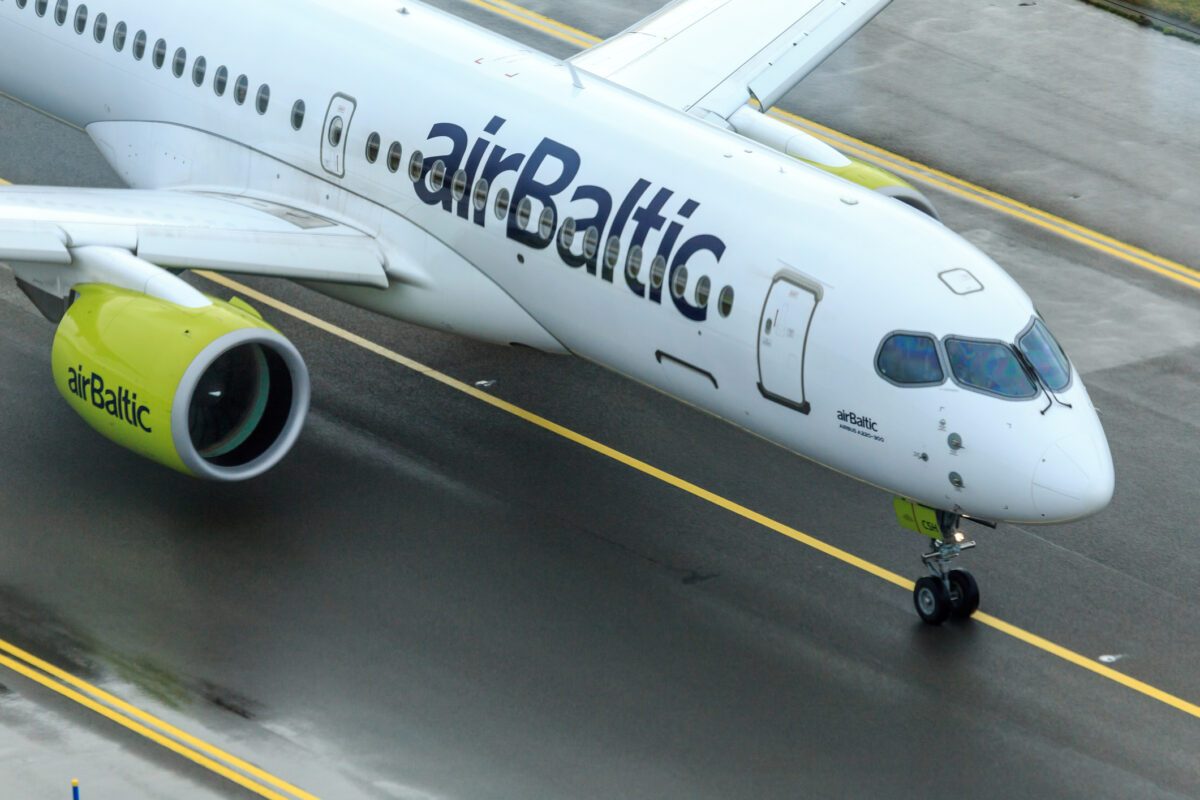
airBaltic will concentrate its summer 2027 scheduled network on Riga (RIX), giving the Latvian hub 57 direct destinations while reducing the breadth of its operations from Tallinn (TLL) and Vilnius (VNO).
The airline’s published summer 2027 program, covering late March through late October, lists 13 destinations from Tallinn and eight from Vilnius. Rather than continue adding thin routes across its bases, airBaltic will put more frequencies into markets it considers capable of supporting stronger demand and revenue.
The schedule is the first full summer program developed under the revised business plan announced in August. It turns the plan’s central network principle — greater depth in proven markets, with Riga retained as the core hub — into a defined operating program.
Read our stories in your inbox
Two aviation newsletters. Zero fluff.
Riga Gains Frequency Rather Than More Network Breadth
From RIX, airBaltic plans frequency increases on 12 routes. London Gatwick (LGW) will receive up to 14 weekly flights, while Paris Charles de Gaulle (CDG) and Vienna (VIE) will each rise to as many as 12.
Barcelona (BCN), Rome Fiumicino (FCO), Hamburg (HAM), and Düsseldorf (DUS) will each be served up to seven times per week. Milan Malpensa (MXP) will receive six weekly flights, followed by Athens (ATH) and Nice (NCE) with four each. Alicante (ALC) and Split (SPU) will each have three.

That pattern gives airBaltic more useful timings in large business and leisure markets without committing aircraft to an equivalent number of lower-frequency destinations. Daily service to Barcelona, Rome, Hamburg, and Düsseldorf also strengthens the bank structure at RIX, while the additional London, Paris, and Vienna flights create more options for both local passengers and connecting traffic.
The airline said it has adjusted departure times and connection windows as part of the new hub structure. Its booking timetable is already displaying travel into summer 2027.
Tallinn and Vilnius Networks Contract
The change is more pronounced outside Latvia. airBaltic offered 25 destinations from Tallinn during summer 2026, according to Tallinn Airport’s season launch. The 2027 program reduces that figure to 13.
The retained Tallinn network combines high-frequency links to airBaltic’s Riga hub and Amsterdam (AMS) with a smaller group of major European markets. RIX will operate up to five times daily, Amsterdam twice daily, and Vilnius 10 times weekly. Paris and Munich (MUC) are scheduled five times weekly; Berlin (BER) and Brussels (BRU), four; Malaga (AGP), London Gatwick, and Vienna, three; and Barcelona, Heraklion (HER), and Nice, twice.
The resulting Tallinn schedule is more heavily weighted toward year-round commercial centers and established leisure markets. Athens, Hamburg, Copenhagen, Oslo, Malta, Rhodes, Split, Palma de Mallorca, Billund, Burgas, and Tirana are among the summer 2026 destinations absent from the carrier’s 2027 Tallinn program.
Vilnius undergoes an even narrower reset. The airline was operating 20 direct routes from the Lithuanian capital during 2026, following an expansion that included a third based aircraft and higher frequencies on several routes. That expansion was detailed by Lithuanian Airports when the 2026 program was announced.
For summer 2027, Vilnius retains Riga at up to four daily flights and Amsterdam at up to two daily. Tallinn will operate 10 times weekly, while Paris and Munich will each receive six weekly services. Düsseldorf, Hamburg, and Lisbon (LIS) complete the network with two weekly flights apiece.
airBaltic will also continue serving Palanga (PLQ), with Amsterdam operating twice weekly and Riga up to twice daily. The high-frequency Vilnius–Riga and Palanga–Riga schedules place greater emphasis on feeding the larger RIX network rather than replicating it with a broad selection of nonstop routes from Lithuania.
Business Plan Calls for a Smaller Fleet
The network concentration follows airBaltic’s August 11 business plan announcement, which replaced the carrier’s previous drive toward a fleet of roughly 100 aircraft with a smaller, profitability-led operation.
The plan forecasts 36 aircraft at the end of 2026 and throughout 2027, compared with 51 at the end of 2025. The fleet would then increase gradually to 41 aircraft by 2031. Scheduled capacity is projected to fall from 9.6 billion available seat kilometers in 2026 to 8.7 billion in 2027, a reduction of about 9%, before recovering to 10.5 billion by 2031.
airBaltic also expects the combination of fleet, network, and operating changes to reduce annual costs by approximately €45 million. The wider recapitalization plan includes €225 million of interim financing, new debt and equity, and the partial conversion of obligations into equity. Bondholders approved associated resolutions in August, and the airline confirmed that the supplemental trust deed took effect on August 24.
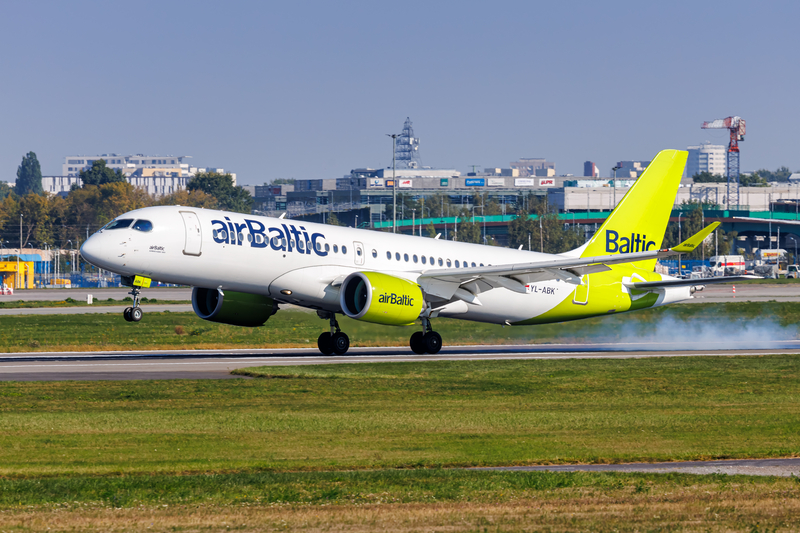
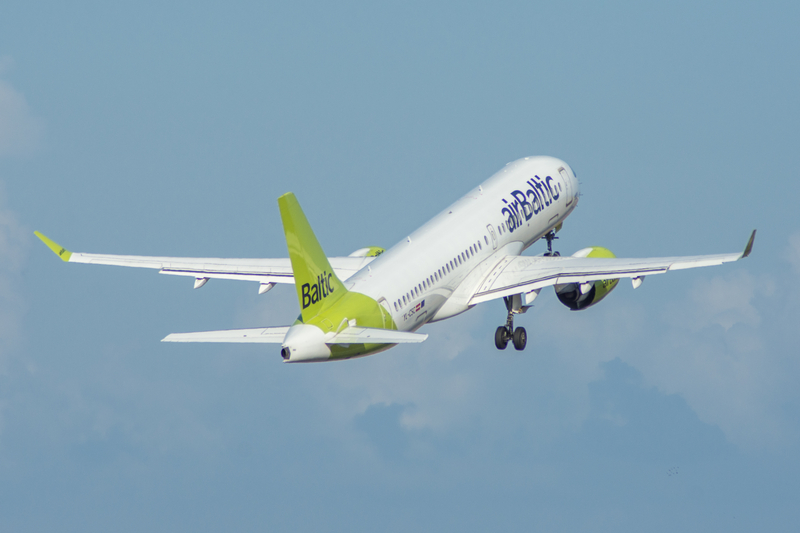
The remaining fleet is composed entirely of Airbus A220-300s. airBaltic markets its current aircraft with 148 seats, a capacity that supports multiple daily frequencies without the larger gauge of an A320-family aircraft. The airline also uses the type for ACMI and charter flying, which the restructuring plan identifies as an important way to balance seasonal demand and keep aircraft productive outside the peak Baltic summer.
Airbus lists the A220-300 with a maximum range of 3,450 nautical miles and typical seating for 120 to 160 passengers. Its combination of range and relatively modest capacity allows airBaltic to use one fleet type across short Baltic sectors, European trunk routes, and longer services to Southern Europe and the eastern Mediterranean. Those capabilities remain well matched to a strategy built around frequency and selective point-to-point flying rather than rapid network expansion.
Bottom Line
Riga passengers gain the clearest benefit from airBaltic’s reset. The network may contain fewer marginal routes than in recent expansion cycles, but higher frequencies to London, Paris, Vienna, Barcelona, Rome, and several German markets make RIX more useful as both an origin airport and a connecting hub. Schedule quality, rather than the headline destination count alone, will determine whether the airline can improve yields and capture more connecting traffic.
Tallinn and Vilnius face a different trade-off. Both retain frequent access to Riga, Amsterdam, and several large European cities, but lose much of the seasonal breadth airBaltic built during its growth phase. That creates openings for competing airlines on local point-to-point markets, particularly where airBaltic’s withdrawal leaves sufficient demand for another operator but no longer fits the carrier’s smaller fleet plan.
The question for summer 2027 is whether a 36-aircraft operation can deliver the planned frequency reliably while also supporting airBaltic’s ACMI commitments. If the airline can improve aircraft utilization and preserve the integrity of its Riga banks, the program will mark a disciplined transition toward a smaller network carrier. If aircraft availability or financing again becomes constrained, the concentrated schedule leaves fewer peripheral routes to remove before core connectivity is affected.
Keep reading FlyMag
Get the Daily Brief in the morning or the Route Watch weekly recap on Fridays. Or both.