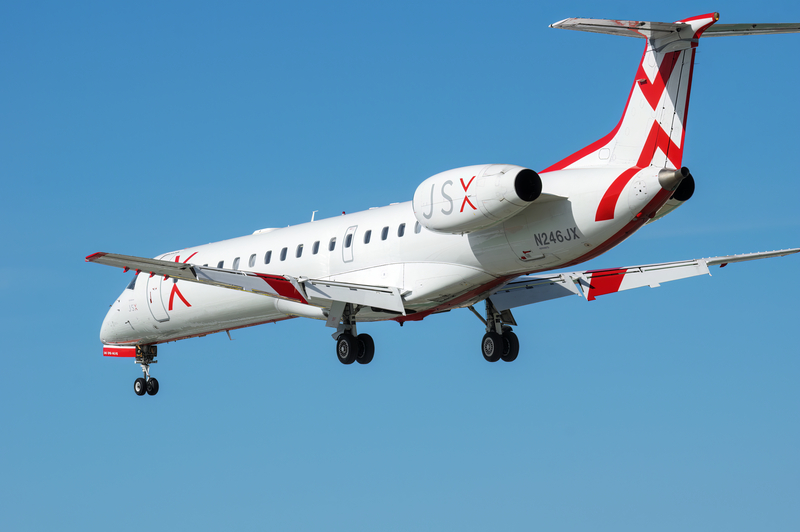
JSX has acquired New Pacific Airlines and is seeking federal clearance to return the bankrupt carrier to service with 42-seat Embraer ERJ145-LRs.
A November 20 filing with the U.S. Department of Transportation says New Pacific is now controlled by JetSuiteX, the company that sells flights under the JSX brand. The acquisition was completed through New Pacific’s Chapter 11 reorganization in August 2026.
The transaction gives JSX control of an airline holding Part 121 operating authority, providing a second regulatory platform alongside the Part 135 carrier that operates its existing network. New Pacific has asked DOT to waive the normal 45-day advance notice period so that it can resume flying once the remaining regulatory work is complete.
Read our stories in your inbox
Two aviation newsletters. Zero fluff.
A Part 121 Platform for JSX
JSX’s current service uses two affiliated companies. JetSuiteX sells individual seats as public charters under Part 380, while Delux Public Charter operates the flights under an FAA Part 135 certificate and DOT commuter authority. JSX’s own passenger information describes a 30-seat operation using dedicated hangars, 20-minute domestic check-in and planeside baggage delivery.
That structure limits the aircraft used for scheduled commuter operations to 30 passenger seats. JSX has therefore operated Embraer regional jets originally designed for denser airline cabins with substantially fewer seats, supporting its premium positioning but constraining the number of passengers carried on each departure.
New Pacific would operate under Part 121 and lease ERJ145-LRs from Delux. The aircraft would carry 42 passengers, increasing capacity by 12 seats, or 40%, compared with JSX’s current 30-seat jets. JetSuiteX would continue selling the flights as public charters under the JSX Air brand.
The proposal is more than a paper transfer of flying. New Pacific would be the direct air carrier, employing its own Part 121-qualified crews and exercising operational control over the aircraft. Delux would remain the operator of JSX’s established 30-seat network.
Six ERJ145-LRs Planned in the First Five Months
New Pacific plans to begin with two ERJ145-LRs before adding one aircraft per month, reaching six aircraft during its fifth month of operation. The filing projects 10,106 departures and 309,086 passenger boardings in the first year.
Those forecasts equal an average of about 30.6 passengers per flight, already beyond the physical capacity of JSX’s existing cabins. On a 42-seat aircraft, the projection represents an average load factor of roughly 73%.
The planned flying is concentrated on domestic sectors of approximately 200 to 300 nautical miles, with average block time of about 72 minutes. Aircraft utilization is expected to build toward roughly six segments per aircraft per day. That pattern points to short, high-frequency markets where the additional 12 seats can materially improve unit economics without requiring a different aircraft family.
The ERJ145-LR is normally associated with 50-seat regional airline service. Embraer lists the LR version with a full-passenger range of up to 1,550 nautical miles, far more than New Pacific’s initial average sector. The 42-seat layout would remain less dense than a conventional regional-airline configuration while using an aircraft already familiar to JSX’s pilots, maintenance operation and supply chain.
New Pacific says the onboard product will include business-class legroom, complimentary drinks and snacks, and free Starlink connectivity. The larger cabin will necessarily differ from JSX’s current low-density arrangement, including the spacious single-seat rows and side tables found on parts of its fleet.
The Certificate Was Central to the Bankruptcy Process
New Pacific and its affiliated companies entered Chapter 11 on January 26, 2026, after ending commercial flying in late November 2025. A bankruptcy court filing said the group had terminated most of its employees and placed three Boeing 757s into long-term storage as it shifted its attention to selling assets.
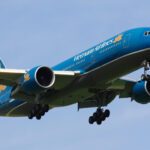
The airline had previously pursued a passenger and charter strategy centered on the 757. That aircraft is not part of JSX’s proposed restart. Instead, New Pacific would be rebuilt around regional jets transferred from within the JSX group.
Bankruptcy documents explicitly identified New Pacific’s regulatory approvals as assets worth preserving. A subsequent Chapter 11 solicitation filing described the company as the holder of both an FAA Part 121 certificate and a DOT certificate of public convenience and necessity.
DOT had reissued that interstate scheduled authority in 2023 when the company changed its name from Northern Pacific Airways to New Pacific Airlines. The authority also permits interstate and foreign charter operations, subject to FAA and other federal approvals.
Restart Still Requires Federal Clearance
New Pacific has asked DOT to accept its financial fitness showing and authorize the resumption of service. Its first-year plan includes approximately $53.9 million in operating expenses and $3.9 million in startup costs covering training, employee compensation, aircraft deposits, maintenance and airport expenses.
To satisfy DOT’s working-capital test, the company says it has more than $18 million on deposit with Texas Capital Bank, exceeding its calculated requirement of approximately $17.4 million.
The filing also asks DOT to waive the 45-day notice requirement, allowing service to begin when the FAA completes its certification review. The acquisition itself does not authorize New Pacific to launch immediately; the airline must still demonstrate that it remains fit, willing and able to conduct the proposed operation under its new ownership and business plan.
JSX has framed the new carrier as a way to add service in small and midsize communities that have lost flights from larger airlines. Its initial markets and fares were filed confidentially, leaving the first deployment of the 42-seat fleet to be disclosed closer to launch.
Bottom Line
New Pacific gives JSX a practical way to test higher-capacity flying without abandoning the aircraft family and public charter distribution model around which it has built its business. The planned 42-seat cabin is still meaningfully less dense than the ERJ145’s traditional 50-seat layout, but the extra revenue opportunity is substantial on sectors where JSX can regularly attract more than 30 passengers.
The transaction also reduces JSX’s dependence on a single regulatory structure. Its existing Part 135 operation remains central to the brand, particularly at smaller airports and dedicated facilities, while New Pacific creates a Part 121 pathway for markets that require more seats or would not fit comfortably within commuter authority. That flexibility could become increasingly valuable as federal agencies continue examining high-frequency public charter operations.
The next points to watch are DOT’s response to the waiver request, completion of the FAA certification work and the identity of the first markets. The airport and terminal choices will show whether JSX intends the 42-seat operation primarily as a denser version of its current product or as the beginning of a broader move into conventional regional airline flying.