Riyadh Air has restarted flights from Riyadh (RUH) to Dubai (DXB), Manila (MNL) and Jakarta (CGK), returning another group of services to its home airport after an extended operational disruption.
The airline’s latest travel update lists Dubai and Manila as resuming on November 22, followed by Jakarta on November 23. London Heathrow (LHR), which was already operating, remains part of the group flying from RUH.
That gives Riyadh Air four active routes at its principal base: London, Dubai, Manila and Jakarta. The carrier’s RUH passenger guidance directs travelers on those services to Terminal 2, where Riyadh Air is using check-in counters 188 through 191.
Read our stories in your inbox
Two aviation newsletters. Zero fluff.
The return of the three routes is a further step in Riyadh Air’s recovery from what it describes as a disruption at Riyadh Airport on October 10. The airline has been restoring operations in stages while managing baggage recovery, airport changes and a temporary suspension of connecting journeys.
Jakarta Returns One Week After Its Planned Launch
Jakarta is the newest of the three restored markets. Riyadh Air opened sales in October for a three-times-weekly Riyadh-Jakarta service scheduled to begin November 16, making the November 23 resumption particularly significant: the route was interrupted almost immediately after joining the network.
The Indonesian capital was Riyadh Air’s 16th destination placed on sale and one of its longest Asian sectors. The carrier positioned the route for business, tourism and religious traffic between two G20 economies, while also seeking to carry passengers beyond Riyadh.
That connecting proposition is temporarily constrained. Riyadh Air says all connecting flights on its network remain canceled until further notice, meaning the restored services are currently more useful for local Riyadh traffic than for the transfer flows around which the airline is building its long-term hub strategy.
Manila is another strategically important Asian route. Riyadh Air launched the service on September 9, initially with four flights per week and a published plan to increase it to daily operation from October 19. The airline has emphasized the market’s substantial worker, family and commercial traffic between Saudi Arabia and the Philippines.
Dubai, meanwhile, was Riyadh Air’s third scheduled destination. The airline opened the route as a daily service on June 18, using a Boeing 787-9 Dreamliner even though the sector is considerably shorter than the aircraft’s core long-haul missions. Its restoration reconnects Riyadh Air with one of the Gulf’s largest aviation and commercial markets.
Several Services Still Use Al Qassim
The partial return to RUH does not mark a full restoration of the airline’s original network pattern. Riyadh Air says flights associated with Cairo (CAI), Jeddah (JED), Dhaka (DAC), Lahore (LHE) and Islamabad (ISB) continue to operate through Al Qassim (ELQ), about four hours by road from Riyadh.
Under the airline’s temporary Al Qassim arrangements, passengers can check in at the InterContinental Durrat Al Riyadh and use a complimentary coach to ELQ. The bus journey is scheduled to take about four and a half hours, with the entire process beginning as much as eight hours and 15 minutes before the flight’s departure.
Passengers can instead travel directly to ELQ, where Riyadh Air asks them to arrive at least three hours before departure. Business Elite and Business passengers use the airport’s private terminal, while Premium Economy and Economy travelers check in at the domestic terminal, which is also being used for the affected international flights.
Other routes remain outside the active RUH operation through November 30. Riyadh Air’s disruption notice names Bangkok (BKK), Kuala Lumpur (KUL), Madrid (MAD), Manchester (MAN) and Mumbai (BOM), alongside the five markets being handled through Al Qassim.
The airline is allowing eligible customers to rebook without a change fee on an available Riyadh Air flight for travel through January 31, 2027. Customers with an unused sector scheduled on or before that date may also request a refund under the carrier’s temporary policy.
The Boeing 787-9 Remains Central to the Recovery
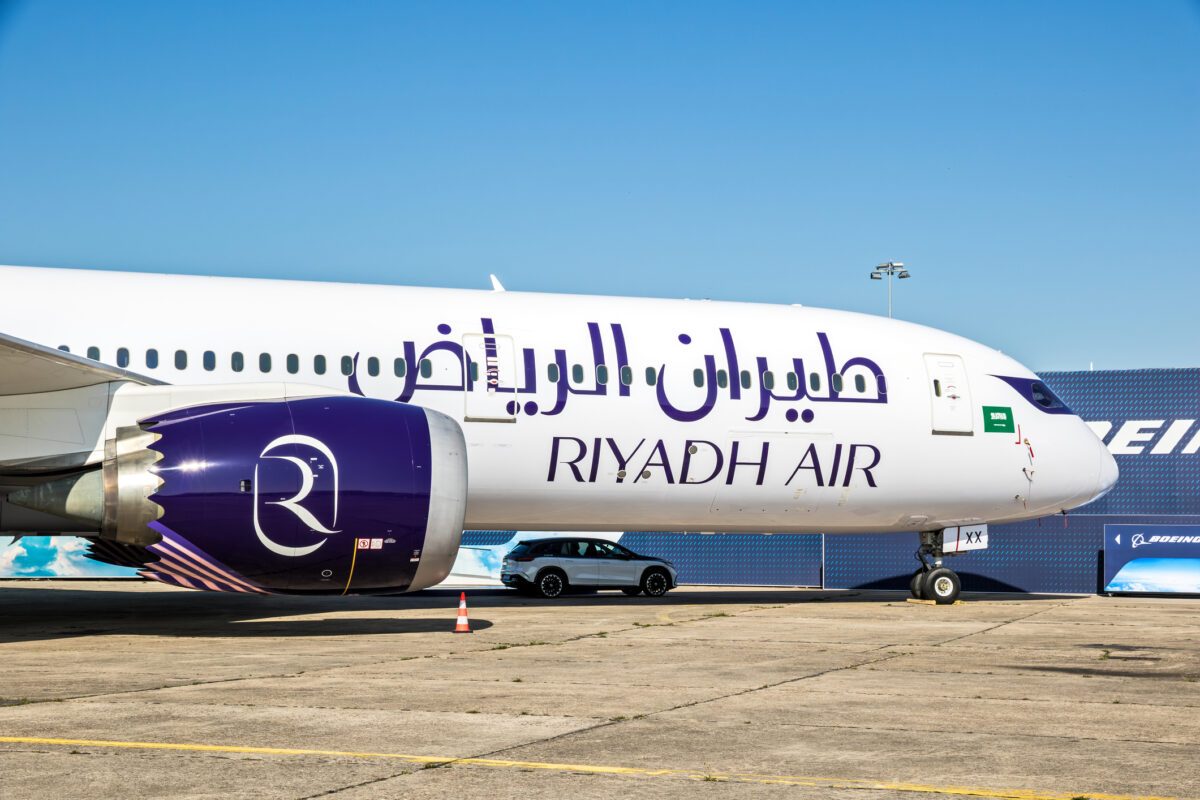
Riyadh Air is operating the restored routes with the Boeing 787-9 Dreamliner, the aircraft type around which it built its initial commercial schedule. The widebody gives the airline a consistent product across short regional sectors and considerably longer services to Southeast Asia.
The carrier’s 290-seat 787-9 configuration has four Business Elite seats and 24 Business seats in a 1-2-1 layout, followed by 39 Premium Economy seats in a 2-3-2 configuration and 223 Economy seats arranged 3-3-3.
The four Business Elite seats occupy the front of the cabin, with the center pair capable of forming a double bed. Both Business products use fully flat seats with privacy doors. Premium Economy offers 38 inches of pitch, while Economy is set at 31 inches.
Deploying the same aircraft from Dubai through to Jakarta simplifies the onboard proposition, but the operational requirements differ sharply. Dubai offers a high-frequency regional market, while Manila and Jakarta are long sectors that keep an aircraft committed for much of the operating day. Restoring all three therefore represents more than adding individual departures: it rebuilds a meaningful portion of Riyadh Air’s available fleet program.
Bottom Line
The resumptions put Riyadh Air’s most commercially distinct markets back at RUH: a major Gulf business route, an established labor and family corridor to the Philippines, and a new Indonesian service with religious, commercial and leisure potential. London’s continued operation means the carrier again has a basic west-east network at its home airport, even if the current ban on connections prevents it from functioning as a conventional hub schedule.
The next measure of recovery will be whether Riyadh Air can bring the Al Qassim flights back to RUH and restore suspended destinations without destabilizing the four routes now operating there. Moving passengers by coach to ELQ preserves flying in selected markets, but it adds substantial journey time and cannot replicate the connectivity or operational concentration of a single Riyadh base.
Fleet utilization will also be central. Riyadh Air’s 787-9 is capable of covering every route in the initial network, but long sectors to Southeast Asia consume aircraft time quickly and leave less room to absorb disruption. Restoring Dubai, Manila and Jakarta suggests the airline is prioritizing routes that combine strategic value with strong local demand while it rebuilds enough operational resilience to reopen connections and consolidate the network at RUH.