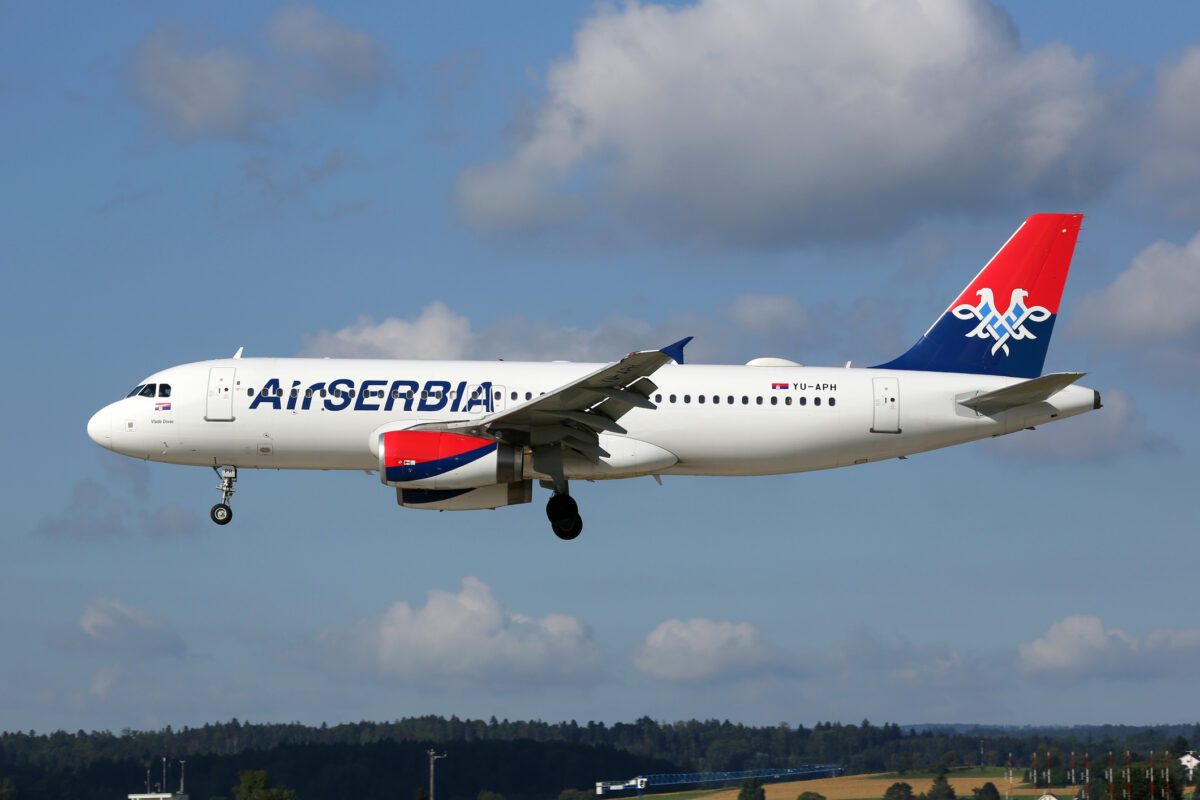
Air Serbia plans to add an average of about 150 weekly flights to its network during the 2027 summer season, combining six new destinations with substantial frequency increases on regional and European routes.

The expansion centers on Belgrade (BEG), where additional departures will strengthen the airline’s connecting banks as well as increase capacity in local markets. Air Serbia has already placed much of the summer program on sale, although individual frequencies may still be adjusted before the IATA season begins on March 28, 2027.
The largest disclosed increases include 13 additional weekly flights to Podgorica (TGD), seven to Sarajevo (SJJ) and seven to Istanbul (IST). Air Serbia is also building more frequencies into Prague (PRG), Zagreb (ZAG), Sofia (SOF), Athens (ATH), Larnaca (LCA), Ljubljana (LJU), Brač (BWK) and Thessaloniki (SKG).
Read our stories in your inbox
Two aviation newsletters. Zero fluff.
Podgorica, Sarajevo and Istanbul Lead the Increase
Podgorica will become one of the most heavily served points in Air Serbia’s regional network. The airline’s published summer plan raises the route from 21 to 34 weekly flights from March 28, an increase of almost 62% and just short of five departures per day on average.
That level of frequency is significant for more than the Serbia-Montenegro local market. Multiple daily rotations allow Air Serbia to distribute passengers from Podgorica across different Belgrade connection banks rather than concentrating demand around one or two departure windows.

Sarajevo will move from seven to 14 weekly flights on May 22, giving the Bosnia and Herzegovina capital two daily services. The additional rotation doubles the route’s frequency and creates more practical same-day and connecting options through BEG.
Air Serbia will also increase Istanbul from 14 to 21 weekly flights during May. Three daily services will be available from May 31, with the new departures divided between morning and evening slots. The phased increase begins May 3.
The three routes account for 27 additional weekly frequencies by themselves. They also illustrate the principal purpose of the broader expansion: adding schedule depth to markets already capable of supporting multiple daily services and feeding more itineraries through Belgrade.
More Flights Across Central and Southern Europe
Prague will rise from 10 weekly flights to twice-daily service in June, with morning and late-afternoon departures from Belgrade. Zagreb will also build toward two daily flights in July after receiving between two and four extra weekly services during June.
Air Serbia plans 11 weekly flights to Sofia throughout the summer. Athens will increase from 15 to 18 weekly flights in June, while Larnaca gains one rotation for a total of 15 per week. Ljubljana is scheduled for 18 weekly services, creating several days with three departures.
Thessaloniki will receive one additional weekly flight, taking the schedule to between 10 and 11 services depending on the month. Seasonal Brač flights will restart on June 1, about three weeks earlier than in 2026, and increase from two to three per week.
These are relatively small changes when considered route by route, but their network effect is larger. Additional frequencies can improve both inbound and outbound connections across a hub schedule without requiring Air Serbia to open another destination. They also provide more recovery options when irregular operations disrupt a passenger’s original itinerary.
Six New Routes Add Regional and Long-Haul Reach
The frequency expansion accompanies six new or returning destinations: Yerevan (EVN), Helsinki (HEL), Miami (MIA), Cluj-Napoca (CLJ), Chișinău (RMO) and Menorca (MAH).

Yerevan begins on March 28 with three weekly Airbus A319 flights, increasing to four from mid-June. Helsinki returns on April 1 with three weekly Embraer E195 services. The 118-seat E195 gives Air Serbia a lower-capacity jet for a market that requires more range and speed than its ATR fleet while not necessarily needing an Airbus narrowbody on every departure.
Miami starts on May 20 with two weekly Airbus A330-200 flights. Air Serbia’s A330-200 fleet has up to 268 seats, making the type the carrier’s long-haul platform for North America and China. The roughly 12-hour outbound sector also makes Miami the most operationally demanding addition in the 2027 program.
The regional expansion continues with Cluj-Napoca on May 31 and Chișinău on June 3, each operating four times weekly with ATR 72 equipment. Air Serbia’s 72-seat ATR 72-600 is well matched to routes where schedule utility and connecting feed matter more than high point-to-point volume.
Menorca joins the network on June 16 with two weekly Airbus A319 flights. The 144-seat type provides sufficient capacity for a seasonal Mediterranean route without committing the 180 seats of an A320. Air Serbia previously added another Spanish leisure market when it opened its Belgrade-Tenerife service.
Fleet Changes Support a Denser Schedule
Air Serbia plans to replace two Airbus A319s with 180-seat Airbus A320s during 2027 and add another 118-seat Embraer E195. The A320 substitutions increase seats per departure on established short- and medium-haul routes, while the E195 gives planners more flexibility between the 72-seat ATR and the larger Airbus fleet.
The airline’s A320s carry 36 more passengers than its standard 144-seat A319s. Replacing two aircraft therefore adds capacity without increasing the number of narrowbody frames, although the extra E195 provides an additional aircraft to support the higher frequency program.
Air Serbia carried 4.25 million passengers during the first ten months of 2026, including nearly 450,000 in October. The airline said October departures increased 11.9% year over year and that the passenger load factor reached 84.2%, providing a strong traffic base for the larger 2027 schedule.
Bottom Line
Air Serbia’s summer plan is less about collecting destinations than making its existing network work harder. Higher frequencies to Podgorica, Sarajevo, Istanbul, Prague and Zagreb should give the airline more viable connection combinations at BEG and make the schedule more useful to travelers whose journeys begin or end in the region.
The fleet changes are equally important. Moving capacity from the A319 toward the A320 raises the number of seats available on mature routes, while another E195 gives Air Serbia a more economical way to add frequency where 180 seats would be excessive. That combination supports growth without forcing every market into the same aircraft gauge.
The main test will be execution during the peak season, when the airline will be operating more flights while launching Miami and five shorter-haul destinations. If Air Serbia can preserve schedule reliability as utilization rises, the 2027 expansion will deepen Belgrade’s position as a connecting point between the Balkans, wider Europe and the carrier’s growing long-haul network.