Emirates has launched daily service between Dubai International (DXB) and Helsinki Airport (HEL), adding Finland to its passenger network and extending its footprint in Northern Europe.

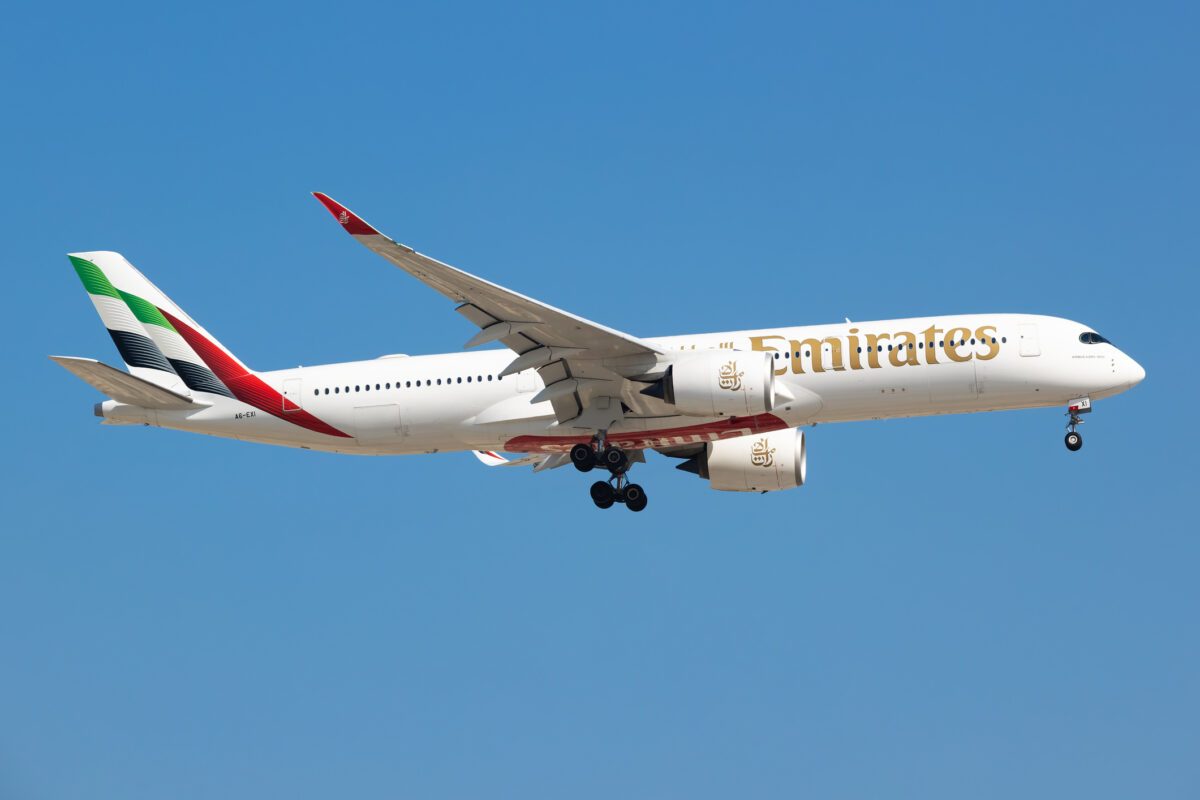
The inaugural flight, EK167, departed DXB at 7:30 a.m. on October 1 with what Emirates described as a near-full passenger and cargo load. The airline operated the flight with an Airbus A350-900 carrying government officials, business representatives and media alongside regular passengers.
The opening establishes the only year-round nonstop air service between Finland and the United Arab Emirates. Emirates is serving the route daily from launch, giving it up to 2,086 passenger seats in each direction per week.
Read our stories in your inbox
Two aviation newsletters. Zero fluff.
Emirates Deputy President and Chief Commercial Officer Adnan Kazim led the airline delegation. Other passengers included Finland’s ambassador to the UAE and Bahrain, Tuula Yrjölä; UAE General Civil Aviation Authority Deputy Director General Omar bin Ghaleb; and representatives working in cybersecurity, energy, education, digital transformation and trade.

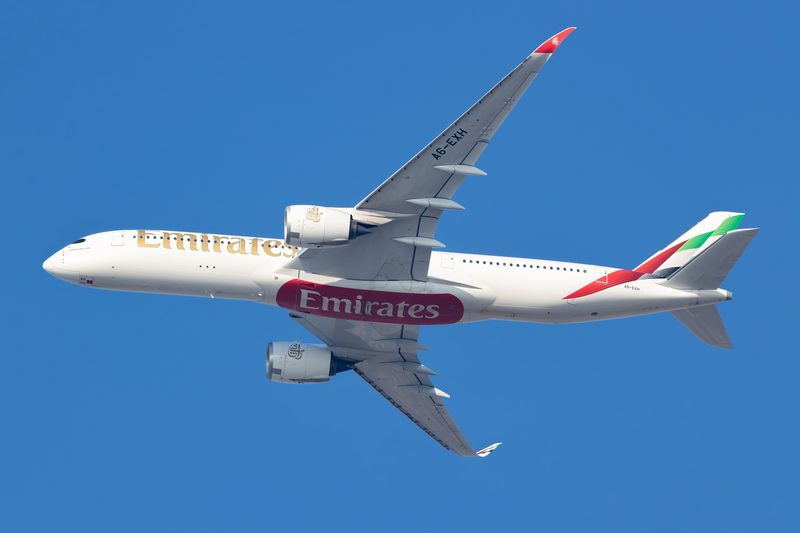
Emirates Deploys Its 298-Seat A350
Helsinki receives Emirates’ long-haul A350 configuration rather than the higher-density version used on some shorter routes. The aircraft seats 298 passengers: 32 in Business Class, 28 in Premium Economy and 238 in Economy.
The Emirates A350 cabin plan places Business Class in a 1-2-1 layout, giving every passenger direct aisle access. Premium Economy uses a 2-3-2 arrangement, while Economy is configured 3-3-3.
Business Class has 21-inch-wide lie-flat seats with 44 inches of pitch and 20-inch 4K entertainment screens. The Premium Economy seats are 19.5 inches wide with 39 inches of pitch. Economy seats measure 18.4 inches across, with pitch ranging from 31 to 32 inches.
The aircraft also introduces Emirates’ newest onboard technology to Finland from the first day of service. Each seat has a 4K screen, Bluetooth audio connectivity and a 60-watt USB-C outlet capable of charging larger devices, including laptops. The A350 also has larger overhead bins, electronic window blinds and the airline’s latest inflight connectivity system.
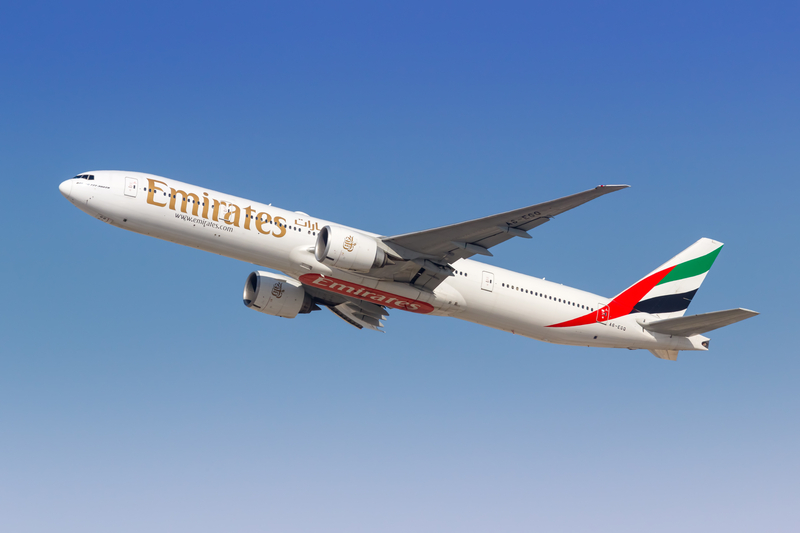
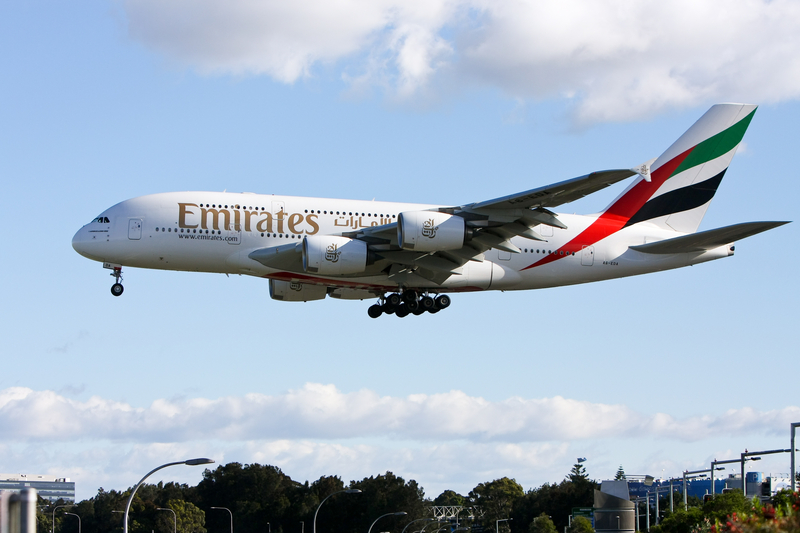
The type gives Emirates a lower-capacity tool than its Boeing 777s and Airbus A380s while retaining a three-cabin widebody product. That combination is well suited to opening a long, relatively narrow route such as Helsinki: the carrier can offer lie-flat Business Class and Premium Economy without introducing the seat volume of its larger aircraft.
Timetable Targets Connections Across Dubai
When it announced the Helsinki route in January, Emirates published a schedule under which EK167 leaves Dubai at 8:45 a.m. and reaches Helsinki at 2:55 p.m. The return service, EK168, departs HEL at 4:45 p.m. and arrives at DXB at 12:20 a.m. the following day. All times are local. The opening flight’s 7:30 a.m. departure was earlier than that published daily timing.
The schedule is designed primarily around connecting traffic rather than relying solely on the Finland-UAE market. Emirates said Helsinki passengers can connect through DXB to destinations in East and Southeast Asia, the Indian Ocean, Africa, the Middle East, Australia and New Zealand.
That gives the airline access to traffic flows that previously required Finnish passengers to reach Emirates through another European gateway or use a competing transfer hub. Helsinki also becomes available through Dubai to travelers originating across nearly 140 points on the Emirates network.
The afternoon arrival and departure at HEL allow the same aircraft to turn around in less than two hours. The overnight arrival in Dubai then feeds the carrier’s early-morning departure banks, an important part of the route’s ability to aggregate demand beyond the local market.
Cargo Adds Another Revenue Stream
Emirates SkyCargo is marketing up to 16 metric tons of belly capacity on each Helsinki flight. At daily frequency, that represents as much as 112 tons of one-way weekly capacity, subject to passenger baggage, operating conditions and the individual flight’s payload limits.
The airline expects pharmaceuticals, electronics, machinery, timber, perishables and other high-value goods to form part of the cargo mix. DXB also gives Finnish exporters access to onward capacity across Emirates’ passenger and freighter networks, while the northbound service opens a direct channel into Finland for shipments originating in the Gulf, Asia, Africa and Australasia.
Cargo matters particularly on a route where passenger demand will vary by season. Finland has strong winter tourism flows, while Gulf-origin summer demand can benefit from Finland’s cooler climate and extended daylight. Freight provides a more diversified revenue base across those seasonal swings.
Helsinki Gains Another Long-Haul Operator
Airport operator Finavia said the daily, year-round route would improve Finland’s access to Asia and the Pacific through Dubai. It also broadens HEL’s long-haul airline mix at a time when the airport is strengthening its role as a transfer point between Northern Europe and markets farther east and south.
For Emirates, Helsinki represents the kind of market the A350 was intended to unlock. The aircraft gives the airline enough range for long-haul missions from Dubai but carries fewer passengers than the 777-300ER or A380, reducing the amount of local and connecting demand required to support a daily schedule.
The route also launches with Premium Economy already installed, avoiding the product differences that can arise when Emirates places older 777 configurations into developing markets. Helsinki passengers receive the airline’s newest three-class product from the outset, while Emirates gains a consistent offering for connecting itineraries involving other A350 or retrofitted aircraft.
Bottom Line
Helsinki is a measured network addition rather than a large capacity play. A daily 298-seat aircraft gives Emirates enough frequency to make connecting itineraries practical while keeping weekly seat volume below what a Boeing 777-300ER deployment would require. The A350 therefore lowers the commercial threshold for maintaining a year-round service through Finland’s quieter traffic periods.
The principal gain for Finnish travelers is not simply a nonstop flight to Dubai, but one-stop access to markets where Emirates has substantial depth, particularly South and Southeast Asia, Australia, Africa and the Indian Ocean. The cargo allocation also gives the route relevance beyond tourism, with Finnish technology, industrial and pharmaceutical shipments able to move through DXB without an intermediate European gateway.
What comes next will depend on how effectively Emirates balances local traffic, connections and freight through the first full winter and summer cycles. If the daily service builds stable year-round loads, Helsinki will strengthen the case for further A350-led growth into midsize European markets that were difficult to serve efficiently with Emirates’ previously larger aircraft types.