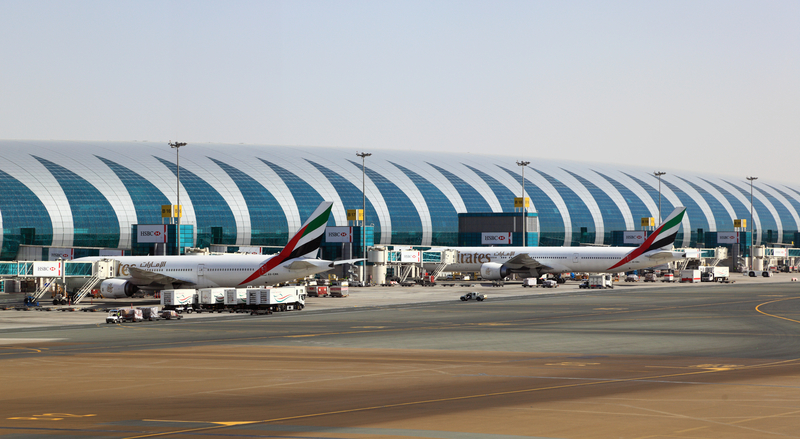
Dubai International Airport (DXB) — the world’s busiest international airport and the primary hub for Emirates — was hit by fallout from Iran’s retaliatory strikes on February 28, 2026, after regional tensions escalated sharply across the Gulf.
Authorities in Dubai said a concourse area at DXB sustained minor damage and four airport staff were injured. The injuries were treated on site as emergency response teams activated, and airport officials coordinated with national security and civil defense services to contain the incident and restore safe operating conditions.
Crucially, early reports indicate the airport was not “taken out” by a direct terminal-destroying hit. The more operationally relevant detail is that drone interception debris impacted airport infrastructure — exactly the kind of scenario that forces conservative airport decisions: suspend movements, inspect for fire and structural risk, then conduct exhaustive airfield and terminal safety checks before restarting a tightly banked hub.
Read our stories in your inbox
Two aviation newsletters. Zero fluff.
Significant damage seen to a commercial flight terminal at Dubai International Airport. pic.twitter.com/MKQnONgUzG
— OSINTdefender (@sentdefender) February 28, 2026
What happened at DXB — and why “minor damage” can still stop a megahub
In modern airport operations, the threshold for pausing movements is low when there’s any uncertainty around:
-
fire/smoke in a passenger area,
-
potential secondary devices or unexploded debris,
-
structural damage in a concourse or sterile zone,
-
or airside FOD (foreign object debris) risk near taxi lanes, stands, or runway environments.
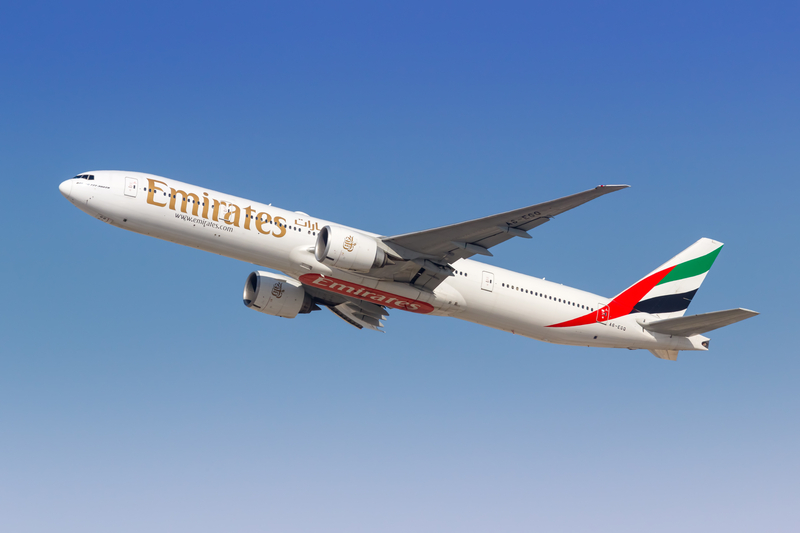
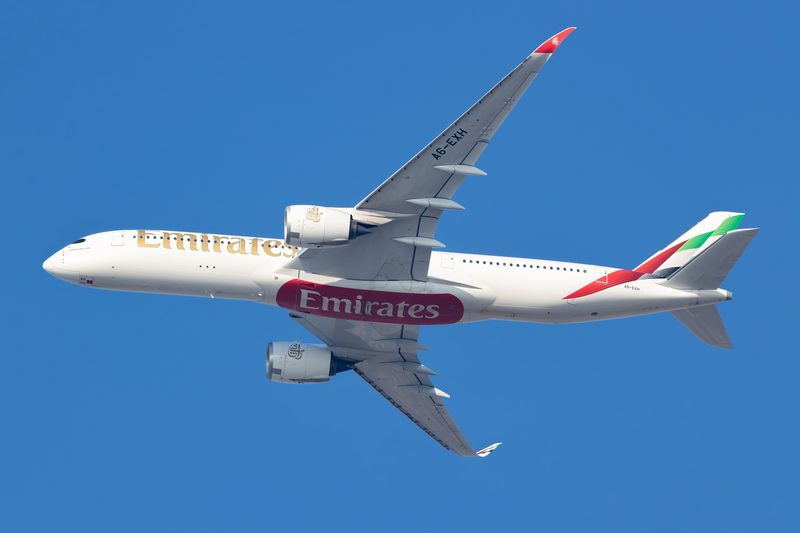
Even a limited-impact incident can cascade quickly at DXB because the hub runs on synchronized widebody waves. Emirates’ long-haul operation is built around large-gauge aircraft — A380s, Boeing 777-300ERs, 777Fs, and other heavy widebodies — arriving and departing in dense banks. When a bank is disrupted, it’s not just one flight late; it’s hundreds of connections and aircraft rotations suddenly out of sequence.
The immediate effect: a corridor collapse becomes a hub shutdown
DXB’s disruption did not occur in isolation. It landed on top of widespread airspace closures and restrictions affecting the region’s core east–west routing lanes. With airspace over and around Iran, plus multiple neighboring states, restricted or closed, airlines lost the predictable corridors that normally support Europe–Gulf–Asia and Africa–Gulf–Asia flying.
Once those corridors go unavailable, the dispatch decision tree becomes brutal:
-
continue only if a safe, legal route and viable alternates exist,
-
otherwise divert early (while alternates still have parking and processing capacity),
-
or cancel proactively to avoid stranding aircraft and crews at airports without recovery resources.
For Gulf hubs like DXB and Doha (DOH), the operating reality is unforgiving: restarting service is not a single “switch flip.” It requires runway and taxiway inspections, stand allocation, crew legality resets, passenger reaccommodation, and aircraft repositioning from diversion airports.
Passenger flow realities: why Terminal 3 becomes the pressure point
At DXB, Terminal 3 is where the operational stress concentrates. It’s built to process massive volumes quickly, but it’s also the most sensitive to disruption because it’s so tightly integrated with Emirates’ bank structure. When alarms sound or smoke spreads in a sterile concourse, standard procedure is to clear affected zones, isolate smoke control systems, and maintain controlled passenger movement — particularly around:
-
sterile departures corridors,
-
transfer screening points,
-
and gate holdrooms feeding widebody departures.
Even if the airfield is physically usable, terminal throughput can become the limiting factor. Airports can’t safely board and process thousands of passengers into a partially constrained terminal environment just to “keep the schedule alive.”
Why diversions became the norm — and why Europe kept showing up as the alternate
As DXB and other Gulf airports restricted operations, long-haul aircraft that were already airborne often had to choose alternates with strong widebody handling capability. Airports like Istanbul (IST) and Rome (FCO) are common in these scenarios because they can rapidly absorb:
-
widebody parking needs,
-
deplaning of 300–500 passengers,
-
medical and emergency response,
-
and passenger processing capacity that smaller airports simply can’t scale on short notice.
For airlines, diverting to a “bigger-than-needed” alternate is often the most controllable option when the destination’s operating status is uncertain.
The bigger context: DXB is too central for disruption to stay regional
DXB isn’t just Dubai’s airport — it’s global infrastructure. In 2025, DXB handled about 95 million passengers, with a large share connecting between continents. When DXB stops, the effects propagate into:
-
missed long-haul connections across Europe, Asia, and Africa,
-
aircraft out of position for next-day schedules,
-
crew duty-time expirations far from base,
-
and significant cargo delays (especially time-sensitive belly freight).
That’s why even short-lived stoppages can take days to unwind. The first cancellations are only the start; the harder work is rebuilding the network once the hub’s aircraft and crews are scattered.
What travelers should do when a hub like DXB is disrupted
When an airport the size of DXB is impacted by a security event, the most useful guidance is practical and immediate:
-
Do not go to DXB (DXB) unless your airline confirms your flight is operating.
-
Expect rebooking delays, especially if your itinerary relies on tight connections through DXB.
-
If you are diverted into Europe (IST/FCO/VIE) or elsewhere, be prepared for local entry requirements, hotel logistics, and limited baggage access depending on customs procedures.
-
Keep essential medication and critical items in carry-on whenever possible; diversion events can separate passengers from checked baggage for longer than standard delays.
Bottom Line
Dubai International (DXB) was forced into disruption mode after Iranian retaliatory strikes led to a drone interception event that damaged a concourse area and injured four airport staff. Even with “minor” physical damage, the operational consequences are major at a banked megahub: movements pause, terminals evacuate affected zones, airfields are swept and inspected, and the network ripple spreads globally through missed connections, diversions, and aircraft/crew displacement.
For aviation professionals, the takeaway is familiar but stark: when geopolitical risk converts into real-world infrastructure impact at a hub like DXB, recovery is measured not in minutes — but in waves, rotations, and days.
Keep reading FlyMag
Get the Daily Brief in the morning or the Route Watch weekly recap on Fridays. Or both.