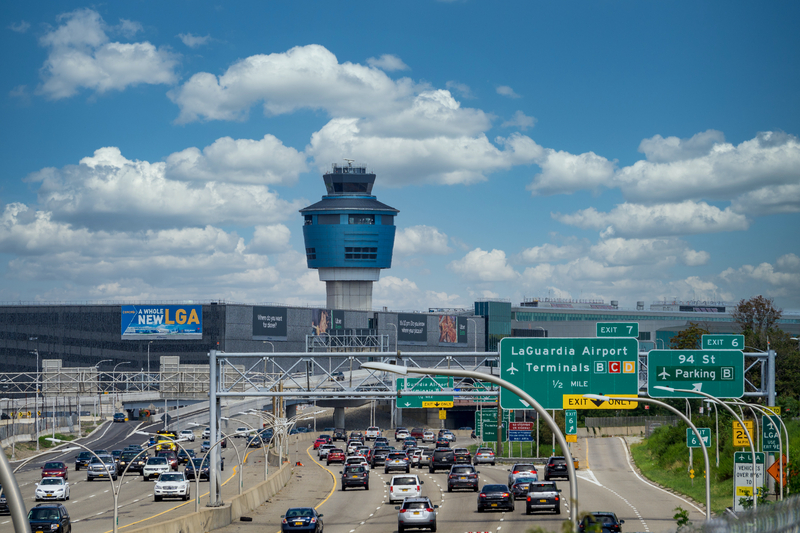
Severe thunderstorms and constrained air traffic control capacity disrupted the New York metropolitan area on Friday, July 10, producing hundreds of cancellations and more than 1,200 delays at the region’s three primary commercial airports.
John F. Kennedy International Airport (JFK), LaGuardia Airport (LGA), and Newark Liberty International Airport (EWR) all experienced substantial operational restrictions as thunderstorms crossed the Northeast and blocked critical arrival, departure, and en route corridors.
Local reporting described more than 500 cancellations and 4,000 delays associated with the wider disruption. However, those numbers should not be interpreted as the combined total for JFK, LGA, and EWR alone.
Read our stories in your inbox
Two aviation newsletters. Zero fluff.
The airport-level FlightAware snapshot cited in the original report showed 328 cancellations and 1,226 delays at the three New York airports. Additional disruptions were recorded at Philadelphia International Airport (PHL), Westchester County Airport (HPN), and airports elsewhere in the Northeast and across the national airline network.
New York Airport Disruptions by the Numbers
Flight disruption totals change continuously as airlines cancel additional services, operate delayed flights, or revise schedules. The following figures represent the point-in-time FlightAware snapshot cited in the report rather than final government statistics for the entire day.
| Airport | Delayed Flights | Canceled Flights |
|---|---|---|
| New York-JFK (JFK) | 369 | 160 |
| New York-LaGuardia (LGA) | 428 | 132 |
| Newark (EWR) | 429 | 36 |
| Philadelphia (PHL) | 386 | 15 |
| Westchester County (HPN) | 36 | 4 |
Together, JFK, LGA, and EWR recorded 1,226 delays and 328 cancellations in that snapshot. Including Philadelphia (PHL) and Westchester County (HPN), the total reached 1,648 delays and 347 cancellations.
Earlier reports contained lower totals because they captured conditions at a different point in the day. One afternoon snapshot, for example, listed 253 delays and 53 cancellations at JFK. The rising numbers demonstrate how rapidly disruption can accumulate when thunderstorms repeatedly close airspace during a peak travel period.
The difference is important for both accuracy and context. The 500-plus cancellations and 4,000-plus delays represented the larger operational event and its network effects—not cancellations and delays occurring exclusively at New York’s three major airports.
FAA Ground Stops and Delay Programs Reduced Airport Capacity
The Federal Aviation Administration’s daily operations forecast warned that thunderstorms could delay traffic at JFK, LGA, EWR, and Philadelphia International Airport (PHL), along with several other major U.S. airports.

As conditions deteriorated, the FAA used a combination of ground stops, ground-delay programs, route closures, and reduced arrival rates to prevent more aircraft from entering congested airspace than controllers and airports could safely accommodate.
A ground stop holds affected flights at their departure airports. An aircraft scheduled to fly from Chicago O’Hare International Airport (ORD) to Newark (EWR), for example, may remain at its gate in Chicago rather than depart and join an airborne queue near New York.
A ground-delay program is less restrictive but can produce lengthy delays. The FAA assigns each affected flight an expected departure clearance time, commonly known as an EDCT, to meter arrivals into the destination airport.
Aircraft may still depart, but only when their assigned slot will place them into the arrival flow at an acceptable time. This prevents excessive airborne holding and reduces the risk of aircraft being forced to divert because they no longer have sufficient fuel to wait.
The FAA’s Air Traffic Control System Command Center operations plan showed ground-delay programs affecting LGA, JFK, EWR, and PHL during the disruption. Newark (EWR) was also placed under a ground stop as thunderstorms affected the airport and surrounding airspace.
These restrictions are not evidence that the air traffic system is operating unsafely. They are measures used to reduce traffic to a level that can be handled safely under the prevailing weather, staffing, and airspace conditions.
Thunderstorms Can Close Airspace Without Reaching the Airport
The most disruptive thunderstorms do not necessarily have to pass directly over an airport.
New York’s airports rely on a limited number of arrival and departure corridors. When strong convective cells block those routes, controllers cannot simply send every aircraft around the same side of the storm. Available airspace can quickly become saturated with traffic being rerouted around hazardous weather.
Thunderstorms can also produce severe turbulence, hail, lightning, wind shear, and rapidly changing winds. Aircraft must maintain additional spacing, and controllers may have fewer runways or arrival paths available.
At the airport itself, lightning can force ramp personnel to suspend baggage loading, fueling, pushback, and other ground activities. A flight may be physically ready to depart but remain at the gate because employees cannot safely work around the aircraft.
The FAA activated its Northeast Severe Weather Avoidance Plan during Friday’s disruption. Several routes used by aircraft traveling through or departing New York Center airspace were restricted or closed because of thunderstorms, including offshore corridors used by traffic moving along the East Coast and toward the North Atlantic.
This creates a compounding effect. Fewer routes mean fewer aircraft can move through the airspace each hour. Those reductions then force the FAA to hold additional flights at airports hundreds or thousands of miles from New York.
Staffing Constraints Reduced the System’s Recovery Margin
Weather was the immediate operational trigger, but air traffic control staffing limitations reduced the system’s ability to recover as conditions temporarily improved.
The FAA’s operations plan identified staffing triggers involving the New York Air Route Traffic Control Center, known operationally as ZNY. That facility manages high-altitude and en route traffic across one of the country’s busiest sections of airspace.
Terminal traffic around JFK and LGA is handled by the New York Terminal Radar Approach Control facility, commonly called N90. Reuters reported in June that N90 had approximately 57% of its targeted number of fully certified controllers, contributing to mandatory overtime and six-day workweeks for portions of the workforce.
Newark requires a separate explanation. Since July 2024, the approach and departure sectors serving EWR have been managed by Philadelphia TRACON rather than N90. The FAA transferred the Newark airspace in an effort to improve staffing and operational resilience.
Therefore, N90’s reported 57% staffing level should not be directly applied to Newark’s approach-control operation. EWR traffic is managed by Philadelphia TRACON’s Area C, while New York Center and other regional facilities continue to play roles in handling flights entering and leaving the area.
Staffing shortages do not necessarily close an airport. Instead, they can reduce the number of sectors available, limit how many positions can be opened, or require the FAA to lower traffic acceptance rates.
That becomes particularly consequential during thunderstorms. A fully staffed operation may have more flexibility to divide traffic among sectors, establish alternate flows, and process the backlog when routes reopen. A constrained facility has less capacity to absorb those changes.
Why Operations Do Not Immediately Recover When a Storm Passes
Passengers often see improving weather outside the terminal and reasonably wonder why their flight remains delayed.
The answer is that the aviation system cannot instantly process the backlog created during a ground stop or reduced-capacity period.
If an airport normally handles 50 arrivals per hour but thunderstorms reduce that figure to 25, the 25 flights that could not be accommodated do not disappear. They remain at their departure airports, enter holding patterns, divert, or receive later arrival slots.
When capacity returns to 50 arrivals per hour, the airport must handle the delayed aircraft in addition to flights that were already scheduled for that period. Airlines may also be dealing with aircraft that are out of position, crews nearing federal duty-time limits, passengers missing connections, and gates occupied by delayed departures.
A flight can consequently remain delayed long after the storm cell that initiated the disruption has moved away.
This is especially difficult in New York because JFK, LGA, and EWR operate within closely coordinated airspace. A change in the arrival flow at one airport can affect the routes available to the others.
Disruption Extended Across Multiple Aircraft Types
Unlike an aircraft-specific technical incident, Friday’s disruption affected nearly every category of commercial airplane operating through the region.
Domestic flights at LGA and EWR include large numbers of Boeing 737-family and Airbus A320-family narrowbody aircraft, along with regional jets used on shorter routes. When those aircraft are delayed, the same airplane may operate several additional flights later in the day, allowing one morning disruption to affect multiple cities.
The consequences can be even more difficult to recover from when an international departure at JFK is canceled.
Long-haul Boeing 777s, Boeing 787 Dreamliners, Airbus A330s, Airbus A350s, and other widebody aircraft frequently operate rotations lasting 20 hours or more. A cancellation can leave the aircraft and its crew on the wrong side of the Atlantic or Pacific for the following day’s schedule.
Widebody substitutions are also difficult. Airlines generally maintain fewer spare long-haul aircraft than narrowbodies, and one type cannot always replace another because of crew qualifications, maintenance support, airport restrictions, and cabin-capacity differences.
A canceled international flight may therefore affect the return service, the aircraft’s next destination, and hundreds of connecting passengers well beyond New York.
Delays Spread Throughout Airline Networks
JFK, LGA, and EWR are not isolated destinations. They are major origin, destination, and connecting points within domestic and international airline networks.
When a New York-bound aircraft is held at its origin, it may not arrive in time to operate its next scheduled flight. Its pilots and flight attendants may also exceed their permissible duty periods before the replacement departure can be operated.
Airlines must then locate another aircraft, assign a reserve crew, delay the flight until the original crew receives legally required rest, or cancel the service entirely.
The effects vary by airport.
LaGuardia (LGA) has a high concentration of short-haul and medium-haul domestic flying. Aircraft commonly operate several segments each day, allowing delays to propagate quickly through the schedule.
Newark (EWR) handles a mixture of domestic connecting traffic and long-haul international services. Restrictions there can affect passengers traveling through the airport between smaller U.S. cities and destinations in Europe, Latin America, Asia, and the Middle East.
JFK is one of the country’s largest international gateways. Evening delays can interfere with tightly timed transatlantic departure banks and create additional complications involving destination-airport curfews, international crew requirements, and overnight passenger accommodations.
Airlines Issued Weather Waivers
Several airlines issued travel waivers allowing eligible passengers to modify their itineraries without the usual change penalties.
Delta Air Lines’ New York weather waiver covered travel through JFK, LGA, EWR, and Westchester County Airport (HPN) on July 9 and July 10. Eligible passengers could rebook qualifying trips for travel completed by July 14, subject to the airline’s conditions.
United Airlines issued a broader East Coast thunderstorm waiver that included EWR, JFK, LGA, Philadelphia (PHL), Baltimore/Washington International Airport (BWI), Ronald Reagan Washington National Airport (DCA), and Washington Dulles International Airport (IAD).
Waivers can help travelers move to an earlier or later flight before their original service is canceled. However, they do not create additional seat capacity.
During a large disruption, later flights may already be full. Passengers can consequently face an overnight stay or a wait of several days, particularly on international routes or services operated only once per day.
Travelers were advised to monitor airline applications and the FAA’s National Airspace System status before traveling to the airport. A flight that appears on time early in the day can receive a substantial delay once a ground-delay program is issued.
New York’s Airspace Has Little Room for Disruption
The New York metropolitan area contains three major airports, several busy general aviation facilities, and some of the most heavily traveled airspace in the United States.
The airports are geographically close enough that their arrival and departure routes must be carefully coordinated. Controllers cannot independently increase traffic at one airport without considering how those aircraft will interact with traffic serving the others.
Airport schedules are also concentrated around commercially valuable departure and arrival periods. During normal conditions, the system can handle those volumes, but it has limited unused capacity when weather removes runways or closes airspace corridors.
The FAA has attempted to provide additional operational flexibility by granting staffing-related schedule relief at JFK and LGA. The policy allows airlines to temporarily return as much as 10% of their slots without risking permanent forfeiture under normal minimum-use requirements.
The current relief period runs through October 30, 2027. The objective is to encourage realistic scheduling when controller staffing cannot reliably support the maximum number of operations airlines would otherwise be permitted to operate.
Separately, the FAA has maintained operating limits and schedule controls at New York-area airports while it recruits and trains additional controllers. Certification can take several years, meaning staffing challenges cannot be solved simply by hiring a large group of trainees.
Weather Was the Trigger, but Staffing Amplified the Impact
It would be inaccurate to attribute every cancellation on July 10 directly to an air traffic control staffing shortage.
The thunderstorms were a major constraint and would have reduced capacity even with every controller position fully staffed. Convective weather can make routes unusable, force runway changes, halt ramp activity, and require significantly greater separation between aircraft.
Staffing limitations nevertheless reduced the amount of operational margin available. When traffic had to be rerouted and the backlog began to build, constrained facilities had fewer resources with which to restore normal traffic flows.
The resulting disruption was therefore caused by an interaction of factors rather than one isolated failure: severe weather reduced the available airspace, staffing constraints limited ATC capacity, and heavily scheduled airline networks had little room to absorb the resulting delays.
Bottom Line
Severe thunderstorms and air traffic control constraints produced another difficult travel day across the New York metropolitan area on Friday, July 10.
The FlightAware snapshot cited in the original report showed 369 delays and 160 cancellations at New York-JFK (JFK), 428 delays and 132 cancellations at LaGuardia (LGA), and 429 delays and 36 cancellations at Newark (EWR).
That amounts to 1,226 delays and 328 cancellations at the three primary New York airports—not the full 500-plus cancellations and 4,000-plus delays referenced in the broader disruption tally.
The FAA implemented ground stops, ground-delay programs, reduced arrival rates, and weather-avoidance routes to keep traffic within safe limits. Those measures protected the operation but left aircraft, crews, and passengers out of position throughout the national and international airline network.
Weather was the immediate trigger. Persistent staffing shortages at several air traffic facilities reduced the system’s ability to manage the backlog and recover between storm cells.
The event demonstrates why New York remains especially vulnerable to convective weather. JFK, LGA, and EWR handle enormous traffic volumes in tightly integrated airspace, leaving limited flexibility when routes close or airport acceptance rates fall.
For passengers and airlines, the effects continue long after the rain ends. Aircraft must be repositioned, crews must remain within legal duty limits, international rotations must be rebuilt, and thousands of disrupted travelers must compete for a limited number of seats on later flights.