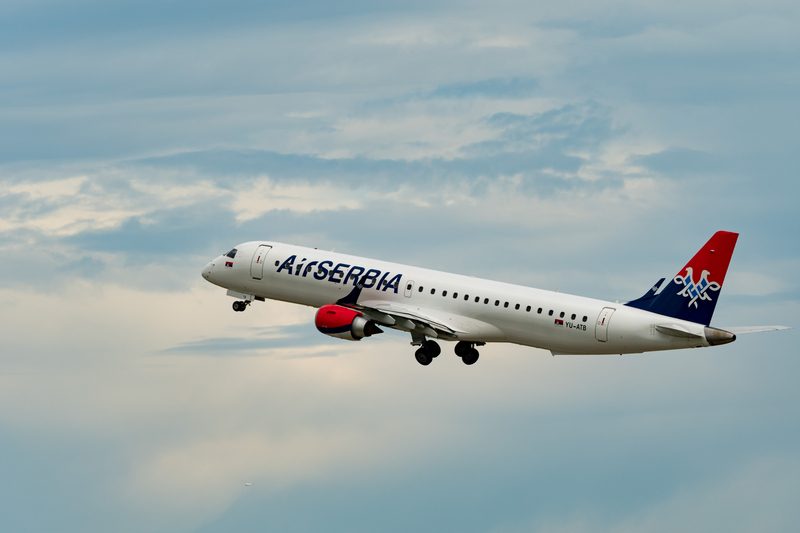
Air Serbia will open six routes from Belgrade (BEG) during the 2027 summer season, adding a third destination in the United States and expanding the regional network that feeds its hub.

The airline has placed tickets on sale for flights to Yerevan (EVN), Helsinki (HEL), Miami (MIA), Cluj-Napoca (CLJ), Chisinau (RMO) and Mahon on Menorca (MAH). The first service will begin on March 28, with the six launches spread across the opening months of the summer schedule.
Air Serbia said in its network announcement that the expansion is intended to build transfer traffic through Belgrade as the carrier prepares for additional demand associated with EXPO 2027.
Read our stories in your inbox
Two aviation newsletters. Zero fluff.
Miami Becomes Air Serbia’s Third U.S. Destination
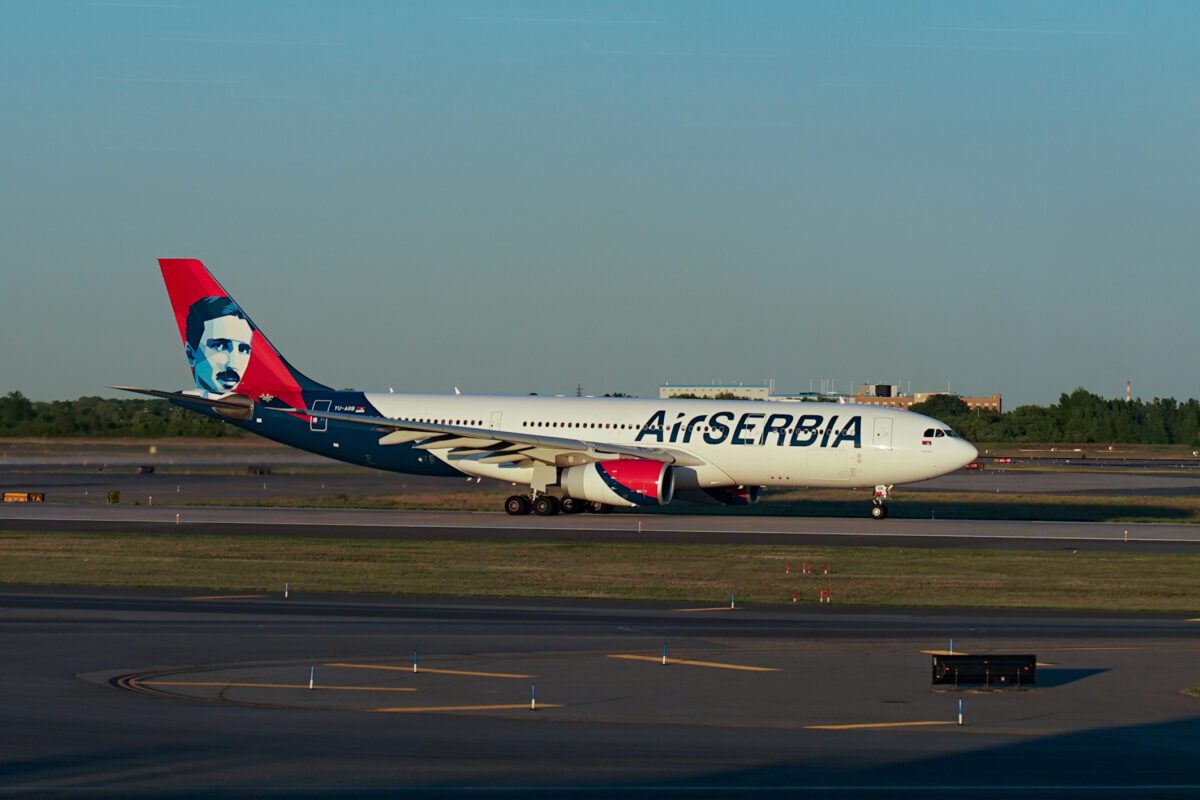
Miami is the largest addition. Air Serbia will begin flying between BEG and MIA on May 20, 2027, operating twice weekly with the Airbus A330-200.
Flight JU502 will depart Belgrade on Thursdays at 1:50 p.m. and Sundays at 11:30 a.m., arriving in Miami at 7:50 p.m. and 5:30 p.m., respectively. The scheduled westbound block time is 12 hours.
JU503 will leave Miami at 10:30 p.m. on Thursdays and 7 p.m. on Sundays. Both eastbound flights have a scheduled block time of 10 hours and 30 minutes, arriving in Belgrade the following afternoon or morning.
Miami will follow New York and Chicago as Air Serbia’s third U.S. destination. The route extends the airline’s North American operation into a market that can draw passengers from Serbia and neighboring countries while also supporting connections beyond Florida to Latin America and the Caribbean.
Air Serbia’s fleet information lists 268 seats for its Airbus A330-200s. The airline operates four of the widebodies, which also support its services to North America and China. A twice-weekly pattern limits the initial capacity commitment while allowing Air Serbia to test demand across several traffic segments rather than relying only on nonstop local passengers.
Regional Routes Add Feed Around Belgrade
The 2027 program begins with Yerevan on March 28. Air Serbia will initially fly three times weekly between BEG and EVN, increasing the route to four weekly services from mid-June. The Airbus A319 is scheduled for the three-hour sector.
Yerevan deepens the airline’s Caucasus coverage following the addition of Tbilisi and Baku. The timetable includes overnight arrivals in Belgrade on some operating days, giving Air Serbia the ability to connect Armenia with early departures across its European network.
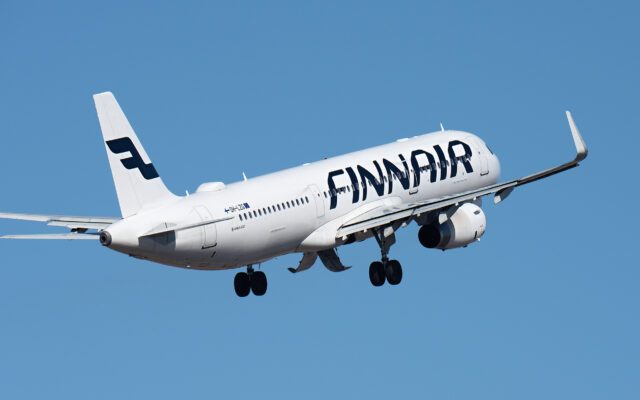
Helsinki returns on April 1 with three weekly flights. Air Serbia previously served the Finnish capital in 2019 before suspending the route during the pandemic. The restored service is scheduled with the Embraer E195, departing Belgrade on Mondays, Thursdays and Sundays.
The 118-seat E195 gives Air Serbia a lower-capacity jet than its Airbus narrowbodies while retaining a two-by-two cabin without middle seats. Its assignment to Helsinki provides enough range and jet performance for the route without requiring the 144 seats offered by the airline’s A319s.

Cluj-Napoca will become Air Serbia’s second Romanian destination after Bucharest. Flights start May 31 and will operate four times weekly with the ATR 72-600. The schedule is divided between afternoon rotations on Mondays and Fridays and overnight services on Thursdays and Saturdays.
The 72-seat turboprop is well matched to a short regional sector where frequency and onward connectivity are more important than adding a larger block of seats on fewer departures. The route also gives passengers from Cluj access to Air Serbia’s longer-haul and Mediterranean network through BEG.
Chisinau follows on June 3 with four weekly ATR 72-600 flights. JU108 will leave Belgrade at 12:20 a.m. on Mondays, Thursdays, Fridays and Saturdays, returning from RMO at 3:55 a.m. and reaching BEG at 5:15 a.m. The early arrival is positioned to feed the airline’s morning departure bank.
Menorca Adds Another Seasonal Spanish Market
Air Serbia will complete the six-route expansion on June 16, when it begins twice-weekly flights to Mahon on Menorca. The Wednesday and Sunday service will use the Airbus A319 and run during the peak Mediterranean leisure season.
Wednesday flights will depart Belgrade at 5:15 p.m., while the Sunday rotation leaves at 6 a.m. The scheduled block time is two hours and 30 minutes westbound and two hours and 25 minutes on the return. Menorca will become Air Serbia’s ninth destination in Spain.
The route fits the carrier’s established use of seasonal Mediterranean flying to balance a network otherwise built around regional feed and year-round business and visiting-friends-and-relatives demand. Twice-weekly service also allows Air Serbia to offer conventional seven- and 10-night leisure itineraries without committing an aircraft to daily flying.
More Capacity Is Coming to the Narrowbody Fleet
The route additions will be accompanied by further fleet changes. Air Serbia plans to replace two Airbus A319s with 180-seat Airbus A320s during 2027 and add another 118-seat Embraer E195.
Each A320 provides 36 more seats than the airline’s 144-seat A319s. Air Serbia has already described the transition toward larger A320s as a way to increase capacity and improve efficiency, including when it announced the arrival of another 180-seat aircraft in July 2026.
The extra E195 will serve a different purpose. It gives planners a 118-seat option between the ATR 72-600 and the Airbus fleet, making it easier to open thinner European routes or add frequency without introducing 144 to 180 seats on each departure.
Bottom Line
The six routes show Air Serbia developing both sides of the Belgrade hub at once. Miami adds another long-haul destination capable of drawing passengers from across Southeast Europe, while Cluj-Napoca, Chisinau and Yerevan increase the number of regional markets that can feed those intercontinental flights. Helsinki broadens the northern European network, and Menorca adds a seasonal outlet for locally generated leisure demand.
The aircraft plan is just as significant as the destination count. Replacing A319s with A320s raises capacity in established markets, while another E195 gives Air Serbia a more measured tool for routes that cannot yet support a larger narrowbody. The combination should allow the airline to grow without forcing the same aircraft size onto every part of the network.
Miami will be the route to watch. A twice-weekly launch reduces the initial exposure, but its performance will indicate whether Air Serbia can extend the connecting model that supports New York and Chicago into a geographically different U.S. market. If the regional additions produce the intended feed, the next step is likely to be higher frequencies rather than another broad round of destination launches.