Spirit Airlines’ shutdown has opened two very different kinds of opportunities in the US domestic market. At large airports, its departure released gates, slots and passengers into markets already contested by several airlines. At smaller airports, the effect was more severe: an entire scheduled network sometimes disappeared overnight.

Breeze Airways is concentrating on the second category. Rather than attempt to rebuild Spirit’s broad, high-frequency operation, Breeze has moved into selected leisure markets where a small number of weekly flights can restore a useful nonstop and face limited direct competition.
The strategy is clearest at Atlantic City (ACY) and Latrobe (LBE), two airports where Spirit’s presence had been central to the commercial-service proposition.
Read our stories in your inbox
Two aviation newsletters. Zero fluff.
Atlantic City Became the Immediate Opportunity
Spirit began its wind-down on May 2, 2026, canceling all flights after failing to secure the additional liquidity needed to continue operating. Breeze already had plans to enter ACY, but Spirit’s collapse created room for a much larger operation.
On May 5, just three days after the shutdown, Breeze added four Atlantic City routes: daily Orlando (MCO), twice-weekly Myrtle Beach (MYR), and three-times-weekly flights to both Fort Myers (RSW) and West Palm Beach (PBI).
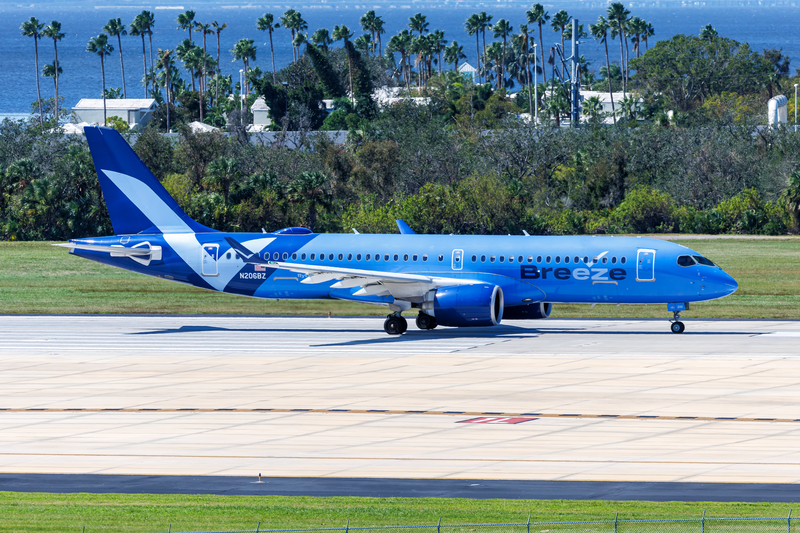
Those additions were layered onto Breeze’s previously announced service to Charleston, Raleigh-Durham and Tampa. A further route to Vero Beach (VRB), operating twice weekly, followed in the airline’s June network announcement.
By late summer, Atlantic City’s published schedule showed Breeze progressively building the operation through the fall and winter. It was not a like-for-like recreation of Spirit’s former schedule. Breeze selected routes that fitted its own network, aircraft and frequency model, while Allegiant also covered several Florida markets from ACY.
The distinction matters. Spirit used Atlantic City as a concentrated leisure station supported by the scale of its wider Florida network. Breeze is treating ACY as another spoke in a nationwide portfolio of point-to-point routes. Only Orlando received daily service in the initial post-Spirit expansion. The other additions generally operate two or three times a week, limiting the capacity committed to any individual market.
Commercial Service Returns to Latrobe
At Latrobe, the withdrawal was even more consequential. Spirit had been the airport’s only scheduled airline, leaving LBE without commercial service when the carrier stopped flying.
Breeze will restore two of the leisure links associated with the airport’s Spirit era. The airport’s current Breeze schedule lists service to Myrtle Beach beginning in February 2027 and Orlando beginning in May 2027.
Latrobe fits Breeze’s established approach more closely than a major Spirit base would. It serves a distinct western Pennsylvania catchment, offers passengers a local alternative to a larger airport and has demonstrated demand for nonstop flights to warm-weather destinations. It also does not require Breeze to match the schedules, loyalty bases or connecting flows of large incumbent airlines.
The initial two-route plan is deliberately narrow. Myrtle Beach and Orlando are proven leisure destinations, but Breeze is not replicating every market Spirit served during its time at LBE. The carrier can establish a station with a small schedule, measure local demand and add flying only if the performance supports it.
The A220 Changes the Capacity Calculation
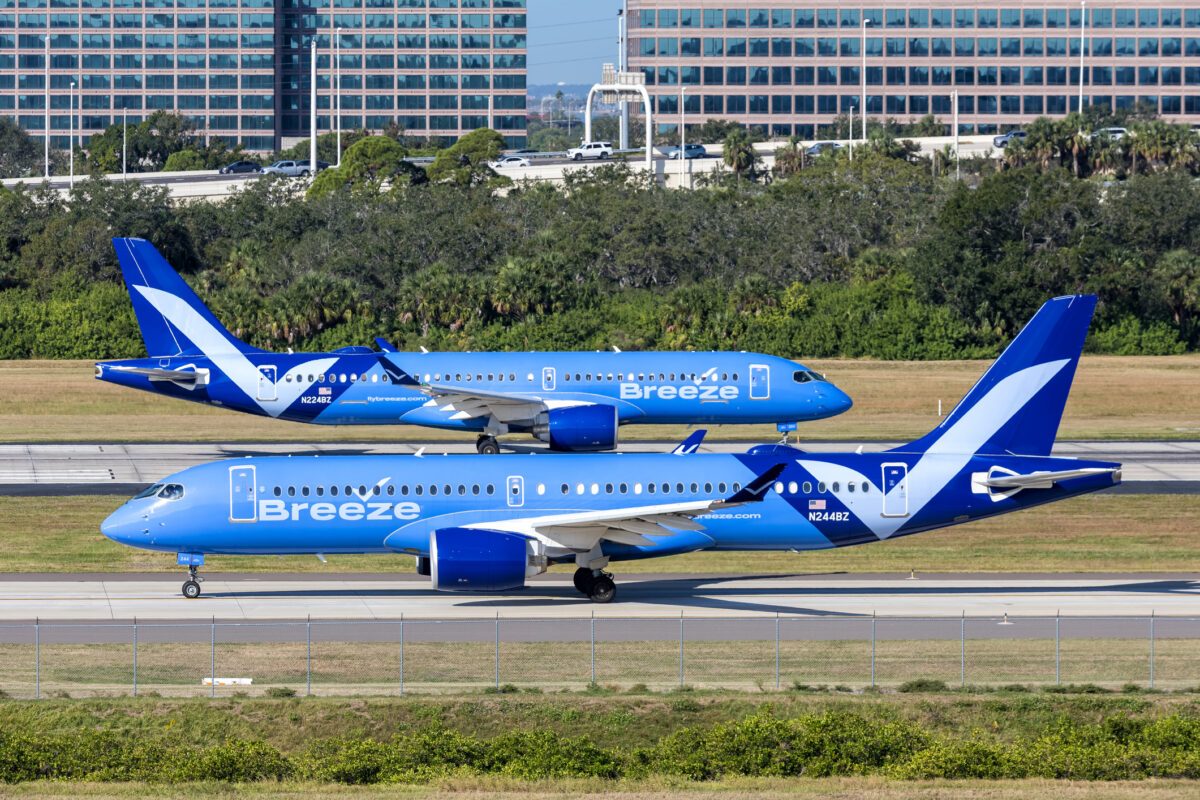
Breeze’s Airbus A220-300 is central to that calculation. The manufacturer positions the type in the 120-to-160-seat segment, with a maximum range of about 3,450 nautical miles. That gives Breeze an aircraft capable of operating short leisure sectors and transcontinental routes without carrying the capacity of a larger narrowbody.

Spirit’s final published fleet plan showed considerably denser aircraft: 176 seats on its Airbus A320s and 222 or 229 seats on its Airbus A321s. Those configurations were designed to drive low unit costs through scale, but they also required deeper demand, particularly when operated several times a day.
The A220 allows Breeze to pursue a different balance. Its smaller capacity reduces the number of passengers needed to fill a flight, while its range allows aircraft to rotate between regional leisure sectors and longer routes. Breeze also sells extra-legroom and first-class-style seating rather than relying entirely on a high-density economy cabin.
Breeze said in September that it was operating more than 300 year-round and seasonal routes to 91 cities with an Airbus A220-300 fleet. That breadth does not mean equal depth. Many routes operate only several times weekly, enabling the airline to spread aircraft across a large number of city pairs.
Why Breeze Is Not Rebuilding Spirit
Spirit’s network included major metropolitan and trunk leisure markets where low fares depended on high aircraft utilization, dense seating and substantial daily capacity. Those routes may have large passenger volumes, but they also expose a new entrant to direct competition from airlines with stronger schedules and established local customer bases.
Breeze has instead targeted the gaps where the nonstop itself is the product. A passenger in Atlantic City or Latrobe may otherwise need to drive to another airport or connect through a hub. That inconvenience gives a less-than-daily flight more pricing power than it would have on a large route with several competing airlines.
The approach also contains the downside of expansion. Breeze can open a market with two or three weekly frequencies rather than assigning several aircraft to a new base. Seasonal flying can be shifted as demand changes, and the same aircraft can support a mix of Florida, coastal and longer-distance services across the network.
Spirit’s disappearance therefore gives Breeze access to demand, airport infrastructure and community support without requiring it to inherit Spirit’s strategy. The airline is taking the parts of the former network that resemble Breeze markets and leaving the scale-driven trunk routes to larger competitors.
Bottom Line
Atlantic City and Latrobe gain more than replacement seats. Both retain a low-cost airline proposition built around nonstop leisure travel, and LBE will recover scheduled service after losing its sole carrier. Breeze also gains airports where its arrival has strategic importance, giving it greater local visibility than it would receive as a small entrant at a major hub.
The expansion signals that Spirit’s former network will be redistributed route by route rather than transferred wholesale to another airline. Breeze is positioned to capture secondary-city demand, but its less-than-daily model will not replace all the frequency or fare pressure Spirit once supplied across larger markets.
The next test will be whether the restored routes can survive beyond their initial incentive periods and peak leisure seasons. If Atlantic City supports daily Orlando service and Latrobe’s first two destinations perform consistently, Breeze will have a case for adding depth. If not, the A220 and low-frequency schedule give it room to redeploy capacity without making a Spirit-sized commitment.