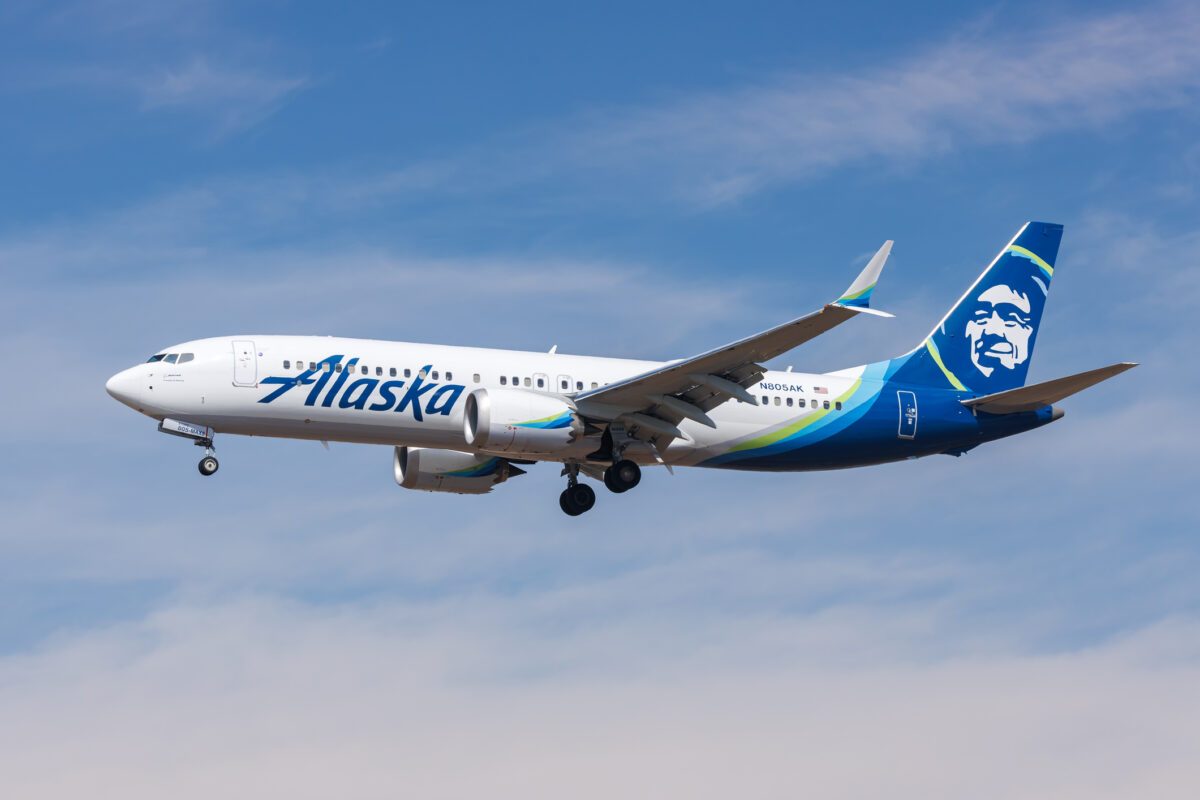
Alaska Airlines will open nonstop service between Anchorage (ANC) and Tokyo Narita (NRT) on May 13, 2027, using a Boeing 737 MAX 8 on a route scheduled at more than eight hours westbound.

The carrier’s published schedule calls for daily flights during the first summer season, subject to government approval. The outbound service will operate through September 7, with the return continuing through September 8. Three weekly flights are then scheduled to begin in January 2028.
ANC departures are set for 2:10 p.m., arriving at NRT at 3:25 p.m. the following day. The return leaves Tokyo at 9:45 p.m. and reaches Anchorage at noon on the same calendar date after crossing the International Date Line.
Read our stories in your inbox
Two aviation newsletters. Zero fluff.
That produces scheduled block times of eight hours and 15 minutes westbound and seven hours and 15 minutes eastbound. The roughly 3,000-nautical-mile great-circle sector sits within the MAX 8’s advertised range, but close enough to the edge of narrowbody operations for winds, reserves and payload to matter.
The Schedule Forms a One-Aircraft Cycle
The timings create a tightly constructed daily rotation. The aircraft has six hours and 20 minutes on the ground at NRT, then two hours and 10 minutes at ANC before the next departure. Including the scheduled flying time, the complete cycle occupies exactly 24 hours.
In practical terms, Alaska can cover the daily route with one aircraft while preserving a long Tokyo layover for the operating crew and a conventional turnaround in Anchorage. The trade-off is limited recovery time at ANC. A substantial late arrival from Tokyo could follow the aircraft into the next transpacific departure unless Alaska substitutes another MAX 8.
The pattern also avoids tying up a widebody in a market that Alaska expects to support with narrowbody capacity. At the carrier’s current 161-seat configuration, daily service represents 1,127 seats in each direction per week. The three-weekly winter schedule reduces that to 483 seats, giving Alaska a measured way to test demand outside the peak Alaska travel season.
Why the MAX 8 Gets the Assignment
Alaska describes the Boeing 737 MAX 8 as the only 737 in its fleet capable of operating the route. The airline’s larger MAX 9 carries more passengers, but the shorter MAX 8 provides more range and better suits a long sector where the market does not require widebody capacity.
Boeing lists maximum ranges of 3,500 nautical miles for the MAX 8, 3,300 nautical miles for the MAX 9 and 3,100 nautical miles for the MAX 10. Those figures are planning benchmarks rather than guarantees of full payload in all conditions, but they explain why Alaska selected the middle-sized member of the family rather than one of its higher-capacity variants.
Alaska’s current fleet listing shows 20 MAX 8s, each with 161 seats: 16 in First Class, 36 in Premium Class and 109 in the standard Main Cabin. The aircraft therefore gives the airline a relatively large premium section without forcing it to sell the volume of seats associated with a twin-aisle jet.
The route will also require a service pattern beyond Alaska’s usual domestic narrowbody operation. The airline plans complimentary meals, including a hot entree and dessert, in Main Cabin and Premium Class. First Class will receive multi-course dining as well as blankets, pillows and an amenity kit. Alaska is installing Starlink across the MAX 8 fleet, although it says free connectivity will initially be available on select flights while that program continues.
For passengers, the principal compromise is the narrowbody cabin itself. The flight will offer recliner-style First Class rather than a long-haul lie-flat product, while the single aisle will serve a scheduled journey comparable in length to many transatlantic flights.

Anchorage Gains a Direct International Role
The Tokyo service is part of Alaska’s largest planned nonstop schedule from its namesake state. The airline is also adding seasonal Anchorage flights to Austin (AUS), Dallas-Fort Worth (DFW) and Nashville (BNA) in 2027, although those domestic routes will operate only weekly during their initial summer schedules.
Narita gives Alaska a way to extend its international network directly from Anchorage without diverting one of Air Group’s widebody aircraft from other missions. The company already serves Tokyo from Seattle (SEA) with twin-aisle aircraft, but the Anchorage route follows a different capacity and operating model: a smaller aircraft, lower weekly seat count and a schedule designed around one daily narrowbody rotation.
It also fits the broader international expansion described at Alaska Air Group’s 2026 investor day. The group is targeting at least 15 long-haul intercontinental destinations by 2030 while increasing the share of revenue generated outside the standard Main Cabin. Anchorage-Tokyo advances both priorities without requiring a new fleet type at ANC.
The choice of Narita is useful beyond the local Tokyo market. Alaska and Japan Airlines are both members of the oneworld alliance, and Narita remains an international connecting point for travel within Japan and elsewhere in Asia. The late-evening return departure also leaves a broad window for passengers arriving in Tokyo on connecting services before continuing to Anchorage.
Tickets are on sale, although Alaska continues to identify the route as subject to government approval.
Bottom Line
Anchorage-Tokyo is a practical demonstration of what the MAX 8 adds to Alaska’s network. It allows the airline to enter a long, internationally significant market with about half the capacity of a typical widebody and with an aircraft already integrated into its pilot, maintenance and scheduling systems. That lowers the threshold of demand required to sustain the route, particularly during Alaska’s strong summer tourism season.
The operation will nevertheless test the MAX 8 near the demanding end of Alaska’s mission profile. Westbound winter winds, payload performance and the reliability of a one-aircraft daily rotation will be closely watched. The January 2028 restart at three weekly frequencies should provide a clearer measure of whether local traffic, tourism and connections can support the route after the summer peak.
If the service performs, it could strengthen the case for additional long narrowbody routes from Anchorage and other geographically advantaged Alaska hubs. More immediately, it gives the airline a way to build an Asian market from ANC without committing scarce widebody capacity—a disciplined experiment made possible by matching the longest-range aircraft in its 737 fleet with a market that may be too thin for anything larger.