Global Airlines Ltd, the British company that sought to build a long-haul carrier around the Airbus A380, has entered compulsory liquidation following an order by the High Court of Justice.
An official notice published in The London Gazette records that the court made the winding-up order on November 4, 2026. The proceeding, case 004213 of 2026, followed a petition filed on May 29.
V Prime was appointed Official Receiver and liquidator on the date of the order. The appointment transfers control of the company’s affairs and assets away from its directors and into the compulsory liquidation process.
Read our stories in your inbox
Two aviation newsletters. Zero fluff.
Global Airlines Ltd was incorporated in July 2021 under company number 13508008. Its Companies House profile continued to display the company as active on November 14, reflecting the lag between the court order and an updated registry status.
Receiver Takes Control of Global Airlines
The winding-up order is a terminal step rather than another warning of potential insolvency. Under the UK compulsory liquidation process, the Official Receiver identifies, secures and protects company assets, reports to creditors and examines the conduct of company officers.
Directors can no longer control the business, act on its behalf or decide how its property is used. They must turn over financial records and provide details of the company’s assets and liabilities. Funds recovered by the liquidator are distributed through the statutory creditor hierarchy after the costs of the proceeding.
The company’s latest published filing history includes micro-company accounts covering the period through December 31, 2024, filed in September 2025. Global subsequently changed parts of its board: Thomas Stokely and Prashant Uttamchandani left during April and May 2026, while Michael Belitz and Dylan Salamon joined as directors in May.
Founder James Asquith remained listed as a director when the winding-up order was made.
An Airline Built Around One A380
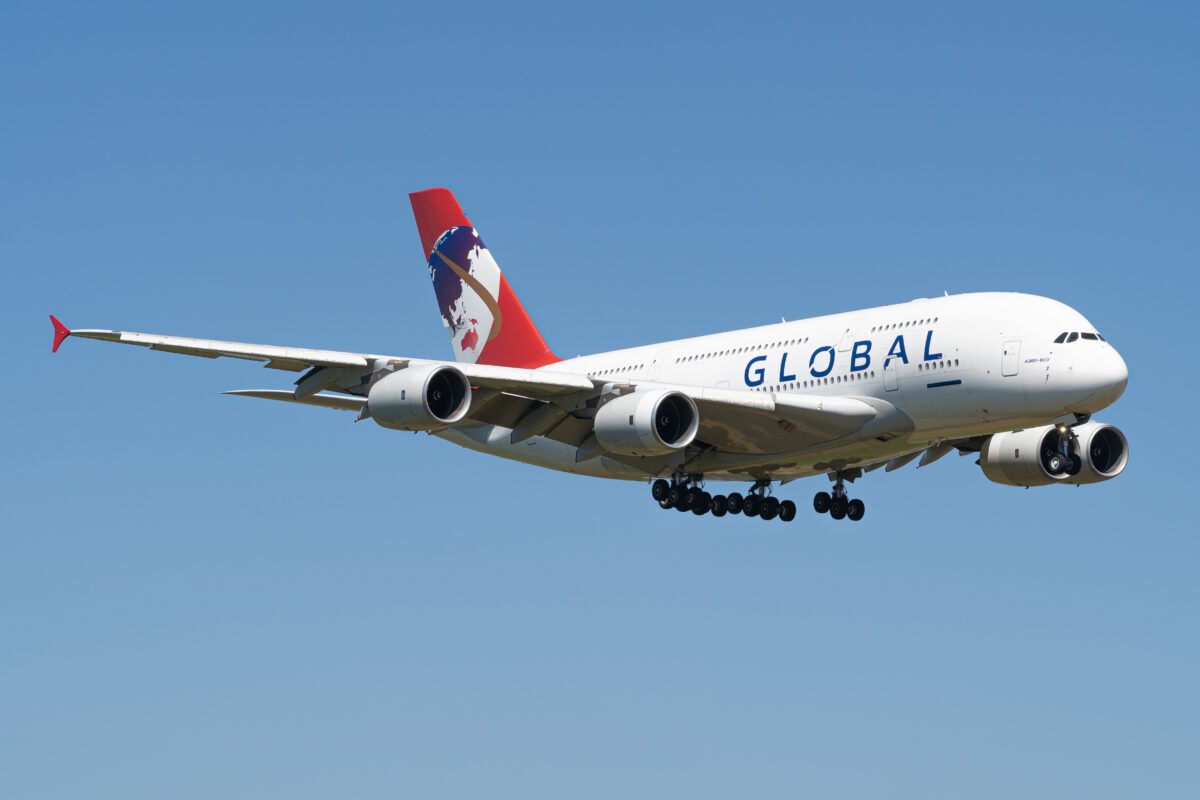
Global’s proposition centered on Airbus A380-841 MSN 120, registered 9H-GLOBL. In February 2024, the company announced that it had acquired full ownership and title to the former China Southern aircraft from Jet Midwest.

The jet had been stored at Mojave (MHV), where Hi Fly and Business Class Aviation supported its return-to-service preparation. It left California in April 2024, flying through Montreal Mirabel before reaching Glasgow Prestwick (PIK).
Further work followed in Europe. Hi Fly moved the aircraft from Prestwick to Dresden in October 2024 with its landing gear extended throughout the flight because of maintenance requirements. The aircraft later went to Beja, Portugal, where Hi Fly completed a local test flight on April 3, 2025, after a cabin refit and software work.
The A380 was both Global’s principal attraction and its largest operational challenge. Airbus describes the type as a full-length, double-deck aircraft with an approximately 8,000-nautical-mile range and a maximum certified capacity of 853 passengers. Its scale suits dense, slot-constrained long-haul markets, but requires substantial maintenance infrastructure and enough demand to support a very large number of seats.
A single-aircraft A380 operation also carries little resilience. A heavy maintenance event, technical delay or unscheduled grounding removes the carrier’s entire productive fleet unless replacement lift is sourced from another operator.

Four Passenger Sectors Operated by Hi Fly
Global never progressed from demonstration-style charters to a regular network. Its passenger flying consisted of four transatlantic sectors in May 2025: round trips linking Glasgow (GLA) and Manchester (MAN) with New York Kennedy (JFK).
The first outbound service left Glasgow for New York on May 15. The Manchester operation followed later that month. Although the aircraft carried Global’s branding and onboard product, Hi Fly operated all four flights.
Global subsequently acknowledged that arrangement directly. In a June 2025 letter to prospective passengers, Asquith said Hi Fly had operated the flights and that the program was being used to develop Global’s service and product.
The company’s website later described the four sectors as part of 20 test, repositioning and customer flights completed by 9H-GLOBL from May 2024 onward. That wording underscored the limited nature of the program: the New York trips provided operational and commercial experience, but they did not establish scheduled service or recurring passenger revenue.
The A380 Now Becomes an Asset Question
The receiver’s examination will determine which assets belong to Global Airlines Ltd, what security or other claims attach to them and what value can be recovered for creditors. MSN 120 is central to that work because Global repeatedly presented the aircraft as fully acquired and made it the foundation of its business.
An A380’s headline value cannot be separated from its technical condition, records, maintenance position and the cost of placing it into service. The aircraft requires specialized facilities, tooling, engineering support and a commercially viable operating plan. A prospective buyer must assess those costs alongside the limited pool of airlines equipped to introduce or expand A380 operations.
The court order closes the operating path pursued by Global Airlines Ltd. Any future use of the brand, onboard concept or aircraft would now require a transaction conducted through the liquidation process or a separate corporate structure with its own funding, regulatory approvals and operating capability.
Bottom Line
Global Airlines demonstrated that a privately acquired A380 could be returned from desert storage, transferred across the Atlantic and used for passenger charters. It did not demonstrate the more difficult step: turning that aircraft into a consistently available, revenue-producing fleet. Four passenger sectors operated by another airline were valuable proof of execution, but they were not a substitute for a durable operating platform.
The liquidation puts the emphasis on asset value rather than branding or future route announcements. Creditors will be watching the receiver’s treatment of MSN 120, including its title, maintenance status and marketability. For the wider A380 market, the case also illustrates the difference between acquiring a relatively inexpensive used superjumbo and funding the technical organization, maintenance program, certification and network needed to operate it sustainably.
Global’s failure does not diminish the A380’s usefulness at established carriers with dense networks, substantial engineering resources and fleet depth. It does show why the aircraft is an exceptionally demanding foundation for a startup. The next significant development will be whether MSN 120 attracts an operator, lessor or part-out buyer once the liquidator establishes what can be offered and on what terms.