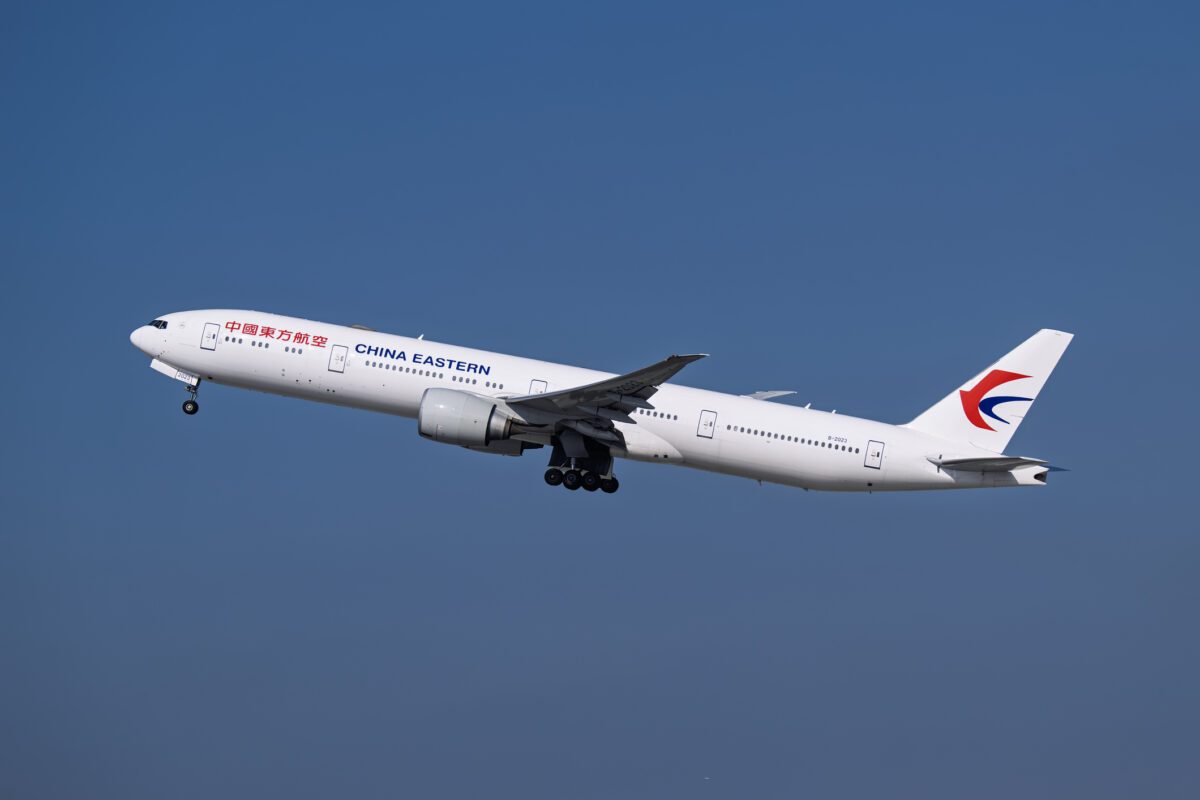
China Eastern Airlines has signed separate agreements with Boeing and Panasonic Avionics to move forward with a cabin upgrade program for its Boeing 777-300ER fleet.

The Shanghai-based carrier announced the agreements following a signing ceremony at the China International Import Expo on November 6. It described the project as an upgrade intended to improve safety, convenience and passenger comfort.
The 777 agreements formed part of a broader procurement package signed during the event. China Eastern said it planned to conclude 23 agreements with 15 suppliers from eight countries and regions, with a combined value of $540 million. Other contracts covered engines, components, tires, fuel and catering supplies.
Read our stories in your inbox
Two aviation newsletters. Zero fluff.
A 20-Aircraft Flagship Fleet
China Eastern operates 20 Boeing 777-300ERs, making the type one of four widebody families in its passenger fleet alongside the Boeing 787-9, Airbus A350-900 and Airbus A330.
The airline’s 2026 interim report listed all 20 aircraft in service at June 30, with an average age of 10.4 years. Twelve were owned and eight were held under finance leases. The fleet recorded no net change during the first half of 2026.
The retrofit decision therefore applies to a relatively standardized group acquired within a short delivery window. China Eastern received its first 777-300ER in September 2014, while the 20th and final aircraft joined the fleet in July 2017.
China Eastern originally configured the aircraft with 316 seats: six enclosed first-class suites, 52 lie-flat business-class seats in a 1-2-1 arrangement and 258 economy seats in a 3-4-3 layout. The aircraft represented a major change in the airline’s long-haul product when it entered service, providing direct aisle access throughout business class and a dedicated international first-class cabin.
The original Boeing delivery announcement gave the 777-300ER a range of 7,825 nautical miles, or 14,490 kilometers, powered by GE Aerospace GE90-115B engines. That combination made it the central aircraft in China Eastern’s initial expansion across the Pacific.
Still Central to China Eastern’s Long-Haul Network
The 777-300ER remains important even as China Eastern has expanded its newer 787-9 and A350-900 fleets. Its capacity, cargo volume and range continue to suit the airline’s longest sectors from Shanghai Pudong (PVG), particularly missions where payload capability matters alongside premium and economy seating.
Its role is illustrated by China Eastern’s Shanghai-Auckland-Buenos Aires service. The airline uses the 777-300ER throughout the route from PVG via Auckland (AKL) to Buenos Aires Ezeiza (EZE), a journey of about 20,000 kilometers linking Asia, Oceania and South America.
China Eastern launched the service in December 2025 and will increase it from two to four weekly round trips beginning December 5, 2026. The aircraft’s ability to carry passengers and freight over the long Pacific sectors makes the route a particularly demanding use of the fleet.
Renewing the cabin extends the commercial relevance of aircraft now entering their second decade. It also lets China Eastern align the passenger product more closely with its younger widebodies without replacing a 20-aircraft fleet that remains well suited to high-capacity intercontinental flying.
Boeing and Panasonic Bring Different Retrofit Capabilities
The two-agreement structure points to a program combining airframe-level cabin engineering with passenger-facing electronic systems. Boeing Global Services offers complete cabin modification and reconfiguration programs, including design, systems integration, validation and certification.
That OEM role is significant on a retrofit involving seats, monuments, power systems, entertainment equipment or changes to cabin density. Boeing says its modification organization can manage the engineering and certification work required to integrate new equipment into an existing aircraft configuration.
Boeing also has a local industrial connection to China Eastern through Boeing Shanghai Aviation Services at PVG. The joint venture between Boeing, China Eastern and the Shanghai Airport Authority supports the 777 and lists cabin retrofits, interior refurbishment and connectivity modifications among its capabilities.
Panasonic Avionics, meanwhile, specializes in in-flight entertainment, connectivity and digital cabin systems. The company’s current portfolio ranges from the Astrova platform, with 4K OLED displays, Bluetooth audio and high-output USB-C power, to products designed specifically to modernize existing installations.
In April 2026, Panasonic introduced eXNeo, a drop-in replacement for its older X Series seatback monitors. The product uses existing wiring and mechanical interfaces, reducing installation and certification work compared with a complete entertainment-system replacement. It is scheduled to become available in 2027.
China Eastern has also been increasing its emphasis on onboard connectivity. Its interim report said every widebody used on domestic flights offered free Wi-Fi by the end of the first half of 2026, while the carrier was accelerating connectivity planning across the wider fleet.
A coordinated cabin and entertainment upgrade would allow China Eastern to address several product cycles during the same aircraft downtime. For a fleet of 20 identical aircraft, concentrating seat, interior, power and electronic work into a repeatable modification package can reduce engineering duplication and limit operational disruption once installations begin.
Bottom Line
The agreements are a clear vote of confidence in the remaining service life of China Eastern’s Boeing 777-300ERs. Rather than treating the aircraft as an interim fleet between the A350 and a future generation of large widebodies, the airline is preparing them for another substantial period of frontline international operation.
The program also reflects a broader shift in the widebody market. Delivery constraints and long waits for new aircraft have increased the value of cabin retrofits, particularly for proven long-haul types with strong cargo capability. China Eastern gains a route-capable aircraft with refreshed passenger hardware, while Boeing and Panasonic gain a sizeable, standardized retrofit project in one of Asia’s largest airline fleets.
The next indicators will be the final cabin architecture, the balance between premium seating and total capacity, and the schedule for taking aircraft out of service. Those decisions will show whether China Eastern is pursuing a targeted technology refresh or a more extensive repositioning of its flagship product for the next decade.