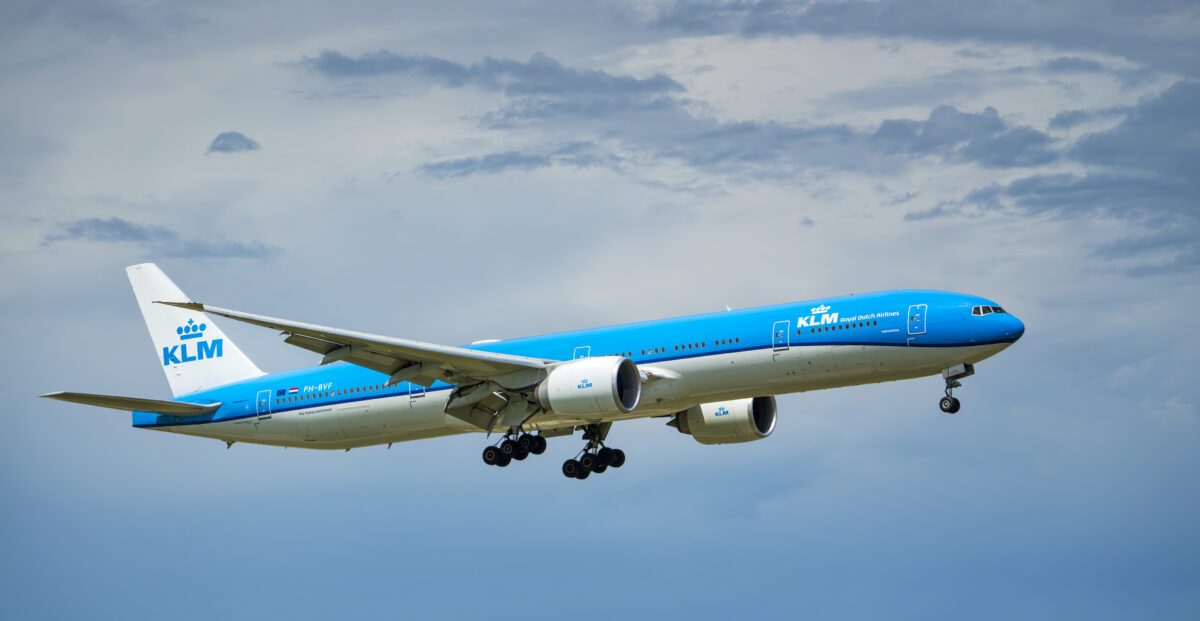
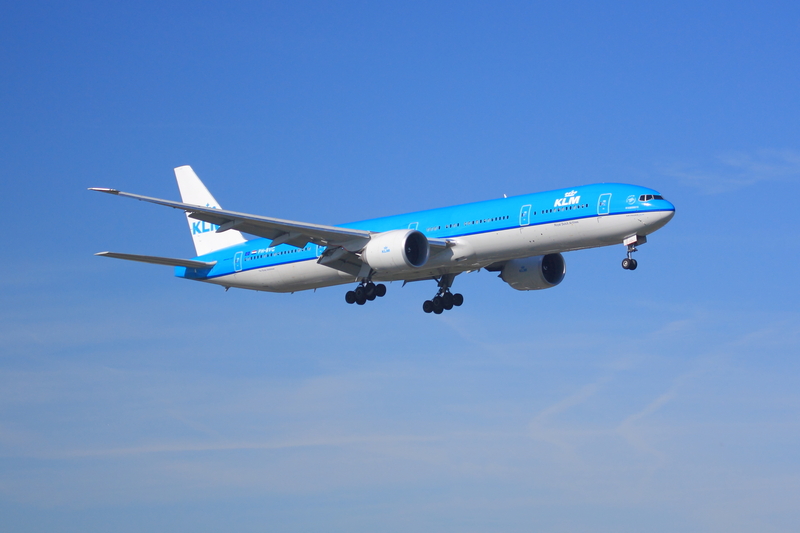
A KLM Boeing 777-300ER returned to Amsterdam Schiphol (AMS) on Thursday, September 17, after a passenger’s power bank caught fire in the cabin during a flight to Curaçao (CUR).

The incident occurred aboard KL735 after the widebody had crossed the European coast and continued over the Atlantic. KLM said cabin crew followed the applicable procedures, extinguished the fire and secured the device. The flight crew then discontinued the journey and returned to Amsterdam, where the aircraft landed safely that evening.
KLM rebooked the passengers, with a replacement flight departing the following morning. The airline did not identify the passenger who owned the power bank.
Read our stories in your inbox
Two aviation newsletters. Zero fluff.
Flight KL735 Returned to Its Departure Airport
KL735 is KLM’s nonstop service from Amsterdam to Curaçao, serving Willemstad. Schiphol’s flight listing shows the service scheduled from AMS to CUR on September 17, with an original departure time of 1:25 p.m.
The aircraft operating the disrupted flight was PH-BVP, a Boeing 777-300ER. Returning the aircraft to Amsterdam brought the flight back to KLM’s principal operating and maintenance base after the cabin fire had been brought under control.
The decision also produced a lengthy flight for passengers without reaching the destination. A return from the Atlantic requires the aircraft to carry the fuel remaining from the outbound sector back toward Europe, while the crew continues to monitor the affected device and the surrounding cabin area for renewed heat, smoke or flames.
Lithium-ion cells can reignite after the visible fire has been extinguished because heat may propagate between cells inside a battery pack. ICAO cabin-fire guidance calls for crews to cool an affected battery with water or another nonflammable liquid and continue monitoring it for signs of renewed thermal runaway.
KLM Prohibits Power Bank Use During Flight
Power banks are permitted in the cabin under tightly defined conditions, but KLM does not allow passengers to use or recharge them in flight. The carrier’s published hand-baggage rules allow no more than two power banks per passenger and require the devices to remain with the traveler rather than being placed in an overhead bin.
Units rated at no more than 100 watt-hours can be carried without advance approval. Batteries between 100 Wh and 160 Wh require the airline’s permission, while those above 160 Wh are prohibited. Damaged, defective or recalled batteries are also barred.
KLM treats power banks as spare lithium batteries, meaning they cannot travel in checked baggage. Keeping them in the cabin is intended to make overheating visible and give crew members immediate access to the device. A power bank buried in an overhead bag can produce smoke or intense heat before passengers or crew can identify its location.
The airline’s restrictions closely track the direction taken by international regulators. In March 2026, the International Civil Aviation Organization introduced new power bank specifications limiting passengers to two devices and prohibiting their recharging during flight.
The European Union Aviation Safety Agency has separately recommended that power banks be carried where passengers can monitor them and that they should not be used to charge other equipment in flight. EASA notes that a malfunction, internal short circuit, mechanical damage or exposure to heat can cause an uncontrolled reaction that produces fire and toxic smoke. Its lithium-battery safety recommendations emphasize both passenger communication and recurrent crew preparation for overheating batteries.
The 777-300ER on KLM’s Long-Haul Network
KLM uses the Boeing 777-300ER on high-capacity intercontinental services. According to the airline’s aircraft specifications, the type can carry as many as 381 passengers and has a maximum range of 12,000 kilometers.
The carrier’s layout includes World Business Class, Premium Comfort and Economy cabins. Business Class is arranged 2-2-2, Premium Comfort 2-4-2 and Economy 3-4-3. The aircraft’s capacity and long-range performance make it well suited to the sustained leisure and visiting-friends-and-relatives demand between the Netherlands and Curaçao.
The 777-300ER also offers both 110-volt and USB power at passenger seats, depending on the cabin. That installed aircraft power is distinct from a portable battery: KLM permits passengers to charge compatible personal devices from approved seat outlets while prohibiting the use or charging of power banks.
Bottom Line
The safe return of KL735 demonstrates why lithium batteries are carried in the cabin rather than placed in checked baggage. Cabin carriage does not remove the possibility of thermal runaway, but it gives trained crew members the chance to detect smoke, reach the device and begin cooling it before the event develops beyond the immediate seating area.
For KLM, the incident puts renewed attention on enforcement as much as policy. Its rules already go beyond basic carriage limits by barring overhead-bin storage and all onboard use of power banks. The operational challenge is ensuring that passengers understand that permission to carry a device does not amount to permission to switch it on, connect it to a phone or recharge it from an aircraft outlet.
Airlines will be watching whether ICAO’s 2026 restrictions and more prominent passenger briefings reduce these events. Power banks remain ubiquitous, while their condition, manufacturing quality and charging history are largely outside an airline’s control. That leaves early detection, accessible stowage and practiced cabin procedures as the principal defenses when a battery fails in flight.
Keep reading FlyMag
Get the Daily Brief in the morning or the Route Watch weekly recap on Fridays. Or both.