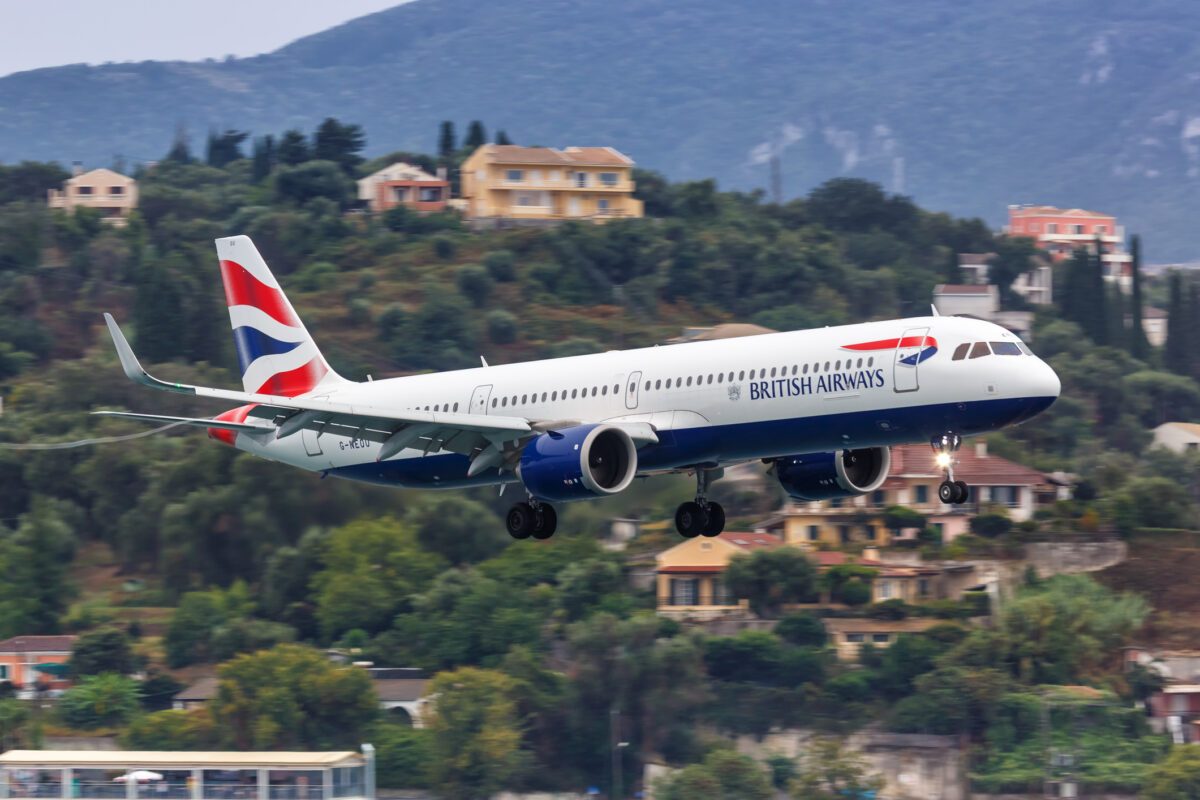
A British Airways Airbus A321neo struck its tail during an attempted landing at London Heathrow (LHR) on November 12, 2026, prompting the flight crew to abandon the landing and climb away.
The aircraft was operating BA431 from Amsterdam Schiphol (AMS). Schiphol’s official flight information identifies BA431 as British Airways’ scheduled Amsterdam-Heathrow service.
Video recorded beside Heathrow shows the A321neo touching down, pitching up again and making contact between the rear fuselage and the runway. The aircraft then transitions into a go-around. The footage appears to show two separate contacts, although the precise sequence will require examination of flight-recorder data and marks or damage found on the aircraft.
Read our stories in your inbox
Two aviation newsletters. Zero fluff.
Landing Attempt Ends in Go-Around
The sequence began with the main landing gear contacting the runway. The aircraft subsequently bounced or became airborne again, after which its pitch attitude increased. The underside of the aft fuselage then contacted the runway as the crew initiated the climb.

A go-around after runway contact is not inherently an emergency maneuver. Crews can discontinue a landing at any point when the aircraft is not positioned to complete it safely. In a tail-strike event, however, the crew must also account for possible structural damage before continuing the flight or making another approach.
Heathrow’s 2026 runway alternation program assigned Runway 27L to morning arrivals during the week beginning November 9, subject to operational changes. The airport identifies 27L as its southern runway when aircraft are approaching from the east under westerly operations.
The aircraft returned for another approach and landed at Heathrow. British Airways subsequently removed it from normal operations for engineering attention, as would be expected following confirmed or suspected contact between the fuselage and the runway.
Why the A321 Requires Careful Inspection
The A321neo is the longest member of the A320 family. The UK Civil Aviation Authority’s type-certificate data sheet gives the A321 a length of 44.51 meters and a wheelbase of 16.91 meters. Its elongated fuselage gives the aircraft more capacity than the A319 and A320, but it also means pitch attitude near the runway must be managed within a comparatively narrow geometric margin.

Air France A320 Diverts To Amsterdam After Smoke Smell Triggers Precautionary Landing
The A321-251NX variant uses two CFM International LEAP-1A32 engines, according to the same CAA certification document. Airbus lists typical A321neo seating at 180 to 220 passengers, with a certified maximum of 244, although airline layouts vary. British Airways uses the type across its short- and medium-haul network, where its capacity makes it useful on dense European sectors such as Amsterdam-Heathrow.
Airbus’ airport and maintenance planning manual describes the A321neo as a 44.51-meter aircraft with capacity for as many as 244 passengers. The standard model can cover far greater distances than the roughly 200-nautical-mile Amsterdam-London sector, allowing airlines to move the aircraft between short European rotations and longer missions without maintaining a route-specific subfleet.
After a tail strike, engineers must establish the location, length and depth of any abrasion or deformation. Inspection can extend beyond visible skin damage to frames, stringers, pressure-shell structure and systems routed through the aft fuselage. The aircraft cannot simply be released because the affected area appears superficial from outside.
The significance of two apparent contacts is also a matter for investigators and engineers rather than video interpretation alone. Separate impacts could impose different loads as the aircraft’s pitch, vertical speed and main-gear compression change during a bounce and subsequent go-around.

Investigation Will Focus on the Landing Sequence
The UK Air Accidents Investigation Branch is responsible for investigating civil aviation accidents and serious incidents in the country. Its current-investigations page notes that the public list is updated periodically and may not contain every investigation underway.
An investigation into the BA431 occurrence would be expected to examine the stabilized-approach parameters, touchdown point, vertical acceleration, pitch inputs, spoiler deployment, thrust selection and the timing of the go-around. Recorded wind and runway conditions will provide additional context, but they do not by themselves establish why the aircraft bounced or reached a tail-contact attitude.
Investigators will also be able to compare cockpit inputs with flight-control responses and determine whether the first runway contact occurred before the crew committed to the go-around. That distinction matters when reconstructing the energy state of the aircraft and the loads transmitted into the aft fuselage.
The video establishes the runway contact and climb-away, but it cannot establish cause. Conclusions about crew actions, aircraft behavior or environmental factors should wait for the evidence collected from the aircraft and its recorders.
Bottom Line
The immediate operational consequence is the loss, at least temporarily, of a high-capacity narrowbody from British Airways’ Heathrow fleet. One aircraft will have little effect on the wider schedule, but an extended structural repair can create a disproportionate maintenance burden because tail-strike work may involve access to pressure-shell structure rather than replacement of an external panel alone.
The occurrence also underlines the narrower tail-clearance margin that accompanies the A321’s longer fuselage. That does not make the type unsuitable for short sectors or busy airports; its combination of capacity, commonality and range is precisely why airlines deploy it so widely. It does make bounce recovery, pitch control and timely go-around decisions important areas of operational attention.
The next meaningful developments will be the inspection findings and the AAIB’s classification of the occurrence. Those will determine whether BA431 becomes a relatively contained maintenance event or produces broader findings concerning approach stability, landing technique or go-around execution.