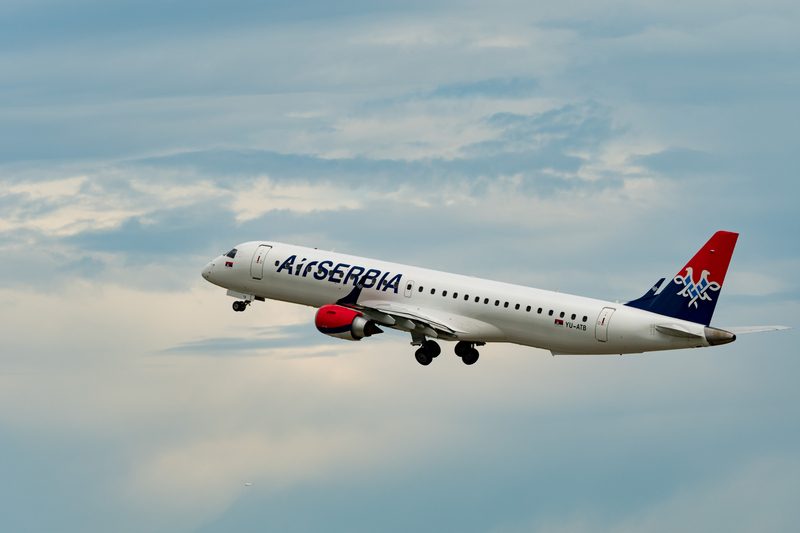
Air Serbia is returning to Munich Airport (MUC) for the first time in 18 years, restoring a daily nonstop link to Belgrade Nikola Tesla Airport (BEG) and giving the Serbian carrier another high-value route into one of Europe’s strongest business and connecting markets.

The service begins on May 22 and will be operated with Embraer E195 aircraft configured with 118 seats across Business and Economy Class. At a headline level, this is a route relaunch. In network terms, it is a meaningful move for both Air Serbia and Munich.
For Air Serbia, Munich is not just another German destination. It is one of Europe’s most commercially important metropolitan markets, with strong corporate demand, deep Balkan ties, and significant connecting potential. For Munich Airport (MUC), the return of Air Serbia adds another layer of Southeast European connectivity at a time when the airport is expanding capacity and refining its terminal offering.
Read our stories in your inbox
Two aviation newsletters. Zero fluff.
Munich Is A Bigger Return Than It First Appears
An 18-year gap is a long time in airline network planning.
That kind of absence means Air Serbia is not simply restoring a recently suspended route. It is re-entering a market that has evolved significantly since the Jat Airways era, with different competitive dynamics, different passenger expectations, and a very different Air Serbia network behind it.

That matters because Belgrade Nikola Tesla Airport (BEG) is now a much more important regional hub than it was when Munich last appeared in the airline’s map. Over the past several years, Air Serbia has built BEG into a stronger transfer point for Southeast Europe, the Balkans, the Eastern Mediterranean, and selected longer-haul markets. A route to Munich therefore carries more strategic value today than it once did.
The Daily Schedule Is Built For Both Local And Connecting Traffic
Air Serbia is launching Munich Airport (MUC) with a full daily operation, and the schedule split is revealing.
On Mondays, Tuesdays, Thursdays, and Saturdays, flights leave Belgrade Nikola Tesla Airport (BEG) in the early morning and return from Munich in the morning. On Wednesdays, Fridays, and Sundays, departures from Belgrade are in the late afternoon, with the return from Munich in the evening.
That kind of alternating timing is useful because it gives the airline exposure to different traffic flows across the week. Morning flights can work well for business travelers and for feeding into onward arrivals, while later departures can better suit leisure demand, weekend traffic, and different connection banks through Belgrade.
In other words, this is not just a token frequency. It is a proper daily business-and-network route.
The Embraer E195 Is A Smart Fit For The Market
Air Serbia has chosen the Embraer E195 for the relaunch, and that is a strong match for the route.
The E195 gives the airline enough capacity to serve Munich Airport (MUC) daily without overcommitting the market, while still offering a two-class cabin that supports both premium and economy demand. With 118 seats, the aircraft sits in a useful middle ground: large enough to make the route commercially meaningful, but small enough to keep risk manageable in the early phase of a relaunch.
That matters because Munich is a strong market, but also a competitive and yield-sensitive one. Using the E195 allows Air Serbia to combine schedule quality with right-sized capacity, rather than jumping immediately to a larger Airbus narrowbody.
For a carrier focused on disciplined growth, that is exactly the sort of aircraft assignment you would expect.
Munich Strengthens Air Serbia’s German Network In A Meaningful Way
Germany is already one of Air Serbia’s most important country markets, and Munich gives the airline another major anchor alongside cities such as Frankfurt, Berlin, Düsseldorf, Stuttgart, and Hamburg.
But Munich Airport (MUC) stands apart because of its economic profile. Bavaria is one of Europe’s most dynamic business regions, with strong industrial, corporate, and technology sectors, as well as a sizeable Serbian and wider Balkan community. That gives the route a more diversified demand base than a purely leisure city pair.
For Air Serbia, that mix is attractive. It means the route is not dependent on one type of traveler alone. It can draw on business traffic, diaspora demand, visiting-friends-and-relatives travel, tourism, and hub connections over Belgrade Nikola Tesla Airport (BEG).
That breadth usually makes a route more resilient.
Belgrade’s Hub Role Is Central To The Logic
One of the strongest arguments for the Munich relaunch is what happens beyond Belgrade.
Air Serbia is not just selling Munich Airport (MUC) to Belgrade Nikola Tesla Airport (BEG) as a local market. It is also selling Munich to Southeastern Europe and beyond via BEG. From its Belgrade hub, the airline can offer onward access to destinations across the Balkans, the Adriatic region, parts of the Eastern Mediterranean, and selected long-haul points.
That hub role has become increasingly important in Air Serbia’s strategy. The carrier may not be a mega-network airline, but it has built a credible transfer proposition in a region where nonstop links are often fragmented and indirect routings remain common.
This makes Munich more than a point-to-point route. It becomes another spoke feeding a broader regional system.
The Timing Also Works For Munich Airport
The route’s return comes as Munich Airport (MUC) continues to expand and refine its own infrastructure, including the opening of a new pier at Terminal 1.
That is relevant because new or restored airline service often lands more effectively when the airport itself is improving passenger flow, gate flexibility, and terminal quality. For MUC, bringing back an airline like Air Serbia also supports the airport’s role as a key gateway between Southern Germany and Southeastern Europe.
From Munich’s perspective, this is not a giant capacity move. But it is exactly the kind of route that strengthens network depth and regional relevance.
This Is A Small Route With Outsized Strategic Value
The daily Belgrade-Munich link will not be one of Europe’s biggest route launches in raw seat terms. That is not the point.
Its importance lies in the quality of the market, the history of the route, and the way it fits into Air Serbia’s wider network strategy. Bringing Munich Airport (MUC) back after 18 years signals that the airline believes it now has the hub strength, aircraft mix, and commercial depth to make this kind of market work again.
That is a stronger statement than the daily frequency alone might suggest.
Bottom Line
Air Serbia’s return to Munich Airport (MUC) is a strategically smart relaunch rather than just a nostalgic one. The daily service to Belgrade Nikola Tesla Airport (BEG), operated by 118-seat Embraer E195 aircraft, reconnects Bavaria with Serbia’s growing hub and gives the airline another high-value route into one of Europe’s strongest business and regional markets.
For Air Serbia, Munich is a route that supports both local demand and onward feed across Southeast Europe. For Munich, it adds another useful Balkans connection at a time of airport growth. After an 18-year absence, this is less a simple comeback than a sign of how much more ambitious Air Serbia’s network has become.
Keep reading FlyMag
Get the Daily Brief in the morning or the Route Watch weekly recap on Fridays. Or both.