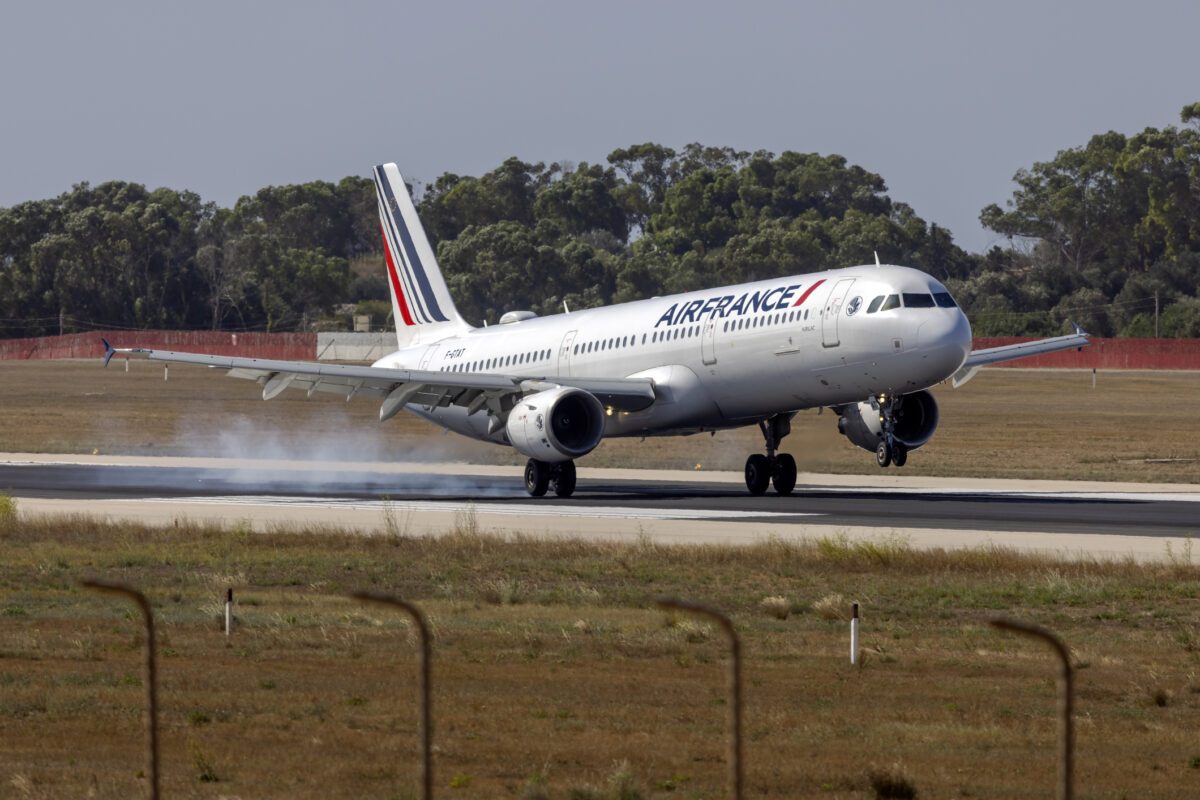
Air France will assign a specially configured Airbus A321 to three state flights during Pope Leo XIV’s first visit to France, moving the pontiff and his traveling party from Paris to Lourdes, onward to Metz and finally back to Rome.

The operation will run from September 26 to 28 and involve more than 100 Air France employees. The aircraft will carry more than 70 Vatican officials, clergy, security personnel and Swiss Guards, together with more than 80 accredited journalists.
Air France said the A321 will be arranged with two cabins for the mission. The airline will temporarily name the aircraft Cité du Vatican, with the title applied to the fuselage below the windows. The Vatican City State coat of arms will also appear beside the forward left boarding door used by the Pope.
Read our stories in your inbox
Two aviation newsletters. Zero fluff.
Three Flights From Orly to Rome
The first of the three Air France flights will leave Paris Orly (ORY) at 5:45 p.m. on Saturday, September 26, for Tarbes-Lourdes-Pyrénées (LDE). Departure will be through Orly’s honorary pavilion, which is used for official and state movements.
On Monday, September 28, the A321 will depart LDE at 7:40 a.m. for Metz-Nancy-Lorraine (ETZ). It will then leave ETZ at 7 p.m. for Rome Fiumicino (FCO), arriving at 8:50 p.m. according to the Holy See’s official itinerary.

The Vatican schedule has Pope Leo XIV arriving at ORY from Rome at 10 a.m. on Friday, September 25. His program in Paris includes meetings at the Élysée Palace and UNESCO headquarters, vespers at Notre-Dame Cathedral and a prayer vigil at the Stade de France in Saint-Denis. He will celebrate Mass at Place de la Concorde on Saturday afternoon before traveling to Orly for the flight to Lourdes.
After two nights in Lourdes, the Pope will use the second Air France sector to reach Metz. His schedule there includes an interreligious meeting, an event focused on Europe, peace and unity, and Mass at Metz Cathedral before the evening departure for Rome.
Transavia will support the wider movement with a separate special flight from ORY to Lourdes. The Air France-KLM Group carrier will transport a delegation of cardinals, bishops and journalists covering the visit.
A State Flight Rather Than a Scheduled Service
Air France said the Pope’s flights will receive state-flight status, bringing the priority handling and dedicated arrangements applied to aircraft carrying heads of state. The planning spans flight operations, cabin service, maintenance, ground handling, security, protocol, catering and operational coordination.
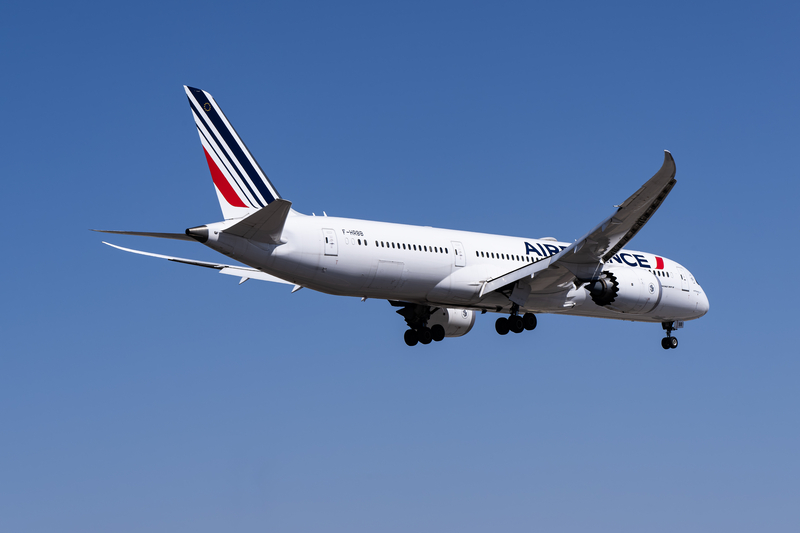
One Air France crew will operate the Paris-Lourdes and Lourdes-Metz sectors. A second crew will take over at Metz for the flight to FCO. Captain Clémence Coussonneau, who is overseeing the Pope’s transport for the airline, said preparations had been underway for several weeks.
The assignment comes as Air France substantially reduces its normal presence at Orly. Under its summer 2026 network restructuring, the airline has concentrated its Paris operation at Charles de Gaulle, apart from Corsica services covered by public-service obligations. Transavia has become the group’s principal scheduled operator at ORY.
That makes the Pope’s departure from Orly an official-flight operation rather than a reflection of Air France’s current scheduled network strategy. The airport nevertheless remains well placed for the Paris portion of the itinerary and has the protocol facilities required for the movement.
The A321 Keeps the Traveling Party Together
Air France has not identified the individual A321 assigned to the mission, but the type has long formed part of the airline’s European medium-haul operation. The A321 is the longest member of the original A320 family, giving it substantially more cabin capacity than the A319 and A320 while retaining the family’s single-aisle layout and operational commonality.

For this mission, that cabin volume allows Air France to carry the Pope, his immediate entourage, the wider Vatican delegation and more than 80 members of the press on one aircraft. The two-cabin arrangement also provides a controlled forward section while keeping the full traveling party aboard the same flight.
The sectors themselves are short European missions. The aircraft’s role is therefore driven less by range than by capacity, airport compatibility and the ability to support a secure, tightly timed itinerary. Air France describes the A320 and its A319 and A321 derivatives as longstanding mainstays of its medium-haul fleet.
Air France’s History of Papal Flights
The September operation continues a series of papal assignments for Air France. On May 2, 1989, the airline carried Pope John Paul II aboard Concorde from Saint-Denis de La Réunion to Lusaka during an African tour. It was an unusual use of the supersonic aircraft outside its best-known scheduled transatlantic work.
Air France later flew John Paul II from Reims to FCO aboard an Airbus A310 on September 22, 1996. In 2008, it operated two A321 flights for Pope Benedict XVI’s visit to France, from ORY to Lourdes and then from Lourdes to Rome. The 2026 mission therefore closely follows the aircraft choice and routing pattern used for Benedict’s journey.
Before departure for Lourdes, Air France will present Pope Leo XIV with a collector’s poster created by the artist Plaquet. The design refers to Air France promotional material produced around the Catholic Church’s 1950 Jubilee, when the airline commissioned posters centered on Lourdes and Rome. Air France presented the Lourdes poster to Benedict XVI in 2008.
Bottom Line
The operation shows why a large single-aisle aircraft remains useful for specialized state flying even as Air France renews its short- and medium-haul fleet. The A321 can keep a traveling party of more than 150 people together, serve regional airports without widebody requirements and complete three sectors within a closely controlled diplomatic schedule.
Orly’s role is also notable. Air France has shifted its scheduled Paris flying toward Charles de Gaulle and handed Transavia a larger position at ORY, but the honorary pavilion and proximity to central Paris preserve the airport’s relevance for government and protocol movements. The parallel Transavia flight demonstrates how the group can divide an unusually large official delegation across its two French carriers.
Attention will now turn to the identity and external presentation of the assigned A321, as well as the ground operation at LDE and ETZ on September 28. With two crews, priority handling and more than 100 employees involved, the flying program is short in distance but closer to a state-visit charter than a conventional European rotation.
Keep reading FlyMag
Get the Daily Brief in the morning or the Route Watch weekly recap on Fridays. Or both.