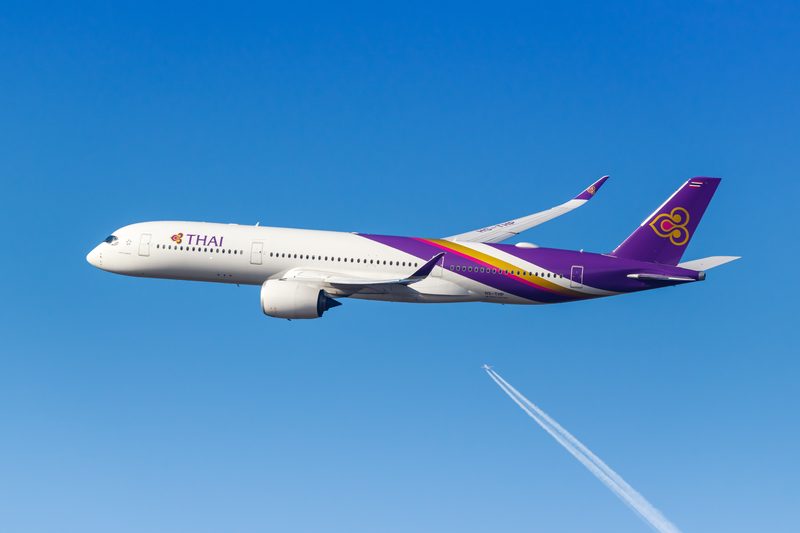
Thai Airways International has restored nonstop service between Bangkok Suvarnabhumi Airport (BKK) and Amsterdam Schiphol Airport (AMS), bringing one of Thailand’s most recognizable long-haul carriers back to the Netherlands with a daily Airbus A350-900 operation.

The route resumed on July 1, 2026, reconnecting Thailand and the Netherlands with seven weekly nonstop flights. For THAI, the Amsterdam relaunch is more than a point-to-point route restoration. It strengthens the airline’s European network, improves access to one of the continent’s most important transfer airports, and gives Dutch travelers a direct Star Alliance option to Bangkok and beyond.
The service operates as TG936 from Bangkok (BKK) to Amsterdam (AMS), departing Suvarnabhumi at 05:35 and arriving at Schiphol at 12:40. The return flight, TG937, departs Amsterdam at 14:15 and arrives in Bangkok at 06:35 the next morning.
Read our stories in your inbox
Two aviation newsletters. Zero fluff.
Amsterdam Returns to THAI’s Long-Haul Map
Amsterdam has long been an important European gateway for Southeast Asia traffic. Schiphol is one of Europe’s largest connecting airports, but it is also a strong local market in its own right, supported by Dutch outbound tourism, business travel, cargo demand, and visiting-friends-and-relatives traffic.
For Thai Airways, returning to Amsterdam (AMS) fills a notable gap in its Western Europe network. THAI already has a strong presence in cities such as London Heathrow (LHR), Frankfurt (FRA), Munich (MUC), Paris Charles de Gaulle (CDG), Zurich (ZRH), Brussels (BRU), Milan Malpensa (MXP), and other major European markets. Amsterdam adds another high-value western European point with both local and connecting potential.
The route also gives passengers in the Netherlands a nonstop alternative to connecting over Middle Eastern hubs, other European gateways, or Istanbul. That matters in a market where Thailand remains one of Asia’s most popular long-haul leisure destinations.
The A350-900 Is the Right Aircraft for BKK-AMS
THAI is using the Airbus A350-900 on the Bangkok-Amsterdam route, and the aircraft is well matched to the mission. The A350-900 has the range for the roughly 11- to 12-hour sector, strong fuel efficiency, and a cabin designed for long-haul passenger comfort.
Depending on the assigned aircraft subfleet, THAI’s A350-900s seat between 321 and 339 passengers. The airline’s published layouts include Royal Silk Business Class cabins with 30 to 33 seats and Economy cabins with 289 to 309 seats. THAI lists its A350 product with fully flat Royal Silk seats, in-seat entertainment, USB ports, power outlets, and long-haul amenities.

For Amsterdam (AMS), the A350 gives THAI a modern widebody with enough capacity to support leisure and connecting traffic without requiring a larger Boeing 777-300ER. It also provides belly cargo capability, which can be important on a route linking Thailand with one of Europe’s major freight and logistics markets.
The A350 is also central to THAI’s future fleet strategy. Airbus and THAI signed a Letter of Intent in 2025 for an A350 cabin retrofit program expected to begin in 2028, including upgraded Royal Silk Business Class, new Premium Economy, new Economy seating, and improved inflight entertainment. That means the A350 will remain a key part of THAI’s long-haul product well beyond this route relaunch.
Schiphol Adds Value Beyond Amsterdam
Amsterdam Schiphol (AMS) is valuable because it is both a destination and a distribution point. Passengers arriving from Bangkok can connect onward across Europe by air or rail, while Dutch travelers can use Bangkok (BKK) as a gateway into Thailand and THAI’s wider Asian network.
The rail piece is especially important. Schiphol’s integrated rail station gives travelers easy access to Amsterdam, Rotterdam, Utrecht, The Hague, and other Dutch cities. It also supports cross-border connectivity into Belgium and Germany. That makes the route more useful than a simple airport-to-airport link.
For THAI, Amsterdam’s location gives the airline access to a broader Benelux and northwestern European catchment. Not every passenger on TG937 will begin in Amsterdam itself. Some will come from other Dutch cities, Belgium, western Germany, or nearby regional markets where Schiphol is a natural long-haul gateway.
That wider catchment is one reason AMS remains such a valuable airport for long-haul Asian carriers.
Bangkok Remains THAI’s Core Strength
The route also reinforces Bangkok Suvarnabhumi (BKK) as THAI’s core long-haul hub. Suvarnabhumi is Thailand’s primary international gateway and one of Southeast Asia’s busiest airports, handling a mix of inbound tourism, regional connections, long-haul transfer traffic, and domestic flows.
For Dutch and European passengers, Bangkok is not only the final destination. It is also a connection point to Thai domestic destinations such as Phuket (HKT), Chiang Mai (CNX), Krabi (KBV), Koh Samui (USM), and onward Asian markets.
That gives THAI multiple passenger segments to work with: Dutch tourists heading to Thailand, Thai travelers going to the Netherlands, business travelers, connecting passengers across Southeast Asia, and premium leisure travelers looking for a nonstop service rather than a one-stop itinerary.
A daily schedule is especially important because it gives the route credibility. Three or four weekly flights can work for leisure markets, but daily service is much more useful for business travel, tour operators, connecting passengers, and cargo customers.
A Route That Supports Tourism and Trade
The Netherlands and Thailand have strong tourism and commercial ties, and direct air service makes those links easier to sustain. Thailand remains a major long-haul destination for Dutch travelers, while Amsterdam is an important European business and logistics market for Thai exporters and companies.
Cargo should not be overlooked. The A350’s belly capacity can support flows such as perishables, pharmaceuticals, electronics, garments, e-commerce, and high-value goods. Schiphol is one of Europe’s most important cargo gateways, and Bangkok is a major Southeast Asian cargo and passenger hub. Even when passenger demand drives the route, freight can help improve the overall economics.
From a tourism perspective, the timing is also useful. The 14:15 departure from Amsterdam allows travelers to leave the Netherlands in the afternoon and arrive in Bangkok the next morning, a classic long-haul Asia schedule. The early morning departure from Bangkok lands in Amsterdam just after midday, giving passengers useful same-day onward options within Europe.
THAI’s European Recovery Continues
The Amsterdam relaunch fits into THAI’s broader post-restructuring recovery and long-haul rebuilding. The airline has been sharpening its fleet plan, restoring strategic international routes, and refocusing around markets where it can support premium demand, tourism flows, and hub connectivity.
Europe remains essential to that strategy. European inbound tourism is important for Thailand, and THAI’s brand still carries weight in markets where the airline has long-standing recognition. Restoring Amsterdam helps rebuild the network depth that THAI needs if it wants to compete more strongly against Gulf carriers, European network airlines, Turkish Airlines, and other Asian carriers.
The daily A350 schedule also sends a clear message: THAI is not returning to Amsterdam with a token seasonal operation. It is putting meaningful capacity back into the market from day one.
Bottom Line
Thai Airways’ return to Amsterdam (AMS) is a significant long-haul restoration for both the airline and the Netherlands-Thailand market. The daily Airbus A350-900 service gives passengers a nonstop link between Bangkok Suvarnabhumi (BKK) and Amsterdam Schiphol (AMS), with TG936 operating east-to-west in the morning and TG937 returning overnight to Thailand.
The A350-900 is the right aircraft for the route: modern, efficient, comfortable, and large enough to support leisure, business, connecting, and cargo demand without overcommitting capacity. Schiphol gives THAI access to a wide Dutch and northwestern European catchment, while Bangkok provides onward access across Thailand and Southeast Asia.
For THAI, Amsterdam is more than a restored city on the map. It is another step in rebuilding a credible, competitive European long-haul network around the airline’s most important widebody aircraft.