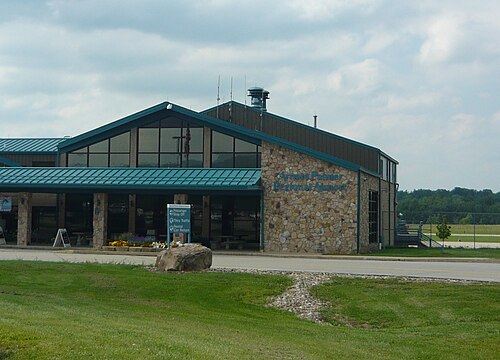
Arnold Palmer Regional Airport (LBE) is suddenly back in the spotlight—not because it added a new route, but because it lost one.
After Spirit Airlines (NK) removed its long-running Latrobe (LBE)–Orlando (MCO) service from the schedule effective mid-April, the airport’s leadership says negotiations with one or more carriers have accelerated. Westmoreland County Airport Authority executive director Gabe Monzo told the authority’s board that the airport expects an offer “within a month,” describing how Spirit’s performance on Orlando has become a proof point for other airlines evaluating the market.
In plain terms: Spirit demonstrated demand, then walked away. Now LBE is trying to convert that demand into a new operator.
Read our stories in your inbox
Two aviation newsletters. Zero fluff.
Why LBE is attractive right now
For airline network teams, LBE checks a few boxes that matter more in 2026 than they did even five years ago:
A runway built for “real” jets.
LBE’s primary runway 6/24 is 8,222 feet long—enough for common narrowbody types like the Airbus A320 family and Boeing 737 family to operate without the performance penalties and payload compromises that can plague shorter regional fields.
A proven leisure lane.
Spirit’s LBE–MCO route has been described locally as strong—strong enough that carriers are now calling it out as a reason they’re interested. Leisure demand to Florida tends to be resilient, especially when you offer a nonstop and avoid the parking, congestion, and drive-time friction associated with larger hubs.
Lower friction than “big airport” operations.
For passengers, LBE’s value proposition is speed and simplicity: shorter walk times, smaller queues, and a more straightforward curb-to-gate experience. For airlines, that can translate into operational reliability—faster turns, fewer gate constraints, and less variability in the passenger flow.
What’s changing in Spirit’s LBE schedule
Spirit has been LBE’s sole scheduled airline since 2011, but that relationship has thinned dramatically over the past year as Spirit shrinks its network.
Here’s how the LBE map has been trending:
-
LBE–Fort Lauderdale (FLL) ended last fall.
-
LBE–Orlando (MCO) is scheduled to end April 15, 2026.
-
LBE–Myrtle Beach (MYR) resumes seasonally the next day, generally operating five days a week after being paused since November.
That leaves LBE with far fewer commercial flights than it had even a year ago—and that shows up quickly in the airport’s finances.
The money: why every landing matters at LBE
Small commercial airports don’t make money the way hub airports do. LBE’s board has been candid about the math:
-
The airport collects about $750 per commercial flight landing.
-
LBE’s total budget is about $5.1 million, supported by an annual county subsidy of nearly $2.6 million.
-
The subsidy helps cover operating costs plus debt service of roughly $800,000 per year.
-
Another $750,000 supports Latrobe Airline Services, which provides flight-day staffing such as ticket-counter personnel, baggage handling, de-icing support, and ramp staff.
The key operational note is that those services are not exclusive to Spirit. If a new carrier signs on, the airport’s existing staffing model is positioned to support it quickly—one reason Monzo has expressed confidence that onboarding another airline could happen without rebuilding the operation from scratch.
What kind of airline is likely to show up at LBE
Monzo hasn’t named the carriers in discussion, and airports typically keep those talks confidential until a contract is signed. But the operational profile suggests what could work:
-
A ULCC or value carrier that can stimulate demand with low fares—especially to Florida leisure markets.
-
A carrier with 150–190-seat narrowbodies (A320/737) that can right-size a leisure route with 2–4 weekly frequencies rather than needing daily lift.
-
A regional-jet operator is less likely here unless the carrier is targeting hub connectivity, because Florida leisure routes generally perform better with higher-gauge aircraft and tighter unit costs.
The real question isn’t whether LBE can support service—it’s whether a new entrant can price, schedule, and market the route in a way that keeps load factors healthy outside peak travel peaks, without relying on constant promotional pricing.
Leadership transition at LBE during a crucial negotiating window
This airline pursuit is also happening during a leadership handoff:
-
Gabe Monzo is slated to retire at the end of April 2026 after four decades at the airport (17 as executive director).
-
Maurice Haas, currently the airport facility manager, is set to take over in May 2026.
-
The authority voted to retain Monzo as a part-time consultant after retirement, capped at 1,000 hours and $50,000.
For airlines, continuity matters. When a station is small, relationships are everything—ground handling, de-icing readiness, customer-service processes, and the “who do I call when things go sideways” factor. Keeping Monzo in a consulting role helps ensure that any new airline agreement doesn’t lose momentum during the transition.
Bottom Line
Arnold Palmer Regional (LBE) is in a rare moment of leverage: a proven leisure route to Orlando (MCO) is being pulled by Spirit (NK), and airport leadership says that vacuum has sparked serious interest from other carriers. With an 8,222-foot runway, a ready-to-use flight-day staffing model, and a community that has already demonstrated demand for Florida nonstop flying, LBE believes a replacement airline deal is close.
If an offer lands in the next month as expected, the next phase won’t be about announcements—it will be about execution: choosing the right city pairs (likely Florida first), matching frequency to demand, and rebuilding a sustainable schedule that keeps LBE relevant even as the ULCC landscape reshuffles.
Keep reading FlyMag
Get the Daily Brief in the morning or the Route Watch weekly recap on Fridays. Or both.