Kuwait International Airport (KWI) suffered a jarring reminder of how quickly geopolitics can spill into day-to-day aviation on February 28, 2026, when a drone strike damaged Terminal 1 (T1) and injured several airport employees, according to Kuwait’s civil aviation authorities.

Officials described the physical impact as limited, but even “minor” terminal damage is operationally major at a national gateway. Once there’s smoke, debris, or any question of secondary hazards, airports move into a conservative playbook: isolate the affected area, activate emergency response, then work methodically through safety checks before attempting to restore normal passenger flows.
Read our stories in your inbox
Two aviation newsletters. Zero fluff.
What happened at KWI
Kuwait’s Directorate General of Civil Aviation (DGCA) said a drone targeted KWI, causing limited material damage in T1 and minor injuries to multiple employees. Emergency procedures were activated immediately, with airport responders coordinating alongside national authorities.
Attribution remains murky in public reporting. While some outlets described the drone as “Iranian,” official statements have focused on the incident itself—damage, injuries, and response—rather than definitive sourcing. In fast-moving conflicts, that distinction matters for aviation: operators and insurers plan around verified risk, not speculation.
Why a “limited” hit can still paralyze a hub
From an ops perspective, the strike intersects with three sensitivities that airports like KWI can’t ignore:
Terminal continuity: T1 at KWI—opened in 1979—is a legacy facility with dense passenger circulation and critical systems (fire suppression, smoke control, power, IT). Any impact that triggers alarms or forces an evacuation can break the terminal’s throughput rate long after the immediate incident is contained.
Airside integrity: Even if the damage is landside, a strike raises the specter of foreign object debris (FOD) on aprons, taxi lanes, or adjacent service roads. Widebody operations, fuel bowsers, and ground equipment movements all become higher risk until inspections are complete.
Security escalation risk: In an environment of regional drone and missile activity, airports also have to plan for the possibility of follow-on attempts. That can mean extended pauses, controlled reopening, and heightened perimeter controls that slow everything from catering to baggage build.

The broader context: KWI hit as Gulf air corridors constrict
The KWI incident landed amid a region-wide airspace shock that forced airlines to cancel, turn back, or divert flights across the Gulf. With multiple countries restricting or closing airspace, the normally crowded corridor linking Europe, the Gulf, South Asia, and Southeast Asia effectively disappeared from flight plans.
For airlines, this creates a cascade:
-
Reroutes add time and fuel, raising payload limits and tightening crew duty margins.
-
Diversions displace aircraft into alternates not planned for widebody banks.
-
Reaccommodation gets harder by the hour, as hubs like Dubai (DXB/DWC) and Doha (DOH) struggle to rebuild bank structures with aircraft and crews out of position.

Cirium estimates from the same day showed a sharply elevated cancellation rate into the region, with particularly high disruption levels in Gulf-adjacent markets—including Kuwait—while traffic managers struggled to re-thread routes through the remaining safe corridors.
Kuwait’s hub ambition: Terminal 2 still the long game
Kuwait’s aviation strategy hasn’t been subtle: build a larger regional air hub around KWI, anchored by the long-delayed Terminal 2 (T2) project designed by Foster + Partners and built by Limak.
The key point for airline planners is that T2 isn’t just a “nicer terminal.” It’s capacity and resilience:
-
More stands and contact gates to reduce hard-stand dependence
-
Expanded security and baggage systems to absorb peak banks
-
More predictable minimum connection times—critical if Kuwait Airways (KU) wants to grow meaningful transfer flows
KWI has already been adding enabling infrastructure, including major airfield works like a new runway and a new control tower coming online in recent phases of the modernization program. But T2 has slipped repeatedly, and the current trajectory is better understood as late 2026 rather than earlier targets. Whether a security incident at T1 slows T2 timelines is not yet clear; in many airports, the construction site and the affected terminal operate as separate operational ecosystems—but supply chain, staffing, and security posture can still influence project momentum.
Kuwait Airways (KU): the operator most exposed to KWI instability
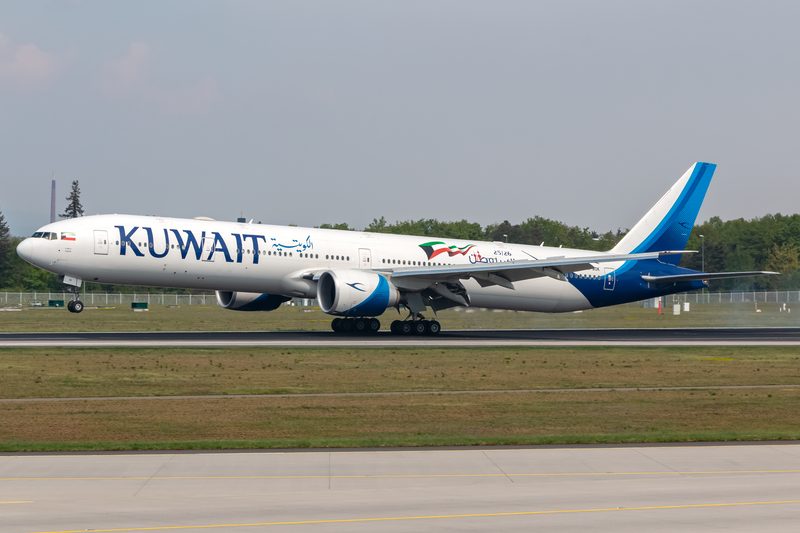
Kuwait Airways’ network is structurally tied to KWI, linking Kuwait to the Middle East, the Indian Subcontinent, Europe, Southeast Asia, and select long-haul markets. When KWI constricts, the carrier’s recovery options are narrower than those of a multi-hub airline.
From a fleet-and-turn standpoint, KWI disruptions also behave differently depending on aircraft gauge:
-
Single-aisles can often be repositioned and recovered more quickly, with more alternate airports able to handle turns.
-
Widebodies require specific stands, equipment, and immigration capacity, making diversions and recovery significantly more complex—especially if multiple Gulf hubs are constrained simultaneously.
That’s why even a brief shutdown can echo across days of schedules: aircraft and crews don’t simply “return to base” when base operations are disrupted.
What passengers should expect
If you’re traveling through KWI during a security-driven disruption, the practical realities tend to be consistent:
-
Rebookings are capacity-limited, especially on long-haul routes and during peak banks.
-
Diversions may strand passengers at airports that aren’t set up for mass reaccommodation of widebodies.
-
Baggage access can be delayed, depending on customs posture and whether bags were loaded into secured streams before flights were canceled.
Passengers should rely on carrier-issued advisories and confirmed flight status before traveling to KWI, and keep essential medication and one change of clothing in carry-on—especially when regional airspace closures are still evolving.
Bottom Line
The drone strike at Kuwait International Airport (KWI) that damaged Terminal 1 (T1) and injured airport employees is both a local safety event and a regional aviation stress test. With Gulf airspace already constrained by broader conflict-driven closures, even limited terminal damage can amplify disruption—grounding departures, complicating diversions, and slowing the recovery of airline schedules that depend on tightly timed connections.
Kuwait’s longer-term hub plans—anchored by the still-incomplete Terminal 2 (T2)—remain strategically important. But in the near term, the priority for KWI is more basic and more urgent: stabilize operations, prove the terminal and airfield are secure, and restore predictable movement in a region where predictability has become the scarcest resource.
Keep reading FlyMag
Get the Daily Brief in the morning or the Route Watch weekly recap on Fridays. Or both.