Russia’s Federal Air Transport Agency has revoked Izhavia’s air operator certificate over unresolved safety and operational-control deficiencies, forcing the regional carrier to end commercial flying from August 1, 2026.

The decision prevents Izhavia from operating scheduled passenger flights or selling new tickets under its own airline certificate. It follows several months of regulatory scrutiny in which the carrier was given a deadline to correct problems involving aircraft maintenance, crew scheduling, technical personnel workloads, and its broader safety management system.
Approximately 46,000 passengers hold Izhavia tickets for travel through February 1, 2027. Russian authorities say those bookings remain valid and are being transferred to other airlines wherever replacement capacity is available.
Read our stories in your inbox
Two aviation newsletters. Zero fluff.
Regulator Had Given Izhavia Three Months to Correct Problems
Rosaviatsiya initially restricted the validity of Izhavia’s operating certificate following an inspection of the airline’s production base at Izhevsk Airport (IJK) between March 31 and April 13, 2026.
In its May regulatory notice, Rosaviatsiya said inspectors had identified violations of Russian aviation requirements and warned that Izhavia’s certificate would be canceled if the carrier failed to correct them by July 28.
The findings included an aircraft being released for service without all required maintenance having been completed, deficiencies in the airline’s safety management system, problems with flight crew scheduling, and technical employees exceeding permitted working-hour limits.
Rosaviatsiya recommended that Izhavia reconsider how it managed flight safety, conduct an internal audit of its continuing-airworthiness and maintenance departments, and make structural and personnel changes.
Izhavia initially acknowledged the findings. Chief Executive Alexander Sinelnikov said in May that many of the problems were procedural or organizational and that the airline had developed a corrective-action plan with Russia’s transport oversight authority.
The airline said it had introduced additional checks before releasing aircraft for service, reviewed employee schedules, and created an internal commission to examine its safety procedures.

A follow-up inspection in July concluded that the carrier had not corrected the most important deficiencies to the regulator’s satisfaction. Rosaviatsiya subsequently annulled Izhavia’s certificate rather than extending the earlier restriction.
What Losing an Air Operator Certificate Means
An air operator certificate, commonly known as an AOC, is the regulatory authorization that allows an airline to conduct commercial air transportation.
Without one, Izhavia cannot legally operate passenger or cargo flights for compensation, even if its aircraft remain technically airworthy. The decision affects the airline operation rather than closing Izhevsk Airport (IJK), which continues to receive flights from other Russian carriers.
The distinction is important because Izhavia has historically been closely connected with the airport serving the capital of the Udmurt Republic. Other airlines, including Aeroflot Group carriers and S7 Airlines, can continue serving Izhevsk Airport (IJK) independently of Izhavia’s regulatory status.

Russian industry reporting indicates that an annulled certificate cannot simply be restored through the same administrative process. Unless Izhavia succeeds in overturning the decision in court, it would likely need to obtain a new operating certificate before resuming commercial flights.
Nearly 46,000 Passengers Must Be Rebooked
Izhavia had sold almost 46,000 tickets for travel between August 1, 2026, and February 1, 2027.
The affected schedule primarily covered services from Izhevsk Airport (IJK) to Moscow Domodedovo Airport (DME), St. Petersburg Pulkovo Airport (LED), Sochi International Airport (AER), Kaliningrad Khrabrovo Airport (KGD), and Yekaterinburg Koltsovo International Airport (SVX).
Rosaviatsiya said arrangements had been reached with Aeroflot, S7 Airlines, Red Wings, and Nordwind Airlines to transport affected customers. Pobeda, NordStar, UVT Aero, and Smartavia also indicated that they had the technical ability to accommodate passengers where schedules and available seats permitted.
Passengers are expected to receive replacement-flight information by text message or email, using the contact details included in their original reservation. Notices should generally arrive no later than 24 hours before departure.
Customers who cannot accept the replacement flight, or whose service cannot be transferred to another airline, are eligible for a full involuntary refund.
Moving 46,000 passengers will still be a significant operational challenge. Several Izhavia routes were built around local departure times and nonstop service from Izhevsk Airport (IJK). A seat on another carrier may involve a different departure time, airport, aircraft, or connecting itinerary.
S7 Airlines has already moved to add service between Moscow and Izhevsk, helping replace some of the capacity previously provided by Izhavia. However, the ability to protect every booking will depend on demand, aircraft availability, and how much capacity competing airlines can add on relatively short notice.
Izhavia Operated Boeing 737-800s and Yak-42Ds
Contrary to some reports, Izhavia did not list the Sukhoi Superjet 100 as part of its operating fleet.
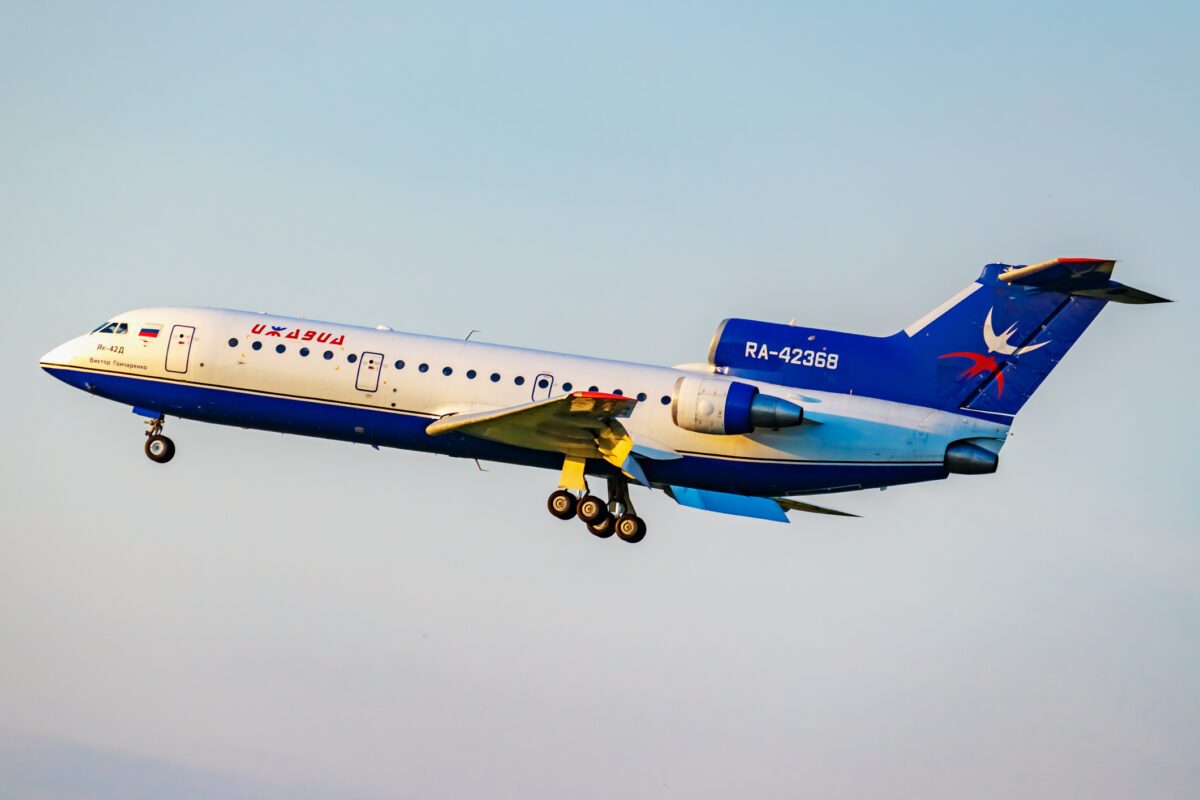
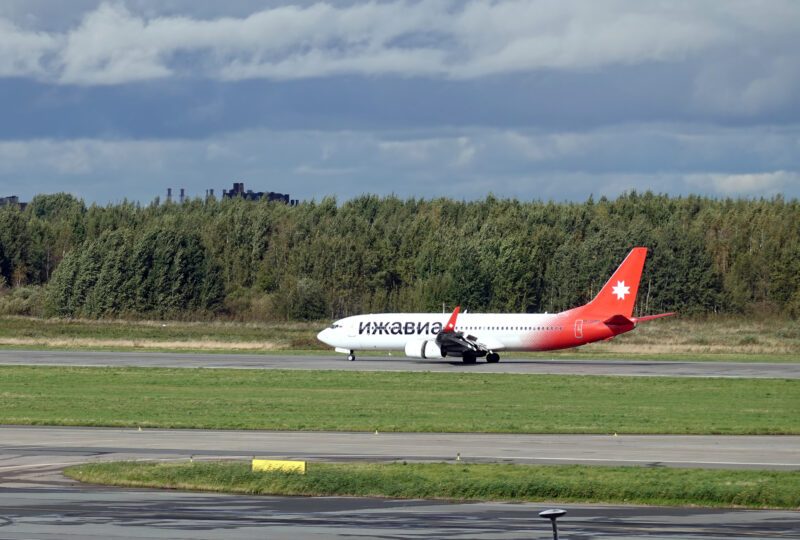
The carrier’s official aircraft page identified two aircraft types: the Boeing 737-800 and the Yakovlev Yak-42D. Russian regulatory and industry sources listed two Boeing 737-800s and four Yak-42Ds immediately before the certificate was revoked.
Izhavia configured its Boeing 737-800s with 185 passenger seats. The aircraft has a published range of approximately 3,540 miles and was used on the airline’s principal domestic routes, including service between Izhevsk Airport (IJK) and Moscow Domodedovo Airport (DME).
The Boeing 737-800 is a twin-engine narrowbody and a member of the 737 Next Generation family. Its higher speed, greater range, and better fuel efficiency made it more commercially useful than Izhavia’s aging Yak-42Ds.
The Yak-42D is a three-engine Soviet-designed narrowbody developed for regional and medium-distance flying. Izhavia’s aircraft seated 120 passengers and had a published range of approximately 1,800 miles.
Although the Yak-42 was once central to the airline’s operation, the four remaining aircraft were no longer regularly flying by the time Izhavia lost its certificate. They continued to appear in Russia’s aircraft registry, but the airline’s two Boeing 737-800s represented its primary commercially valuable fleet assets.
Aircraft Could Be Leased to Other Airlines
The Udmurt government, which owns Izhavia, has indicated that the carrier’s aircraft could be leased to other Russian operators rather than left grounded.
That would allow the Boeing 737-800s to continue operating under another airline’s certificate, provided the aircraft, maintenance records, insurance arrangements, and transfer documentation satisfy regulatory requirements.
Leasing the aircraft would not preserve Izhavia’s flight operation or airline code. The airplanes would fly under the operational control of the receiving carrier, using its crews, maintenance system, and air operator certificate.
The regional government has described the halt as a forced restructuring measure intended to address the safety findings while preserving as much of the company’s value as possible.
Before the shutdown, officials had also considered privatizing Izhavia and the airport business. The loss of the airline’s certificate makes a combined sale more complicated and could result in the airport, aircraft, and airline organization being handled separately.
Despite its aging fleet, Izhavia remained profitable. The carrier generated approximately 6.88 billion rubles in revenue during 2025 and reported net income of roughly 1.7 billion rubles. It carried approximately 674,000 passengers that year, placing it among Russia’s 20 largest airlines.
Izhavia Is Challenging the Decision in Court
Izhavia filed a claim with the Moscow Arbitration Court on July 31, one day before the certificate revocation took effect.
The airline is asking the court to invalidate Rosaviatsiya’s order and temporarily suspend its enforcement while the case is considered. Izhavia argues that it corrected the regulator’s findings and that some of the remaining issues were related to documentation rather than immediate operational safety.
The carrier also claims that updated crew-training programs cited during the review had been approved by Rosaviatsiya on July 20.
Those assertions represent Izhavia’s position and do not overturn the regulator’s findings. Unless the court grants interim relief or later rules in the airline’s favor, the certificate revocation remains effective and Izhavia cannot resume commercial flights.
Bottom Line
Rosaviatsiya’s decision to revoke Izhavia’s air operator certificate brings the regional carrier’s commercial flight operation to an immediate halt from August 1, 2026.
The action followed inspections that identified incomplete aircraft maintenance, crew and technical-staff scheduling violations, and deficiencies in the airline’s safety management system. Izhavia was given approximately three months to implement corrective measures, but regulators concluded that the most important problems remained unresolved.
Nearly 46,000 passengers holding tickets through February 1, 2027, are being transferred to Aeroflot, S7 Airlines, Red Wings, Nordwind, and other Russian carriers. Existing bookings remain valid, while passengers who cannot accept an alternative are entitled to a refund.
Izhavia’s fleet consisted of Boeing 737-800s and Yakovlev Yak-42Ds—not Sukhoi Superjet 100s. The aircraft may now be leased to other operators while the airline challenges Rosaviatsiya’s decision in court.
The legal action leaves open a narrow path for Izhavia, but unless the carrier secures a favorable ruling or obtains a new operating certificate, one of Russia’s remaining independent regional airlines has effectively reached the end of its flying operation.