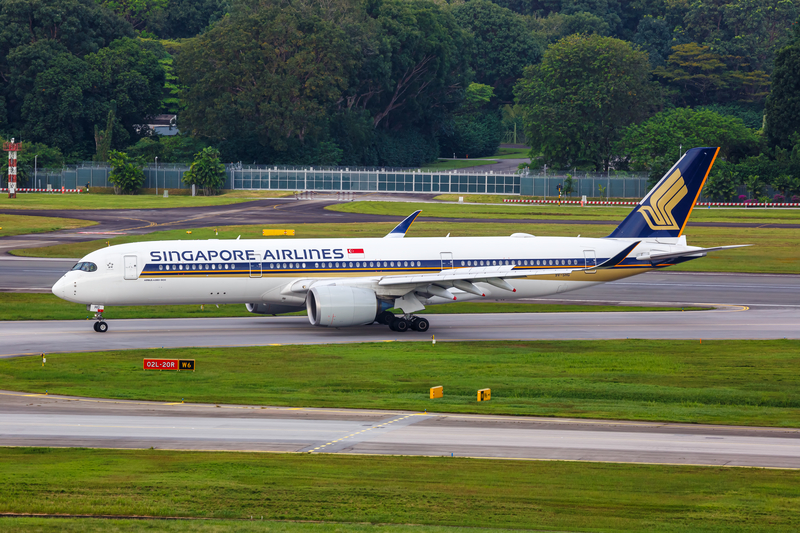
Singapore Airlines is one of Asia’s largest international carriers by both seats and available seat miles. Its position is particularly notable because the airline operates no domestic network. Every Singapore Airlines flight crosses an international border, and much of its capacity is deployed on widebody aircraft flying long sectors from Singapore Changi Airport (SIN).

According to the OAG schedule data used for this analysis, Singapore Airlines plans to serve 81 passenger destinations between August 2026 and May 2027. Its network continues to expand, with new or returning service to Madrid-Barajas Airport (MAD), King Khalid International Airport (RUH) in Riyadh, and Western Sydney International Airport (WSI).
That growth does not mean every destination attempted by Singapore Airlines has remained viable.
Read our stories in your inbox
Two aviation newsletters. Zero fluff.
A review of the carrier’s schedules from January 2006 through July 2026 identifies 16 longer-distance destinations that do not appear in its planned schedule for August 2026 through May 2027. These are not 16 simultaneous cuts. They represent two decades of network adjustments caused by weak demand, changing fleet economics, the COVID-19 pandemic, geopolitical disruption, and the transfer of certain markets to Scoot.
Several cities remain accessible through the wider Singapore Airlines Group, Star Alliance partners, or codeshare agreements. The distinction is that Singapore Airlines itself no longer operates its own aircraft to them.
Singapore Airlines Is Still Expanding Its Long-Haul Network
Before examining the discontinued destinations, it is important to place the list in context.
Singapore Airlines returned to Riyadh on June 2, 2026, with four weekly nonstop flights between Singapore Changi Airport (SIN) and King Khalid International Airport (RUH). The route uses a 303-seat Airbus A350-900 configured with 40 Business Class and 263 Economy Class seats. Riyadh is therefore already back on the carrier’s network, rather than being a future addition later in 2026. (Singapore Airlines)
Madrid-Barajas Airport (MAD) will return on October 26, 2026, through a five-times-weekly Singapore–Barcelona–Madrid operation. Singapore Airlines will use a 253-seat long-haul Airbus A350-900 with 42 Business Class seats, 24 Premium Economy seats, and 187 Economy seats. Madrid will become the airline’s second Spanish destination and its 15th in Europe. (Singapore Airlines)
Daily service to the new Western Sydney International Airport (WSI) is scheduled to begin on November 23, 2026. Those flights will also use the 303-seat regional A350-900 configuration, increasing Singapore Airlines’ total service between Singapore and the Sydney area to five daily flights when combined with its four existing departures to Sydney Kingsford Smith Airport (SYD). (Singapore Airlines)
The 16 cities below therefore illustrate how Singapore Airlines continually reallocates aircraft and capacity rather than evidence of a broad retreat from long-haul flying.
The 16 Destinations No Longer Served by Singapore Airlines
The comparison includes destinations served by Singapore Airlines between January 2006 and July 2026 that are absent from its scheduled passenger network between August 2026 and May 2027.
| Destination | Airport | Last SIA Service | Notable Routing or Aircraft |
|---|---|---|---|
| Amritsar | Sri Guru Ram Dass Jee International Airport (ATQ) | 2009 | Nonstop Boeing 777-200 service; now served by Scoot |
| Karachi | Jinnah International Airport (KHI) | 2010 | Part of Singapore–Karachi–Lahore service |
| Lahore | Allama Iqbal International Airport (LHE) | 2010 | Served after Karachi on the same triangular routing |
| Kuwait City | Kuwait International Airport (KWI) | 2011 | Boeing 777-200 via Dubai and later Abu Dhabi |
| Abu Dhabi | Zayed International Airport (AUH) | 2012 | Former Middle Eastern destination and Kuwait gateway |
| Cairo | Cairo International Airport (CAI) | 2014 | Withdrawn after prolonged weak performance |
| Athens | Athens International Airport (ATH) | 2015 | Final seasonal nonstop flights used the Boeing 777-200ER; now served by Scoot |
| Jeddah | King Abdulaziz International Airport (JED) | 2016 | Airbus A330-300 service via Dubai transferred to Scoot |
| São Paulo | São Paulo/Guarulhos International Airport (GRU) | 2016 | Boeing 777-300ER via Barcelona |
| Canberra | Canberra Airport (CBR) | 2020 | Initially linked with Wellington; later served via Sydney |
| Düsseldorf | Düsseldorf Airport (DUS) | 2020 | Nonstop Airbus A350-900 service |
| Stockholm | Stockholm Arlanda Airport (ARN) | 2020 | Airbus A350-900 service via Moscow |
| Wellington | Wellington International Airport (WLG) | 2020 | Served via Canberra and later Melbourne |
| Moscow | Moscow Domodedovo Airport (DME) | 2022 | Airbus A350-900; suspended following Russia’s invasion of Ukraine |
| Vancouver | Vancouver International Airport (YVR) | 2023 | Seasonal Airbus A350-900 operation via Seattle |
| Houston | George Bush Intercontinental Airport (IAH) | 2025 | Initially served via Moscow and later Manchester |
Three other former destinations—Davao International Airport (DVO) and Nanjing Lukou International Airport (NKG), along with several shorter regional markets—are not included because this analysis focuses on long-haul and upper-medium-haul flying.
Houston Was Singapore Airlines’ Most Recent Exit
George Bush Intercontinental Airport (IAH) was the most recent airport removed from Singapore Airlines’ long-haul network.
Singapore Airlines began serving Houston in 2008 through a Singapore Changi Airport (SIN)–Moscow Domodedovo Airport (DME)–Houston Intercontinental Airport (IAH) routing. The airline used the Boeing 777-300ER, combining Singapore–Russia demand with fifth-freedom traffic between Moscow and Houston.
The unusual routing had a clear commercial rationale. Houston was a major center for the energy industry, while Moscow generated substantial oil-and-gas-related business traffic. Singapore Airlines could carry passengers between all three markets while avoiding the payload and range challenges of operating nonstop between Singapore and Texas with the aircraft available at the time.
The Moscow–Houston sector ended in 2016. Singapore Airlines replaced it with a Manchester Airport (MAN)–Houston Intercontinental Airport (IAH) fifth-freedom flight, creating a Singapore–Manchester–Houston operation. The change coincided with the introduction of the more fuel-efficient Airbus A350-900. The new routing launched on October 30, 2016. (Singapore Airlines)
The 253-seat long-haul A350-900 was considerably better suited to the route than the larger Boeing 777-300ER. Its lower fuel consumption and smaller capacity reduced the number of seats Singapore Airlines needed to sell while still providing Business Class, Premium Economy, and Economy cabins.
Despite those advantages, Singapore Airlines ultimately decided that Houston no longer justified tying up an A350 for the additional transatlantic sector. The airline suspended Manchester–Houston on April 1, 2025, while retaining nonstop flights between Singapore Changi Airport (SIN) and Manchester Airport (MAN). (Singapore Airlines)
The withdrawal ended approximately 17 years of Singapore Airlines service to Houston, divided between two very different fifth-freedom routings.
Moscow Once Supported Two Singapore Airlines Long-Haul Routes
Moscow Domodedovo Airport (DME) played a particularly important role in Singapore Airlines’ network.
In addition to serving as the intermediate point for Houston, Moscow was later used to extend Singapore Airlines’ European network to Stockholm Arlanda Airport (ARN). The Singapore–Moscow–Stockholm route began on May 30, 2017, with the Airbus A350-900.
The routing allowed Singapore Airlines to combine multiple traffic flows:
- Passengers traveling between Singapore and Moscow
- Travelers flying between Singapore and Stockholm
- Fifth-freedom passengers between Moscow and Stockholm
- Connecting customers traveling beyond Singapore Changi Airport (SIN)
The Stockholm sector ended during the dramatic network contraction caused by the COVID-19 pandemic. Singapore Airlines’ 2020 restructuring permanently removed Stockholm Arlanda Airport (ARN), Düsseldorf Airport (DUS), Canberra Airport (CBR), and Wellington International Airport (WLG) from the passenger network.
Moscow Domodedovo Airport (DME) subsequently returned as a standalone Singapore route. That operation continued until February 28, 2022, when Singapore Airlines suspended flights following Russia’s invasion of Ukraine and the resulting operational complications. The airline cited operational reasons and has not announced plans to return.
Moscow’s removal therefore occurred in two stages: Stockholm disappeared during the pandemic, while the remaining nonstop Moscow service was suspended in 2022.
São Paulo Was Singapore Airlines’ Only South American Destination
Singapore Airlines entered South America on March 28, 2011, with three weekly flights from Singapore Changi Airport (SIN) to São Paulo/Guarulhos International Airport (GRU) through Barcelona-El Prat Airport (BCN).
The airline operated the route with the Boeing 777-300ER, which offered the range, cargo capacity, and premium cabin necessary for two long intercontinental sectors. Singapore Airlines also held fifth-freedom rights between Barcelona and São Paulo, enabling it to sell local Spain–Brazil tickets in addition to carrying passengers traveling between Asia and South America.
The route was operationally complex. A complete Singapore–Barcelona–São Paulo rotation consumed significant aircraft and crew resources, while passengers traveling between Asia and Brazil had numerous competing options through Europe, the Middle East, and Africa.
Singapore Airlines operated its final São Paulo flight on October 20, 2016. The carrier’s financial results specifically recorded the suspension of the Barcelona–São Paulo extension while Barcelona remained in the network. (Singapore Airlines)
The withdrawal left Singapore Airlines without an online destination in South America. Passengers can still travel to the continent through partner airlines, but no Singapore Airlines aircraft currently operates south of North America.
Düsseldorf and Stockholm Were Early A350 Markets
Düsseldorf Airport (DUS) joined the Singapore Airlines network in July 2016 and was one of the carrier’s early long-haul Airbus A350-900 destinations.
The aircraft opened markets that would have been more difficult to sustain with a Boeing 777-300ER or Airbus A380. Its lower seat count, improved fuel efficiency, and long range allowed Singapore Airlines to serve important secondary European business centers without deploying excessive capacity.
Düsseldorf was a logical target because of the surrounding Rhine-Ruhr region’s corporate base and large population. However, it also sat within a highly competitive European network. Singapore Airlines already served Frankfurt Airport (FRA) and Munich Airport (MUC), while Lufthansa and other Star Alliance partners provided extensive connecting service within Germany.
Stockholm Arlanda Airport (ARN) presented a similar challenge. The market had strong corporate and premium potential but was not large enough to support the same nonstop capacity as London Heathrow Airport (LHR), Frankfurt Airport (FRA), Paris-Charles de Gaulle Airport (CDG), or Zurich Airport (ZRH). Routing the flight through Moscow allowed Singapore Airlines to combine several thinner demand flows on one aircraft.
Both destinations disappeared in 2020 as Singapore Airlines reduced its network and retired older aircraft during the pandemic. Neither has returned to the airline’s own schedule.
Canberra and Wellington Formed the “Capital Express”
Canberra Airport (CBR) and Wellington International Airport (WLG) were among the most unusual destinations in Singapore Airlines’ recent network history.
In September 2016, the airline launched the “Capital Express,” operating four weekly flights from Singapore Changi Airport (SIN) to Canberra Airport (CBR) and onward to Wellington International Airport (WLG).
The service was historically significant for both cities. It gave Canberra its first regular scheduled international airline connection beyond nearby regional markets and created a nonstop link between the Australian and New Zealand capitals.
Singapore Airlines initially used a 266-seat Boeing 777-200 configured with 38 Business Class and 228 Economy Class seats. (Singapore Airlines)
The original triangular operation did not last.
In 2018, Singapore Airlines separated Canberra and Wellington into different routings. Canberra became part of a daily Singapore–Sydney–Canberra service using a 264-seat Boeing 777-300ER. Wellington was linked to Singapore through Melbourne Airport (MEL), initially with a Boeing 777-200. (Singapore Airlines)
The Sydney tag gave Canberra greater frequency, while the Melbourne routing connected Wellington to a larger Australian traffic pool. Nevertheless, both services remained dependent on fifth-freedom passengers and complex multi-sector aircraft scheduling.
The pandemic accelerated their disappearance. Singapore Airlines permanently closed both destinations in September 2020.
Canberra Airport (CBR) has since attracted other long-haul operators, but Wellington International Airport (WLG) remains constrained by its runway, surrounding terrain, and relatively small long-distance market.
Vancouver Lasted Less Than Two Years After Its Return
Singapore Airlines returned to Vancouver International Airport (YVR) in December 2021 through a seasonal Singapore–Seattle–Vancouver service.
The operation used an Airbus A350-900 and allowed Singapore Airlines to combine demand for Seattle-Tacoma International Airport (SEA) with traffic to western Canada. It also gave the carrier fifth-freedom rights between Seattle and Vancouver.
The route was introduced while pandemic-related border restrictions were still affecting international aviation. Its continuation depended on demand recovering strongly enough to support the additional Seattle–Vancouver sector.
Singapore Airlines suspended Vancouver service in October 2023 as it adjusted capacity in response to changing demand. Seattle remained in the network as a nonstop destination from Singapore Changi Airport (SIN).
The decision followed a familiar pattern: Singapore Airlines retained the stronger endpoint while eliminating a tag sector that added complexity and aircraft time.
Three Middle Eastern Markets Disappeared Within Five Years
Kuwait International Airport (KWI), Zayed International Airport (AUH) in Abu Dhabi, and Cairo International Airport (CAI) all left the Singapore Airlines network between 2011 and 2014.
Kuwait service began in March 2009 with Boeing 777-200 aircraft. The route initially operated through Dubai International Airport (DXB) and was later linked with Abu Dhabi. By 2011, Kuwait was served three times weekly as an extension of one of Singapore Airlines’ daily Abu Dhabi flights. The final service operated in October 2011.
Abu Dhabi lasted another year. Singapore Airlines suspended its year-round service in October 2012, citing sustained weak performance. Athens’ regular year-round operation was withdrawn at the same time.
Cairo service ended on September 30, 2014. Singapore Airlines again attributed the withdrawal to continued weak commercial performance. Riyadh service was also suspended during the same period, although the Saudi capital returned to the network in June 2026.
The withdrawals reflected the increasing strength of Gulf hub carriers. Emirates, Etihad Airways, and Qatar Airways could distribute passengers across the Middle East through Dubai International Airport (DXB), Abu Dhabi’s airport, and Hamad International Airport (DOH), often with far greater frequencies than Singapore Airlines could justify from Changi.
Athens, Jeddah, and Amritsar Shifted to Scoot
Not every Singapore Airlines withdrawal represents a loss for the wider airline group.
Athens International Airport (ATH), King Abdulaziz International Airport (JED), and Sri Guru Ram Dass Jee International Airport (ATQ) in Amritsar are now served by Scoot, Singapore Airlines’ low-cost subsidiary.
Singapore Airlines’ year-round Athens operation ended in 2012, but the airline returned with limited seasonal flights. Its final 2015 program operated twice weekly from June through October using the Boeing 777-200ER.
Scoot later entered the Athens market with the Boeing 787 Dreamliner. Its lower-cost structure and denser seating make it better suited to a price-sensitive leisure market where Singapore Airlines’ full-service cabin and cost base may be difficult to support.
Jeddah followed a more direct transfer. Singapore Airlines had operated three weekly flights through Dubai International Airport (DXB) with a 285-seat Airbus A330-300. Scoot assumed the route in May 2016, allowing the group to retain access to religious, leisure, and visiting-friends-and-relatives demand while reducing unit costs.
Amritsar was removed from the Singapore Airlines network in February 2009. The airline had served the Indian city with Boeing 777-200 aircraft, but Scoot eventually restored group service in 2016 using the Boeing 787-9.
These transfers demonstrate the strategic value of operating two airline brands. Singapore Airlines can focus on premium-heavy markets, while Scoot serves destinations where traffic is substantial but more sensitive to price.
Pakistan Service Ended as One Triangular Route
Karachi and Lahore were served through a Singapore–Karachi–Lahore routing.
Singapore Airlines announced the suspension after continued weak demand, operating the final service on February 17, 2010. Both Jinnah International Airport (KHI) and Allama Iqbal International Airport (LHE) therefore disappeared from the network together.
The routing illustrates a strategy Singapore Airlines used frequently during that period. Rather than operate separate nonstop flights to two smaller markets, it combined them in a single rotation. The first city generated additional passengers for the second sector, while the aircraft served two destinations during one trip away from Singapore.
Such routes can work when local traffic rights, schedules, and demand align. They also create operational disadvantages. Passengers traveling to the second destination face a longer journey, delays can propagate across three airports, and the airline must sell enough seats across several distinct markets to support the full rotation.
Singapore Airlines has not returned to either Pakistani city.
Why Fifth-Freedom Routes Have Gradually Disappeared
Many of the destinations on the list were served through intermediate cities rather than nonstop from Singapore Changi Airport (SIN).
Houston was linked through Moscow and Manchester. São Paulo was served through Barcelona. Stockholm operated through Moscow. Wellington was paired with Canberra and later Melbourne. Canberra was subsequently served through Sydney. Kuwait was reached through Dubai and Abu Dhabi, while Jeddah operated through Dubai.
These fifth-freedom sectors allowed Singapore Airlines to serve destinations beyond the nonstop capabilities or commercial reach of its Singapore hub. They also enabled the airline to sell local tickets between two foreign countries.
The model has become less attractive as aircraft technology and competitive conditions have changed.
The Airbus A350-900 and A350-900ULR now permit Singapore Airlines to operate exceptionally long nonstop flights from Singapore Changi Airport (SIN), including service to New York John F. Kennedy International Airport (JFK), Newark Liberty International Airport (EWR), Los Angeles International Airport (LAX), San Francisco International Airport (SFO), and Seattle-Tacoma International Airport (SEA).
At the same time, fifth-freedom sectors add cost and complexity. They require additional traffic rights, local sales, ground handling, airport slots, and crew planning. Passengers traveling end to end also spend more time on the ground and face another opportunity for disruption.
A tag flight remains valuable when it generates sufficient local traffic or gives the airline access to a market that cannot support nonstop service. When the intermediate sector underperforms, Singapore Airlines increasingly retains the stronger destination and removes the extension—as it did with Houston, Vancouver, Stockholm, and São Paulo.
The Boeing 777-200’s Retirement Changed the Network
Aircraft availability has also shaped the destinations Singapore Airlines can economically serve.
Many of the discontinued routes were developed around the Boeing 777-200 or 777-200ER. These aircraft once provided a useful middle ground between short-haul airplanes and larger Boeing 777-300ERs or Airbus A380s.
Singapore Airlines used the 777-200 family on routes including Amritsar, Athens, Canberra, Wellington, and Kuwait. The aircraft could serve medium- and long-haul destinations without introducing as much capacity as the 777-300ER.
The 777-200 fleet has since been retired. Singapore Airlines now relies on the Airbus A350-900 for much of its long-haul flying, while inherited Boeing 737-8s and 737-800s operate many former SilkAir routes.
The A350 is more fuel-efficient and capable than the older 777-200, but aircraft economics alone cannot make a marginal destination profitable. Singapore Airlines still must determine whether each market can support its premium product, cargo demand, schedule requirements, and network contribution.
Scoot’s Boeing 787 fleet offers another option for markets with adequate passenger volume but lower average fares.
What the 16 Exits Reveal About Singapore Airlines
The list is notable not because Singapore Airlines has withdrawn from 16 destinations, but because of the different reasons behind those decisions.
Amritsar, Athens, and Jeddah migrated to Scoot. Düsseldorf, Stockholm, Canberra, and Wellington were casualties of the pandemic-era restructuring. Moscow disappeared because of geopolitical and operational conditions. Houston, Vancouver, and São Paulo involved complex fifth-freedom routings that no longer justified their aircraft commitments.
Other cities, including Kuwait, Abu Dhabi, Cairo, Karachi, and Lahore, were removed after demand failed to support continued service.
The pattern reflects a highly disciplined network strategy. Singapore Airlines operates from a geographically constrained home market and cannot rely on domestic passengers to fill its aircraft. Every long-haul route must attract local Singapore traffic, connecting passengers, premium demand, cargo, or some combination of those sources.
A destination can be strategically interesting and still fail to produce enough revenue to justify the aircraft time required.
Bottom Line
Singapore Airlines has removed 16 long-haul or upper-medium-haul destinations from its own network since 2006, but it did not eliminate them in one round of cuts.
The list includes Amritsar (ATQ), Karachi (KHI), Lahore (LHE), Kuwait City (KWI), Abu Dhabi (AUH), Cairo (CAI), Athens (ATH), Jeddah (JED), São Paulo (GRU), Canberra (CBR), Düsseldorf (DUS), Stockholm (ARN), Wellington (WLG), Moscow (DME), Vancouver (YVR), and Houston (IAH).
Some routes failed because of weak demand. Others were reallocated to Scoot, eliminated during the COVID-19 pandemic, disrupted by geopolitical events, or rendered less attractive by the declining economics of multi-stop fifth-freedom operations.
The broader network remains in expansion mode. Riyadh returned on June 2, 2026, Madrid will follow on October 26, and Western Sydney is scheduled to join on November 23.
Singapore Airlines’ history shows that network strength is not measured solely by the number of pins on a route map. It is determined by whether each destination can support the aircraft, premium cabins, frequencies, connecting flows, and operating costs required to serve it over the long term.