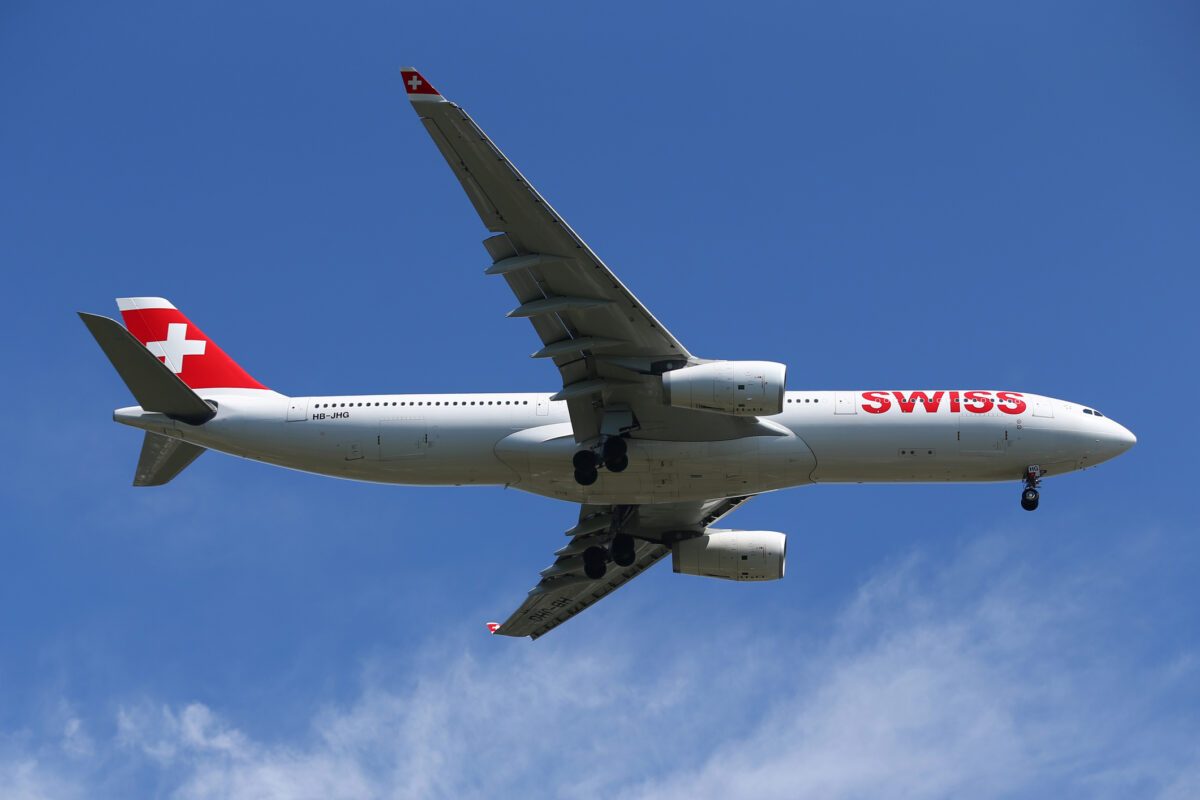
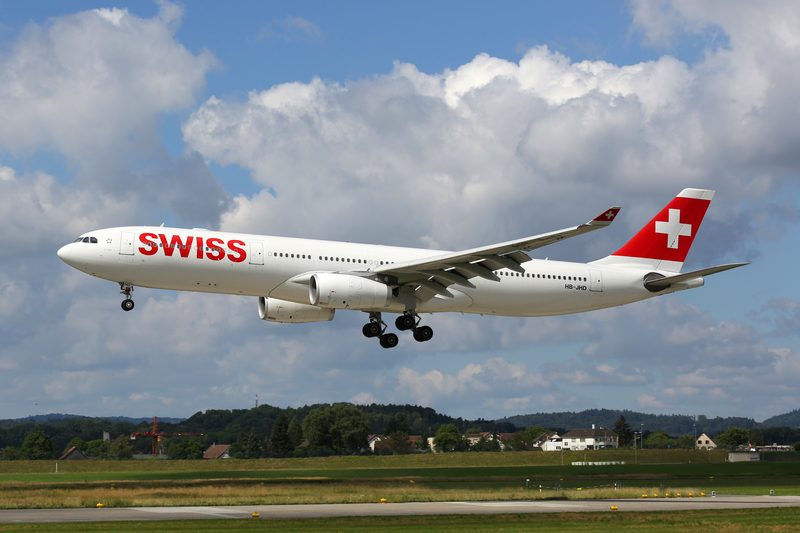
A SWISS Airbus A330-300 operating from Zurich Airport (ZRH) to New York John F. Kennedy International Airport (JFK) diverted to Bangor International Airport (BGR) on July 27, 2026, after unexplained smoke appeared in the forward section of the business-class cabin.

Flight LX16 landed safely at Bangor International Airport (BGR), where airport firefighters inspected the aircraft and found no evidence of an active fire or excessive heat. SWISS said all 208 people aboard, including passengers and crew, were unharmed. The cause of the smoke had not been determined immediately after the incident. Local reporting from Maine confirmed that both SWISS and the Federal Aviation Administration are investigating.
SWISS Flight LX16
Read our stories in your inbox
Two aviation newsletters. Zero fluff.
LX16 Declares an Emergency Near North America
Flight LX16 departed Zurich Airport (ZRH) at approximately 10:26 a.m. local time, 26 minutes behind its scheduled departure, for the daily transatlantic service to New York JFK Airport (JFK).
As the Airbus A330-300 approached northeastern North America, the crew selected transponder code 7700 and requested a diversion to Bangor International Airport (BGR). The aircraft landed on Runway 33 at approximately 12:14 p.m. local time. Based on the departure and arrival times, the aircraft had been traveling for about seven hours and 48 minutes when it reached Bangor.

The original account’s assertion that the aircraft landed six hours after leaving Zurich Airport (ZRH) does not align with available tracking data. Flight LX16 left Zurich at 8:26 a.m. UTC and arrived in Bangor at approximately 4:14 p.m. UTC.
Code 7700 is the international transponder setting used to signal a general emergency. It immediately highlights the aircraft to air traffic controllers but does not identify the nature of the problem. The FAA’s Aeronautical Information Manual notes that the code triggers an emergency indication at air traffic control positions.
SWISS and the FAA Provided Different Initial Descriptions
SWISS said the diversion followed the appearance of smoke in the forward part of the business-class cabin. The airline has not identified what produced the smoke and said it would not speculate before completing a detailed technical inspection.
The FAA’s initial account was somewhat different. An agency spokesperson said the flight crew had preliminarily reported a cockpit fire, while emphasizing that the information remained subject to change. No visible fire or abnormal heat was found when emergency personnel examined the aircraft after landing.
That distinction matters. Smoke observed in the business-class cabin does not necessarily indicate a fire in the passenger compartment. It can originate from electrical equipment, an in-flight entertainment component, a galley appliance, an air-conditioning system, a faulty battery or another source elsewhere in the aircraft.
Similarly, an initial report transmitted to air traffic control may use urgent terminology based on the information available to the pilots at that moment. It should not be treated as a confirmed diagnosis of the problem.
Until investigators inspect the aircraft and identify the source, the event is best described as an emergency diversion following unexplained smoke in the forward business-class area rather than a confirmed cockpit or cabin fire.
Runway Temporarily Closed After the Landing
Emergency vehicles were positioned for the Airbus A330-300’s arrival at Bangor International Airport (BGR). The airport temporarily closed its primary runway around the landing, allowing rescue crews to inspect the aircraft without other traffic operating nearby.

The runway reopened at approximately 12:30 p.m. after the aircraft had landed safely and emergency personnel determined there were no signs of fire or excessive heat. SWISS said the landing itself was completed without further incident.
Closing a runway during an aircraft emergency does not necessarily indicate that the airplane sustained damage. Airports frequently suspend runway operations to give aircraft rescue and firefighting teams unrestricted access and to keep other airplanes clear until the situation is understood.
Why Bangor Was a Logical Diversion Airport
Bangor International Airport (BGR) regularly serves as a practical diversion point for aircraft arriving in North America from Europe.
Its location in Maine places it close to many North Atlantic routes, while its infrastructure can accommodate widebody aircraft. According to FAA airport data, Bangor’s Runway 15/33 measures 11,440 feet long and 200 feet wide, providing ample landing distance for an Airbus A330-300.
Bangor International Airport (BGR) also has 24-hour operations, air traffic control services, aircraft rescue and firefighting capabilities, international passenger-processing facilities and maintenance support. Those resources are particularly valuable when an airline must divert a large international flight on short notice.
Continuing toward New York JFK Airport (JFK) would have required the aircraft to remain airborne considerably longer. Once smoke is detected and its origin cannot be immediately established, landing at the nearest suitable airport is generally the most conservative option.
The Aircraft Involved Was HB-JHK
The aircraft operating Flight LX16 was HB-JHK, an Airbus A330-343 with manufacturer serial number 1276.
HB-JHK made its first flight on December 5, 2011, and was delivered to SWISS on January 11, 2012. The aircraft was therefore approximately 14 years old at the time of the diversion. It is powered by two Rolls-Royce Trent 772B-60 turbofan engines.
The “A330-343” designation provides additional information about the aircraft. The final digit identifies the engine installation, with the “3” corresponding to a Rolls-Royce-powered A330-300.
SWISS publishes a standard capacity of 236 passengers for its Airbus A330-300 fleet. The cabin contains eight first-class seats, 45 business-class seats and 183 economy seats. The aircraft has a maximum takeoff weight of 235 metric tons and a published fully loaded range of approximately 8,400 kilometers, or 5,220 miles. SWISS’s technical specifications also list a length of 208 feet and 10 inches and a wingspan of approximately 197 feet and 10 inches.
The A330-300 is a twin-engine, twin-aisle widebody designed for medium- and long-haul flying. Its range and passenger capacity make it a common choice for transatlantic routes such as Zurich Airport (ZRH)–New York JFK Airport (JFK).
The Rolls-Royce Trent 700 engine family was developed specifically for the Airbus A330 and has accumulated more than 60 million operating hours. Rolls-Royce lists a maximum in-service thrust rating of approximately 72,000 pounds for the engine family.
A Replacement A330 Continued to New York
SWISS initially said it was working with Bangor International Airport (BGR) to arrange onward transportation for the disrupted passengers.
Flight-tracking data later showed another SWISS Airbus A330-300, registered HB-JHD, operating a 58-minute flight from Bangor International Airport (BGR) to New York JFK Airport (JFK) later on July 27. The unusual Bangor-to-New York operation is consistent with a recovery aircraft being sent to complete the passengers’ journey.
The original aircraft, HB-JHK, remained at Bangor International Airport (BGR) for technical inspections. Its scheduled return operation from New York JFK Airport (JFK) to Zurich Airport (ZRH), Flight LX17, was canceled following the diversion.
Sending a replacement widebody aircraft allowed SWISS to move the passengers to New York while keeping the affected A330-300 on the ground for a more comprehensive examination.
Bottom Line
SWISS Flight LX16 diverted to Bangor International Airport (BGR) on July 27, 2026, after smoke appeared in the forward section of the business-class cabin during a flight from Zurich Airport (ZRH) to New York JFK Airport (JFK).
The Airbus A330-300, registered HB-JHK, declared an emergency and landed safely at approximately 12:14 p.m. local time. All 208 passengers and crew were unharmed, while firefighters found no signs of an active fire or excessive heat.
SWISS described the event as unexplained smoke in business class, while the FAA’s preliminary information referenced a reported cockpit fire. The discrepancy will need to be resolved through the technical investigation, and neither explanation should be treated as the confirmed cause at this stage.
The crew’s decision to divert to Bangor International Airport (BGR) placed the aircraft at a capable airport with an 11,440-foot runway and appropriate emergency services. A second SWISS Airbus A330-300 later continued from Bangor to New York JFK Airport (JFK), while HB-JHK remained behind for inspection.