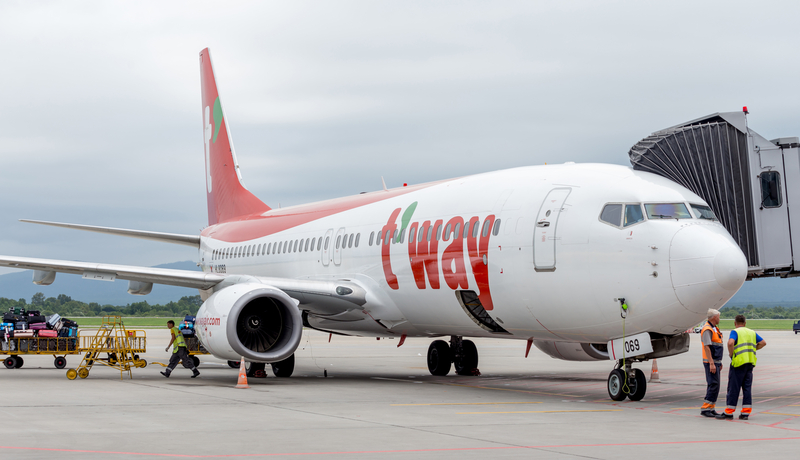
T’way Air has taken a significant corporate step by approving its rebrand to Trinity Airways, a move that points to a broader repositioning of the South Korean carrier beyond its traditional low-cost identity.

That said, the timing matters. The name change has been approved internally, but the airline is not yet operating as Trinity Airways in a regulatory sense. Until the necessary domestic and international approvals are completed, the carrier will continue flying as T’way Air. For passengers, that means the immediate operating reality does not change: bookings remain valid, flight numbers remain the same, and airport check-in should still be handled at T’way Air counters.
This is an important distinction because airline rebrands often sound more immediate than they actually are. In this case, the brand direction is clear, but the operational transition is still pending.
Read our stories in your inbox
Two aviation newsletters. Zero fluff.
Trinity Airways Is Meant to Mark a Broader Strategic Reset
T’way has framed the new name around a more global identity, emphasizing comfort and reliability rather than only price. That language is telling.
For years, T’way Air was understood primarily as a South Korean low-cost carrier with a strong short-haul and regional profile. But that description has become less complete as the airline has expanded into longer-haul flying and more internationally visible markets. A name like Trinity Airways is designed to sound broader, more international, and less tied to the narrow expectations that often come with the low-cost label.
In that sense, this is not just a cosmetic rebrand. It is an attempt to reposition how the market reads the airline.
The Fleet Helps Explain Why the Airline Wants a New Identity
The fleet mix is a major part of the story. T’way Air is no longer built only around short-haul narrowbody flying. It still relies heavily on Boeing 737-family aircraft for much of its regional operation, but it has also added widebody Airbus A330 aircraft and Boeing 777-300ERs to support longer sectors and a more ambitious network.
That matters because aircraft shape brand perception. A low-cost carrier built around Boeing 737-800s and Boeing 737 MAX 8s tends to be read one way. A carrier operating Airbus A330-300s with a lie-flat Business Saver product and Boeing 777-300ERs on long-haul sectors is read another way.
T’way’s Airbus A330-300 is especially relevant here. The airline describes it as a medium- to long-haul widebody and lists it in a 347-seat layout. That gives the carrier far more capacity and range than a standard short-haul low-cost platform, while also allowing it to present a more substantial onboard proposition on longer routes.
The Rebrand Fits the Airline’s Network Evolution
The strategic logic becomes clearer when the network is considered alongside the fleet.
T’way has been pushing beyond its traditional intra-Asia footprint and into longer-haul markets from Seoul Incheon Airport (ICN), including Europe and North America. That expansion changes the role of the airline. A carrier serving leisure-heavy short-haul sectors is marketed one way. A carrier flying ICN to major long-haul markets such as Paris Charles de Gaulle Airport (CDG), Rome Fiumicino Airport (FCO), Barcelona El Prat Airport (BCN), Frankfurt Airport (FRA), and Vancouver International Airport (YVR) needs a name and identity that can travel more comfortably across different customer segments.
That is why the Trinity Airways branding matters. It appears designed to support a wider international proposition at a time when the airline is trying to look more credible in long-haul markets, not just more visible in short-haul ones.
Passengers Will See Continuity First, Change Later
From a customer standpoint, the airline is understandably trying to remove friction from the transition.
Existing bookings remain valid. There is no need for passengers to reissue tickets or take corrective action. The carrier has also said that the airline code, flight numbers, and website use will remain unchanged during the approval phase. Until the brand is formally launched, travelers should continue to use T’way Air facilities at the airport.
That is the right operational approach. Airline rebrands can create confusion quickly if booking systems, airport signage, and customer communication move out of sync. T’way appears keen to avoid that by separating brand approval from brand activation.
For airport operators and ground handlers, that matters as well. A phased transition is usually cleaner, especially for an airline that serves multiple international jurisdictions where regulatory sign-off does not arrive all at once.
The Real Question Is What Trinity Airways Will Mean in Practice
The more interesting issue is what happens after the approvals are complete.
If the Trinity Airways name is simply attached to the same product, the rebrand will have limited long-term value. But if it is paired with stronger service consistency, a clearer long-haul identity, better integration between short-haul and widebody operations, and a more coherent premium narrative, then the move starts to look more substantial.
That is where airline professionals will be paying attention. A rebrand is easy to announce. It is harder to turn it into a commercially meaningful shift in positioning.
T’way’s challenge will be to prove that Trinity Airways is not just a new paint scheme and a new wordmark, but a more mature airline proposition built around a broader fleet, wider network, and more internationally legible brand.
Bottom Line
T’way Air’s transition to Trinity Airways is not yet operationally complete, but it is strategically significant.
The airline has secured shareholder approval for the new name, while making clear that the existing T’way structure will remain in place until domestic and international approvals are finalized. For passengers, the short-term message is stability: bookings, flight numbers, and airport processes remain unchanged. For the industry, the longer-term message is repositioning.
This looks less like a routine rename and more like an effort to align the airline’s public identity with what it is becoming: a broader international carrier built not only on Boeing 737-family short-haul flying, but also on Airbus A330 and Boeing 777 long-haul operations from Seoul Incheon Airport (ICN) into larger global markets.
Keep reading FlyMag
Get the Daily Brief in the morning or the Route Watch weekly recap on Fridays. Or both.