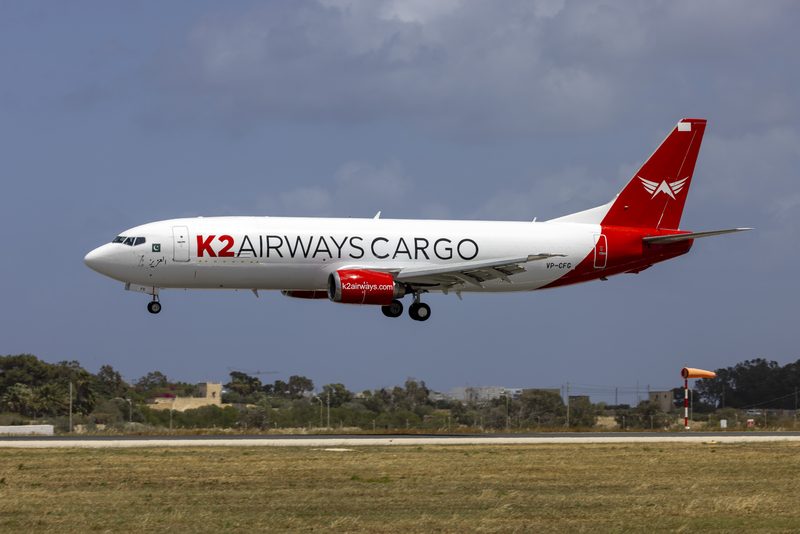
A K2 Airways Boeing 737-400 freighter is missing over the Arabian Sea after reporting a navigation-system problem while operating from the United Arab Emirates to Pakistan on July 7, 2026.
The aircraft, registered AP-BOI, was operating as K2 Airways Cargo flight KTA1732 from Sharjah International Airport (SHJ) to Jinnah International Airport Karachi (KHI) with five crew members on board. According to Pakistan aviation authorities, the crew reported a navigation-system issue at 21:18 local time while en route over the Arabian Sea. Karachi Area Control Centre began providing guidance, but roughly three minutes later the aircraft was observed on radar rapidly descending and making sharp heading changes before contact was lost about 155 nautical miles west of Karachi.
A search and rescue operation was launched at sea after the aircraft failed to arrive in Karachi. As of the latest official reports, the aircraft remained missing, and investigators had not determined the cause of the accident sequence.
Read our stories in your inbox
Two aviation newsletters. Zero fluff.
A Cargo Positioning Flight Ends in a Search Operation
The flight was operating from Sharjah (SHJ) to Karachi (KHI), reportedly after maintenance work had been completed in the UAE. The route itself is not unusual for a Pakistani cargo operator. Sharjah is an important maintenance, cargo and charter base in the Gulf, while Karachi is K2 Airways’ home city and Pakistan’s principal commercial aviation gateway.
What made KTA1732 unusual was the speed of the final sequence. According to reporting based on the Pakistan Airports Authority, the crew first advised air traffic control of a navigation-system problem at 21:18 Pakistan Standard Time. At that stage, the aircraft was still in controlled flight and receiving assistance from Karachi ATC.
By 21:21, the situation had changed dramatically. Radar showed the aircraft descending rapidly with heading changes before radio and radar contact were lost over the Arabian Sea. The reported last known position was around 155 nautical miles west of Karachi, placing the search area offshore rather than near the airport environment.
That timeline gives investigators a narrow but important window: the period between the navigation report and the sudden loss of altitude.
Flight-Tracking Data Shows a Severe Final Descent
Flightradar24 reported that preliminary ADS-B data showed a loss of altitude, followed by a climb, and then a second, sudden and dramatic descent. The final received ADS-B point placed the aircraft at about 1,100 feet above mean sea level with a reported vertical rate of -22,400 feet per minute.
That number should be treated carefully. ADS-B and multilateration data can be degraded, incomplete or affected by coverage limitations, especially over water. It is useful for understanding the broad profile of the final moments, but it is not a substitute for the flight data recorder, cockpit voice recorder, radar data, ATC recordings, maintenance records and wreckage examination.
Still, the available data points to a very serious in-flight upset or loss-of-control-type event. A reported navigation issue alone would not normally explain a rapid descent from cruise altitude into the sea. That does not mean the navigation issue was unrelated. It means the cause cannot be established from early reports.
At this stage, the most accurate wording is that the aircraft is missing and presumed to have crashed into the Arabian Sea. Anything more specific about cause would be premature.
The Aircraft: Boeing 737-4M0(BDSF) AP-BOI
The aircraft involved, AP-BOI, was a Boeing 737-4M0(BDSF), a converted 737-400 freighter. The 737-400 is part of the Boeing 737 Classic family, powered by CFM56 engines and widely used for short- and medium-haul passenger service before many airframes were later converted for cargo operations.
The “BDSF” designation refers to a passenger-to-freighter conversion. In practical terms, that means the aircraft’s passenger cabin was modified into a main-deck cargo compartment, with a large cargo door, reinforced floor structure, cargo loading system, smoke detection and other freighter-specific systems installed.
AP-BOI had a long history before joining K2 Airways. Flight-tracking and aircraft-history sources report that the aircraft first entered service as a passenger jet with Aeroflot in 1999, later flew with Garuda Indonesia, was converted to a freighter in 2012, and subsequently operated with TNT Airways and ASL Airlines before entering service with K2 Airways in 2024.
For K2 Airways, AP-BOI was a significant aircraft. The airline’s own company material describes the arrival of its first Boeing 737-400SF in Karachi in July 2024 as a major step in building cargo capacity for domestic and international operations.
Why the 737-400 Freighter Still Matters
The 737-400 freighter is an older aircraft, but it remains useful in regional cargo networks. Converted 737-400Fs typically offer around 20 tonnes of payload capability, depending on configuration, aircraft weight limits and operating conditions. That makes the type well suited for express freight, e-commerce, mail, perishables, pharmaceuticals and regional cargo routes where a widebody would be too large and too expensive.
For a carrier such as K2 Airways, the 737-400F offers a practical entry point into scheduled and charter cargo operations. It can serve medium-range sectors across Pakistan, the Gulf, Central Asia and nearby cargo markets without the trip costs of a larger freighter.
But the age of the type also makes maintenance history, component reliability and conversion quality especially important. Older freighters can operate safely for many years, but their continued airworthiness depends on disciplined maintenance, structural inspections, engine condition, avionics reliability and compliance with all applicable airworthiness directives.
That does not imply a maintenance-related cause in this accident. It simply explains why investigators will likely review the aircraft’s maintenance work in Sharjah, recent defects, navigation equipment, flight controls, engine parameters and any post-maintenance release documentation as part of the broader investigation.
Navigation Problems Do Not Equal Cause
The reported navigation-system issue will naturally draw attention, but it should not be treated as the cause of the crash.
Modern transport aircraft have multiple navigation sources and layers of redundancy, including inertial systems, radio navigation, flight management systems and satellite-based inputs where available. If one navigation source becomes unreliable, crews can often cross-check with other systems and receive radar vectors from ATC, as appears to have happened in this case.
Flightradar24 also noted that aircraft in the region experienced GNSS interference shortly after departure from Sharjah, causing degraded data near the UAE before tracking improved after the aircraft exited the affected area. GNSS interference can affect navigation inputs and flight-tracking quality, but it does not automatically mean an aircraft is unsafe or uncontrollable.
That distinction is important. A navigation warning, GNSS interference, degraded ADS-B data and an actual aircraft upset are related only if evidence shows a link. Investigators will need to determine what the crew saw in the cockpit, what systems were affected, what guidance ATC provided, and what happened in the final three minutes.
Until the recorders and wreckage are recovered, the navigation report is a key fact, not a conclusion.
Search and Rescue Moves Offshore
After contact was lost, Pakistan’s Rescue Coordination Centre was activated and a coordinated search was launched at sea. The Associated Press reported that Pakistan’s Navy, Air Force and National Shipping Corporation assets were involved, including naval and aerial search resources.
Offshore aircraft accident searches are difficult, especially when the final position is based on radar and ADS-B data rather than a confirmed wreckage location. Search teams must account for drift, currents, sea state, visibility, night conditions and the last reliable radar position.
Recovery of the flight recorders would be central to understanding the accident. The cockpit voice recorder could reveal crew communications, warnings, alarms and workload. The flight data recorder could show flight-control inputs, altitude, attitude, speed, engine performance, navigation status and system failures.
Because the aircraft is believed to have gone down over water, recorder recovery may depend on locating wreckage and detecting underwater locator beacon signals. The depth and seabed conditions in the search area will determine how difficult that becomes.
A Young Cargo Airline Faces Its Most Serious Event
K2 Airways is a relatively new Pakistani cargo carrier based in Karachi. The company says it was established in May 2018 under an airline charter license issued by the Government of Pakistan, with a focus on cargo services such as perishables, pharmaceuticals, mail, charter freight and general cargo.
The loss of contact with AP-BOI is therefore a major event for the airline. For a small cargo operator, one aircraft can represent a large share of operational capacity, technical investment and commercial capability. The effect is not only human and operational, but also strategic.
For Pakistan’s aviation sector, the accident also comes under intense scrutiny because it involves a domestic operator, a Pakistani-registered aircraft, a Gulf-Pakistan cargo route and search operations close to Karachi’s flight information region.
The investigation will likely involve Pakistan’s aviation accident investigation authorities, the aircraft operator, air traffic control, maintenance organizations, and potentially foreign authorities connected to the aircraft’s design, engines, conversion history or recent maintenance.
What Investigators Will Likely Examine
The early facts point to several areas investigators will need to study, but none should be read as a conclusion.
They will likely examine the reported navigation-system issue, possible GNSS interference, ATC radar data, crew communications, maintenance work performed in Sharjah, aircraft release records, flight-control and autopilot behavior, engine data, weather, cargo loading, weight and balance, and the aircraft’s final trajectory.
The aircraft’s freighter conversion history may also be reviewed. Converted freighters undergo major structural and systems modifications, and investigators routinely examine whether all relevant systems, inspections and documentation were in order.
The final descent profile will be especially important. A rapid descent with heading changes can result from several very different scenarios, including loss of control, structural failure, severe flight-control anomaly, spatial disorientation, unreliable instrumentation, or other emergency conditions. At this stage, there is no public evidence sufficient to identify which, if any, applies.
That uncertainty should be reflected in the reporting. The known facts are serious enough without adding speculation.
Bottom Line
K2 Airways flight KTA1732, a Boeing 737-4M0(BDSF) registered AP-BOI, disappeared over the Arabian Sea while operating from Sharjah (SHJ) to Karachi (KHI) with five crew members on board. The crew reported a navigation-system issue at 21:18 local time, received assistance from Karachi ATC, and then disappeared from radar about three minutes later after a rapid descent and heading changes roughly 155 nautical miles west of Karachi.
The aircraft is missing and presumed to have crashed, but the cause remains unknown. The navigation report is an important part of the timeline, not a final explanation.
For airline professionals, this accident will raise difficult questions about navigation reliability, post-maintenance operations, flight-tracking data, search and rescue response, and the continued use of older converted narrowbody freighters in regional cargo networks. For now, the priority is the search for the aircraft and crew, followed by the recovery of evidence needed to understand what happened in the final minutes of KTA1732.