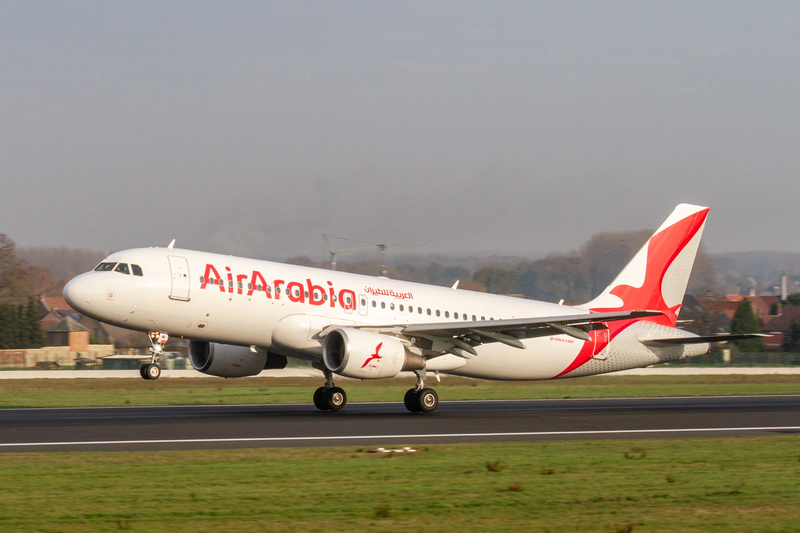
Air Arabia has opened one of its most important European routes yet, launching nonstop service between Sharjah International Airport (SHJ) and London Gatwick Airport (LGW) while also restoring daily flights from Sharjah (SHJ) to Aleppo International Airport (ALP).
The dual expansion gives the Sharjah-based low-cost carrier a new foothold in the United Kingdom and a stronger position in the recovering UAE-Syria market. It also shows how Air Arabia is using its longer-range Airbus narrowbody fleet to stretch the traditional boundaries of low-cost flying from the Gulf.
The new Sharjah (SHJ)-London Gatwick (LGW) route is being operated with the Airbus A321LR, the long-range version of the A321neo. For Air Arabia, the aircraft is the key enabler. It gives the airline enough range to connect the UAE and the UK nonstop while keeping the economics of a single-aisle aircraft.
Read our stories in your inbox
Two aviation newsletters. Zero fluff.
Gatwick Gives Air Arabia Its First Direct UK Link
The new London Gatwick (LGW) route marks Air Arabia’s entry into the UK market with direct scheduled service. London Gatwick previously described the service as the only direct link between the UK and Sharjah, an important distinction in a market already crowded with flights to Dubai (DXB), Abu Dhabi (AUH), and Doha (DOH).
Air Arabia’s current booking material shows Sharjah to London flights operating double daily from July 4, 2026. Gulf News reported that the route opened with an initial daily Airbus A321LR service, with the second daily rotation scheduled to begin July 10. Either way, the commercial intent is clear: Air Arabia is not testing Gatwick with a light schedule. It is moving quickly toward a full two-daily pattern on the route.
The first daily round trip operates as G9 258 from Sharjah (SHJ) at 13:45, arriving at London Gatwick (LGW) at 18:35. The return, G9 259, departs Gatwick (LGW) at 19:35 and arrives back in Sharjah (SHJ) at 05:50 the following morning.
The second daily rotation is scheduled as G9 265, departing Sharjah (SHJ) at 03:55 and arriving at London Gatwick (LGW) at 08:45. The return flight, G9 266, leaves Gatwick (LGW) at 10:05 and arrives in Sharjah (SHJ) at 20:20.
Those timings give Air Arabia two useful schedule windows. The early-morning Sharjah (SHJ) departure arrives at Gatwick (LGW) in time for a full day in London, while the afternoon Sharjah (SHJ) departure caters to travelers who prefer a later start from the UAE. On the return, the 19:35 departure from Gatwick (LGW) is particularly useful for passengers who want a full day in London before flying overnight to the Gulf.
Why the A321LR Is the Right Aircraft for SHJ-LGW
The aircraft choice is central to the story. The Airbus A321LR was designed to open longer thin routes that would previously have required a widebody or would have been difficult to support economically. Airbus lists the A321LR as capable of flying up to 4,000 nautical miles with 206 passengers when equipped with additional center tanks.
The Sharjah (SHJ)-London Gatwick (LGW) sector is roughly 2,960 nautical miles on a great-circle basis, putting it comfortably within the A321LR’s published range. That makes it a logical route for Air Arabia’s long-range narrowbody operation.
Air Arabia’s fleet is built entirely around the Airbus A320 family, giving it strong commonality across pilots, maintenance, spares, and ground operations. The carrier says its fleet includes Airbus A320 and A321 aircraft, with its A321 aircraft offering seating for up to 215 passengers.
For a low-cost carrier, that combination is powerful. A widebody would add more seats and cargo capacity, but it would also increase trip cost and operational complexity. The A321LR gives Air Arabia the ability to serve London nonstop with lower risk, better frequency, and a cabin size more appropriate for a route it is building from scratch.

Sharjah Is Becoming More Than a Dubai Alternative
The launch also strengthens Sharjah International Airport (SHJ) as a serious point-to-point and connecting gateway. Sharjah sits close to Dubai, but Air Arabia has built its model around making SHJ a lower-cost, highly efficient alternative to the larger Dubai International Airport (DXB) ecosystem.
For passengers in London and southeast England, the new Gatwick (LGW)-Sharjah (SHJ) service adds a different UAE option. It avoids the scale and congestion of Dubai (DXB), while still placing travelers within easy reach of Dubai, Sharjah, Ajman, and the northern emirates.
That matters commercially. The UK-UAE market is large, but much of it is dominated by full-service widebody operators. Air Arabia is entering with a different proposition: nonstop access, lower fares, and a narrowbody cost base. It will not compete with Emirates or Etihad on premium cabin depth, but it does not need to. Its value is in price, frequency, and access to Sharjah’s growing network.
Aleppo Returns to Air Arabia’s Sharjah Network
At the same time as the Gatwick launch, Air Arabia has resumed daily nonstop service between Sharjah (SHJ) and Aleppo International Airport (ALP), restoring an important air link between the UAE and northern Syria.
The daily Sharjah-Aleppo service operates as G9 351, departing Sharjah (SHJ) at 08:00 and arriving in Aleppo (ALP) at 10:35. The return flight, G9 352, leaves Aleppo (ALP) at 11:35 and arrives back in Sharjah (SHJ) at 15:55.
This is a shorter regional route than London Gatwick (LGW), but strategically it may be just as important. Air links between the UAE and Syria have been rebuilding, and Air Arabia already operates 21 weekly flights between Sharjah (SHJ) and Damascus International Airport (DAM). Adding Aleppo (ALP) gives the carrier a second Syrian city from its main Sharjah hub.
For Aleppo, the route is significant because it restores direct Gulf connectivity at a time when international air access to Syria remains limited compared with pre-war levels. For Air Arabia, it adds a high-demand regional market with strong visiting-friends-and-relatives traffic, business links, and potential religious and cultural travel demand.
Abu Dhabi Also Gains Aleppo Flights
Air Arabia Abu Dhabi is also joining the Syria expansion. Beginning July 7, 2026, the carrier is launching three weekly flights between Zayed International Airport (AUH) and Aleppo International Airport (ALP).
The Abu Dhabi-Aleppo service will operate on Tuesdays, Thursdays, and Saturdays. Flight 3L 456 is scheduled to depart Abu Dhabi (AUH) at 09:00 and arrive in Aleppo (ALP) at 11:30. The return, 3L 457, leaves Aleppo (ALP) at 12:30 and arrives in Abu Dhabi (AUH) at 16:50.
That gives Air Arabia two UAE gateways into Aleppo: daily Sharjah (SHJ)-Aleppo (ALP) service and three weekly Abu Dhabi (AUH)-Aleppo (ALP) flights. It also complements the carrier’s Damascus (DAM) operation, where Air Arabia Abu Dhabi has been increasing service as demand returns.
The result is a more layered UAE-Syria network, with Sharjah (SHJ) serving as the main volume gateway and Abu Dhabi (AUH) adding capital-city access.
A Split Strategy: Long-Range Growth and Regional Restoration
The timing of the London and Aleppo moves is notable because the two routes serve very different purposes.
London Gatwick (LGW) is a long-range strategic expansion. It pushes Air Arabia deeper into Western Europe, gives the airline a UK presence, and demonstrates the usefulness of the A321LR from Sharjah (SHJ). The route also gives Gatwick another Middle East carrier and adds a lower-cost alternative in a market where demand for Gulf travel remains strong.
Aleppo (ALP), by contrast, is a regional restoration story. It is about rebuilding air access, serving diaspora demand, and strengthening links between the UAE and Syria. The aircraft requirements are different, the demand profile is different, and the competitive landscape is different. But both routes fit Air Arabia’s broader model: identify underserved city pairs, keep aircraft and operating costs disciplined, and build frequency where demand supports it.
That is where Air Arabia has been particularly effective. The airline does not need every route to look like a traditional hub-and-spoke legacy market. Its strength is in combining high-utilization narrowbody aircraft with point-to-point demand and a growing multi-hub footprint across the UAE and beyond.
Air Arabia’s Network Keeps Stretching
Air Arabia’s wider network now reaches more than 206 destinations across the Middle East, North Africa, Asia, and Europe, according to the airline’s own destination material. Its UAE operation is centered on Sharjah (SHJ), Abu Dhabi (AUH), and Ras Al Khaimah International Airport (RKT), with additional group operations outside the UAE.
The airline’s continued reliance on the Airbus A320 family is also important. Fleet simplicity is one of the reasons Air Arabia can add routes like London Gatwick (LGW) and Aleppo (ALP) without building a more complex aircraft mix. The A320 handles core short- and medium-haul markets, while the A321LR extends the airline into longer sectors such as Sharjah (SHJ)-Gatwick (LGW).
That makes the Gatwick route more than just another dot on the map. It is proof that Air Arabia can use long-range narrowbodies to reach major Western European airports while maintaining the low-cost structure that defines its business.
Bottom Line
Air Arabia’s new Sharjah (SHJ)-London Gatwick (LGW) service is a major step for the carrier’s European network and a strong showcase for the Airbus A321LR. The route gives Air Arabia its first direct UK link, adds a lower-cost nonstop option between the UAE and London, and strengthens Sharjah’s role as a serious alternative gateway in the Gulf.
At the same time, the return of daily Sharjah (SHJ)-Aleppo (ALP) flights, followed by new Abu Dhabi (AUH)-Aleppo (ALP) service, shows Air Arabia rebuilding regional connectivity where demand is returning.
The two launches are very different, but together they say a lot about Air Arabia’s strategy. The airline is stretching west with longer-range narrowbodies, rebuilding key regional markets, and using its UAE hubs to connect city pairs that larger legacy airlines may overlook.
Keep reading FlyMag
Get the Daily Brief in the morning or the Route Watch weekly recap on Fridays. Or both.