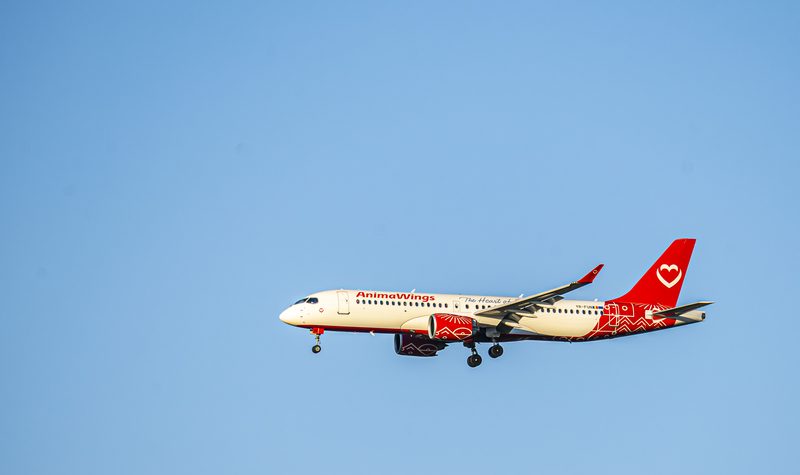
AnimaWings has entered the U.K. market with a new nonstop service between London Gatwick Airport (LGW) and Bucharest Henri Coandă International Airport (OTP), a move that is more significant than a simple new city pair on the departures board.

The route began on March 22 and operates six times weekly from Gatwick’s South Terminal using the Airbus A220-300. For a market that is often associated with low-cost competition and purely price-led demand, AnimaWings is trying something slightly different: a full-service product with Business Class, Premium Economy, and Economy cabins on one of Europe’s busiest point-to-point corridors.
That is what makes the launch interesting. This is not just another airline adding Bucharest. It is a smaller carrier trying to position itself differently in a very well-traveled market.
Read our stories in your inbox
Two aviation newsletters. Zero fluff.
The UK–Romania Market Is Strong Enough To Support More Than Low-Cost Demand
The logic behind the route is straightforward.
Traffic between the United Kingdom and Romania is deep, diverse, and structurally strong. There is business travel, tourism, visiting-friends-and-relatives demand, and a large Romanian diaspora that creates steady year-round traffic. Bucharest (OTP) is also increasingly being sold as a short-break destination in its own right, while still acting as the main air gateway to wider Romania, including Transylvania and the Carpathian region.
That makes LGW–OTP an attractive route for almost any airline. The difference is that AnimaWings is not entering it with a stripped-down low-cost model. It is trying to create a slightly more premium alternative.
The Airbus A220-300 Is Exactly The Right Aircraft
The aircraft choice matters here.
The Airbus A220-300 is one of the most suitable narrowbodies for this kind of route. It offers a quieter cabin, better passenger comfort, and a more modern onboard feel than many older short-haul aircraft. On a market such as London Gatwick (LGW)–Bucharest (OTP), where flight time is long enough for comfort to matter but not so long that a widebody is needed, the A220 is a very strong fit.
That helps AnimaWings sharpen its positioning. The airline is not just competing on schedule. It is also competing on onboard experience.
Gatwick Gains Another Useful European Link
For Gatwick (LGW), the route is another sign of continued European network broadening.
The airport has been adding carriers and destinations steadily, and AnimaWings’ arrival fits that pattern well. Bucharest is a high-volume Eastern European market with a mix of traffic types, and a six-times-weekly schedule gives Gatwick a strong near-daily offering without overextending the new entrant.
It also reinforces Gatwick’s role as more than just a leisure airport. Routes like LGW–OTP carry a meaningful blend of visiting-friends-and-relatives, business, and tourism traffic, which helps strengthen the airport’s year-round relevance.

AnimaWings Is Making A Reputation Play
The route is also important for the airline itself.
AnimaWings is not a household name in the United Kingdom, so launching from London Gatwick (LGW) is as much about visibility as it is about immediate seat sales. The carrier is stepping into a high-demand international market and doing so with a product that suggests it wants to be seen as more than just another budget operator from Eastern Europe.
That is a smart move. Airlines entering crowded corridors need a point of difference, and AnimaWings has chosen product and positioning rather than trying to win solely on fare.
Bottom Line
AnimaWings’ new London Gatwick (LGW)–Bucharest (OTP) route is a notable addition because it brings a full-service airline into one of the busiest and most durable U.K.–Eastern Europe markets.
The six-times-weekly Airbus A220-300 service strengthens UK–Romania connectivity, gives Gatwick another useful European route, and offers passengers a more differentiated onboard product than many competitors on the corridor. For aviation readers, the main takeaway is clear: this is not just a new route. It is a strategic market entry by an airline trying to stand out in a crowded space.
Keep reading FlyMag
Get the Daily Brief in the morning or the Route Watch weekly recap on Fridays. Or both.