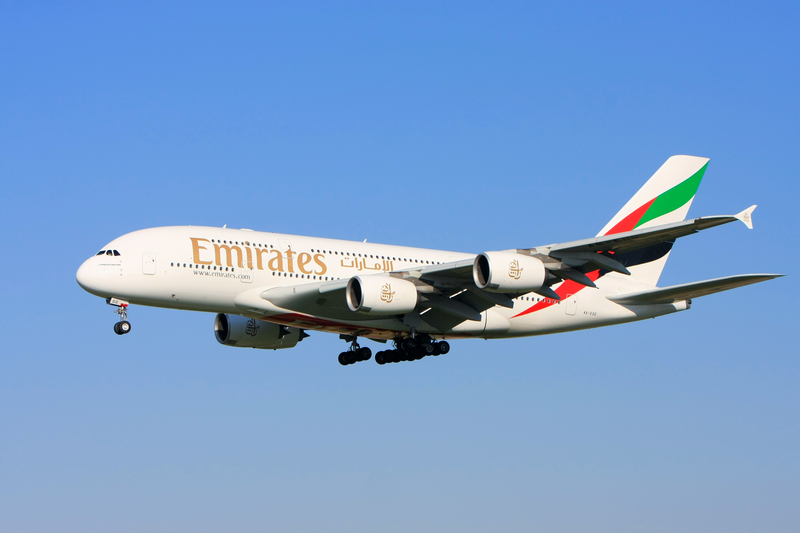
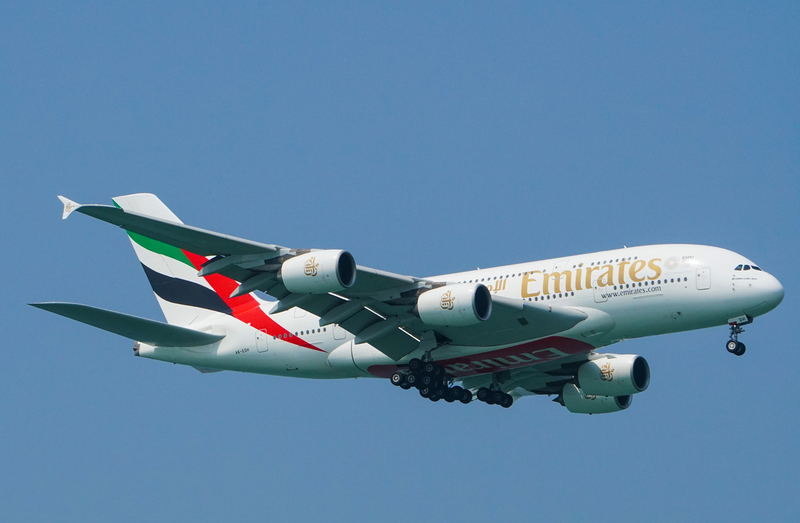
Emirates is preparing one of its largest-ever Airbus A380 schedules to London, with nine daily superjumbo departures planned between Dubai and the British capital during December 2026.

The airline’s currently filed schedule calls for six daily A380 round trips between Dubai International Airport (DXB) and London Heathrow Airport (LHR), along with three daily A380 services between Dubai (DXB) and London Gatwick Airport (LGW).
A fourth daily Gatwick flight will use the Airbus A350-900, while Emirates’ two daily services to London Stansted Airport (STN) will continue operating with Boeing 777-300ERs.
Read our stories in your inbox
Two aviation newsletters. Zero fluff.
That produces a total of 12 daily round trips—or 84 weekly flights—between Dubai (DXB) and Emirates’ three London gateways. Nine of those 12 daily services are scheduled to use the Airbus A380.
The schedule is a strong indication that Emirates expects London demand and its wider connecting network to be substantially restored by the year-end peak. It also represents a major rebuilding of capacity following the operational reductions caused by conflict and airspace restrictions across the Middle East earlier in 2026.
However, the December operation remains a forward schedule rather than an irrevocable commitment. Emirates is still advising passengers that it is operating a reduced network and that its published schedules may not always reflect short-notice operational changes.
Emirates’ December 2026 London Aircraft Plan
The planned December operation is divided among three London airports and three aircraft types.
| London airport | Daily flights | Airbus A380 | Airbus A350-900 | Boeing 777-300ER |
|---|---|---|---|---|
| London Heathrow (LHR) | 6 | 6 | 0 | 0 |
| London Gatwick (LGW) | 4 | 3 | 1 | 0 |
| London Stansted (STN) | 2 | 0 | 0 | 2 |
| Total | 12 | 9 | 1 | 2 |
The Heathrow operation is expected to consist entirely of A380s. Gatwick will receive three A380 rotations and the airline’s newer A350, while Stansted remains an all-Boeing 777 station.
That distinction matters. Emirates is not simply increasing flight frequency. It is concentrating its largest aircraft at Heathrow (LHR) and Gatwick (LGW), where passenger volume, premium demand, connecting traffic, airport infrastructure, and slot constraints make the A380 commercially effective.
Stansted (STN), by comparison, will continue receiving Boeing 777-300ERs. Those services provide useful access to northeast London, eastern England, and parts of the Midlands without requiring Emirates to deploy the capacity of an A380.
Six Daily A380s at London Heathrow
Emirates’ December schedule calls for all six daily Dubai-Heathrow rotations to use the Airbus A380.
The flight pairs are expected to be:

| Dubai-Heathrow flight | Heathrow-Dubai flight | Planned aircraft |
| EK1 | EK2 | Airbus A380 |
| EK3 | EK4 | Airbus A380 |
| EK5 | EK6 | Airbus A380 |
| EK7 | EK8 | Airbus A380 |
| EK29 | EK30 | Airbus A380 |
| EK31 | EK32 | Airbus A380 |
Emirates’ online schedule currently lists six daily Heathrow rotations, although temporary aircraft substitutions have included the Boeing 777-300ER on EK31 and EK32 during the carrier’s reduced summer operation. The December filing restores an all-A380 schedule across the six core flight pairs.
Operating six daily A380s gives Emirates approximately one departure every few hours during the most useful portions of the day. It also allows the airline to offer several different connection windows through Dubai International Airport (DXB).
An early departure from Heathrow (LHR), for example, reaches Dubai in time for overnight connections. Later flights connect with Emirates services leaving Dubai for South Asia, Southeast Asia, Africa, Australia, and New Zealand during the following morning.
In the other direction, Emirates can feed the six Heathrow flights from different arrival banks at Dubai (DXB). That distributes London-bound travelers across the day instead of forcing the airline to accommodate the entire market within one or two departures.
Heathrow’s Missing Seventh Flight
The December 2026 schedule should not be confused with Emirates’ enhanced winter 2025-2026 operation.
In October 2025, Emirates added flight EK41 from Dubai (DXB) to Heathrow (LHR) and return flight EK42 on six days each week. Those flights supplemented the airline’s six established daily services and were operated with a three-class Boeing 777-300ER offering more than 350 seats.
The additional frequency raised Emirates’ Heathrow schedule to 48 weekly flights during the peak winter period.
EK41 and EK42 are not included in the current December 2026 filing. Emirates is instead scheduled to operate the six core daily Heathrow rotations, all with A380s.
As a result, the airline’s planned 84 weekly London flights in December 2026 will be below the 90 weekly flights it offered across Heathrow, Gatwick, and Stansted after the expanded Gatwick schedule began in February 2026.
The nine-A380 figure is still significant, but it does not represent Emirates’ highest-ever London frequency. It reflects a particularly heavy concentration of large aircraft within a 12-flight daily schedule.
Gatwick Gains a Third Daily A380
The central change occurs at London Gatwick Airport (LGW), where Emirates is scheduled to operate three daily A380 round trips in December.
The planned Gatwick aircraft allocation is:
| Dubai-Gatwick flight | Gatwick-Dubai flight | Planned aircraft |
| EK9 | EK10 | Airbus A380 |
| EK11 | EK12 | Airbus A380 |
| EK15 | EK16 | Airbus A380 |
| EK69 | EK70 | Airbus A350-900 |
The key upgauge involves EK11 and EK12, which are scheduled to change from the Boeing 777-300ER to the Airbus A380.
Emirates’ present online timetable lists EK11 departing Dubai (DXB) at 2:35 a.m. and arriving at Gatwick (LGW) at 7:20 a.m. The return EK12 leaves Gatwick at 10:05 a.m. and reaches Dubai at 8:00 p.m. All times are local and can change between summer and winter schedule seasons.
Replacing the 777 on that rotation adds a substantial amount of capacity without requiring another Gatwick slot.
Emirates’ three-class Boeing 777-300ERs can carry approximately 354 passengers. Its published A380 configurations range from 484 seats in four classes to 517 seats in a three-class long-range layout, excluding the airline’s unusually dense 615-seat two-class aircraft.
Even if Emirates assigns its lowest-capacity published A380 configuration, the change would add approximately 130 seats in each direction. A 517-seat aircraft would increase capacity by more than 160 seats per departure.
Over a 31-day month, that single aircraft change could add more than 8,000 round-trip seats between Dubai (DXB) and Gatwick (LGW), depending on the exact A380 and 777 configurations assigned.
The final seat increase may be higher or lower because Emirates can rotate multiple cabin layouts through the route. The airline has not identified a permanent A380 subfleet for EK11 and EK12.
The A350 Complements Gatwick’s Three Superjumbos
The fourth Gatwick rotation, EK69 and EK70, will continue using the Airbus A350-900 rather than the A380.
Emirates launched the flight on February 8, 2026, giving Gatwick four daily Dubai services. The airline described it as a complementary late-evening operation intended to provide a different departure window for both corporate and leisure passengers.
EK69 is scheduled to leave Dubai (DXB) at 5:05 p.m. and reach Gatwick (LGW) at 8:50 p.m. The return EK70 departs Gatwick at 11:55 p.m. and arrives in Dubai at 11:00 a.m. the following day.
The A350 is configured with 298 seats:
| Cabin | Seats |
| Business Class | 32 |
| Premium Economy | 28 |
| Economy Class | 238 |
| Total | 298 |
Unlike Emirates’ A380s and most of its Boeing 777s, the A350 assigned to Gatwick does not offer First Class.
Its Business Class cabin uses a 1-2-1 layout, providing direct aisle access from every seat. Premium Economy is arranged in a dedicated 28-seat cabin, while the aircraft also introduces Emirates’ latest inflight entertainment and connectivity systems.
The mix of three A380s and one A350 gives Emirates a useful balance at Gatwick. The A380s provide high volume and large premium cabins, while the smaller A350 supports a later departure without requiring Emirates to fill another 484-to-517-seat aircraft.
Stansted Retains Two Daily Boeing 777 Flights
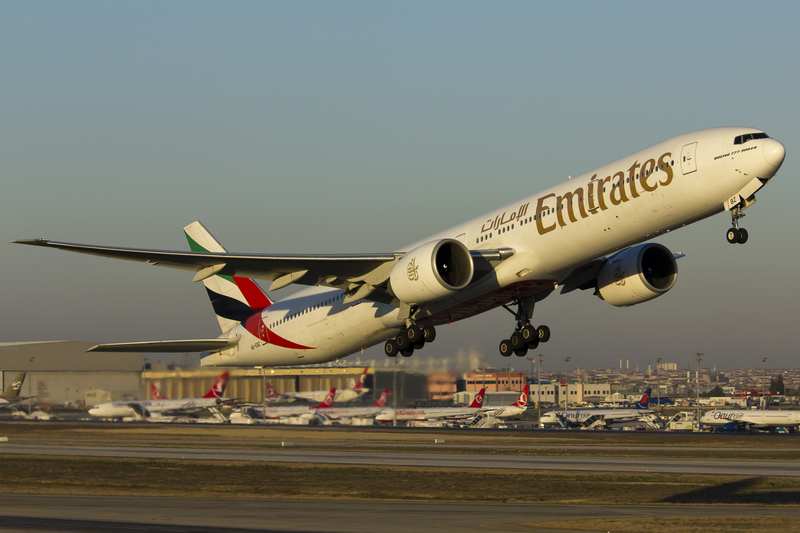
Emirates’ two daily Stansted services are expected to remain with the Boeing 777-300ER.
The flight pairs are:
| Dubai-Stansted flight | Stansted-Dubai flight | Planned aircraft |
| EK65 | EK66 | Boeing 777-300ER |
| EK67 | EK68 | Boeing 777-300ER |
The carrier’s published schedule lists EK65 leaving Dubai (DXB) at 8:10 a.m. and EK67 departing at 2:10 p.m. The return services leave Stansted (STN) during the afternoon and evening.
The Boeing 777 is a better fit for Stansted’s traffic profile than the A380. Emirates can still offer substantial passenger and cargo capacity while avoiding the commercial risk of placing nearly 500 or more seats on each departure.
Stansted also serves a somewhat different catchment area from Heathrow and Gatwick. It is convenient for parts of Essex, Hertfordshire, Cambridgeshire, northeast London, and the East Midlands.
The airport’s Emirates operation is therefore not simply an overflow service for passengers unable to use Heathrow. It allows the airline to capture travelers who might otherwise connect through a competing European or Middle Eastern hub.
More Than 5,000 Emirates Seats Leave London Every Day
The planned aircraft mix will give Emirates an enormous amount of daily capacity between London and Dubai.
Using the lowest seat counts currently published by Emirates for each type, the 12 daily departures would provide at least:
- Nine A380s with 484 seats each: 4,356 seats
- One A350 with 298 seats: 298 seats
- Two 777-300ERs with at least 324 seats each: 648 seats
That produces a conservative minimum of approximately 5,302 one-way seats per day.
The actual total will probably be higher because Emirates operates A380s with 489, 517, and other seating capacities, while some 777-300ERs carry around 354 passengers.
Depending on the specific airframes assigned, Emirates could offer approximately 10,600 to more than 11,000 passenger seats between London and Dubai in both directions every day.
Across December’s 31 days, that would place approximately 329,000 to 350,000 or more one-way seats into the London market.
Those figures are estimates rather than a confirmed Emirates capacity total because the carrier has not published a registration-by-registration aircraft assignment. Nevertheless, they illustrate the extraordinary scale of the operation.
Why London Can Support Nine Daily A380s
The London-Dubai market combines several forms of demand that are particularly well suited to the A380.
There is substantial local traffic between the United Kingdom and the United Arab Emirates, including business travel, tourism, expatriate traffic, family visits, and passengers beginning or ending cruise vacations in Dubai.
London also supplies large numbers of connecting passengers to Emirates’ wider network.
Travelers originating in the United Kingdom use Dubai (DXB) to reach destinations across India, Pakistan, Bangladesh, Sri Lanka, Southeast Asia, Africa, Australia, and New Zealand. In the opposite direction, passengers from those markets connect through Dubai for travel to London.
This means Emirates is not relying solely on filling nine daily A380s with passengers traveling only between London and Dubai.
Each London flight can draw customers from dozens of origins and destinations throughout the airline’s global network. That is one of the central advantages of Emirates’ hub-and-spoke model.
A passenger flying from Birmingham, England, to Bangkok may choose a one-stop itinerary through Dubai. So might a traveler from London to Perth, Manchester to Johannesburg, or Glasgow to Bengaluru.
The combined volume from those individual markets allows Emirates to fill aircraft that would be difficult to support using local London-Dubai demand alone.
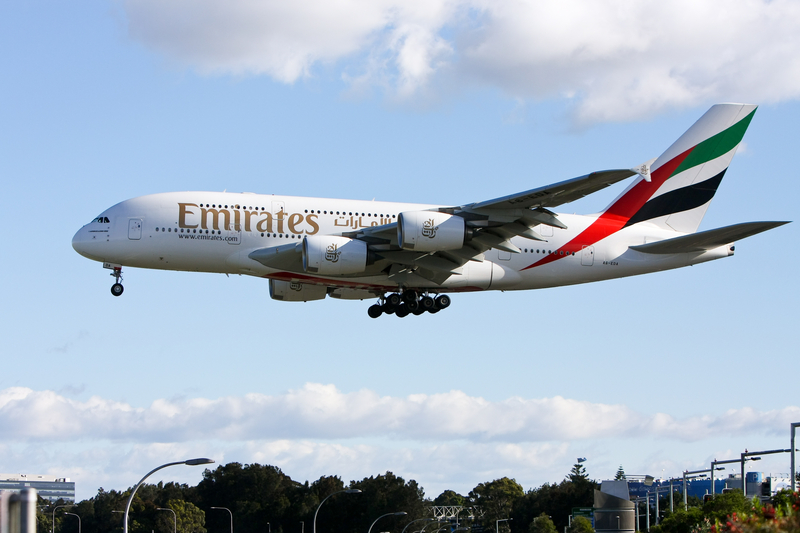
The A380 Is Particularly Valuable at Heathrow
Heathrow (LHR) is one of the most heavily slot-constrained airports in the world. Airlines cannot freely add another flight whenever demand increases.
A carrier that controls a valuable Heathrow slot pair must therefore decide how much capacity to place into that limited operating opportunity.
The A380 allows Emirates to carry significantly more passengers per arrival and departure than it could with a Boeing 777-300ER or Airbus A350-900. That is particularly useful when additional slots are unavailable or commercially prohibitive.
A four-class Emirates A380 accommodates 484 passengers, while its three-class versions seat as many as 517. By comparison, Emirates’ current A350 carries 298 passengers, and its 777-300ER fleet generally accommodates approximately 324 to 354 passengers.
Replacing a 354-seat 777 with a 484-seat A380 increases passenger capacity by about 37% without using another runway slot.
The economics are more complicated than simply dividing the number of seats by the number of slots. The A380 has four engines, requires specialized gates, consumes more fuel than newer twin-engine aircraft, and can be expensive to operate if demand is weak.
At Heathrow, however, the scarcity of slots changes that calculation. An aircraft that would be too large for a thinner route can become commercially valuable when the alternative is being unable to add another flight.
Heathrow Remains One of the World’s Leading A380 Airports
London Heathrow remains one of the most diverse airports in the surviving global A380 network.
Heathrow’s own aircraft guide identifies British Airways, Emirates, Etihad Airways, Qantas, Qatar Airways, Korean Air, and Singapore Airlines as carriers that use or have recently used the A380 at the airport. Actual operations vary by season, and not every airline maintains year-round daily service.
British Airways bases its A380 fleet at Heathrow, while Emirates schedules the type there more frequently than any other foreign airline.
Qantas uses the superjumbo on flights linking Heathrow (LHR) with Singapore Changi Airport (SIN) and Sydney Airport (SYD). Singapore Airlines also serves Heathrow from Singapore (SIN), while Etihad connects the airport with Abu Dhabi International Airport (AUH) and Qatar Airways links it with Hamad International Airport in Doha (DOH).
That mix makes Heathrow unusually important to the A380 program more than five years after Airbus delivered the final aircraft.
While other airports may see a greater total number of Emirates A380 movements, few receive the type from such a broad group of operators.
Emirates’ A380 Fleet Makes the Schedule Possible
No other airline could easily build a nine-daily A380 operation to a single metropolitan market.
Emirates owns or operates the overwhelming majority of the world’s active A380 capacity. Its fleet contains aircraft with several different cabin layouts, allowing the airline to match configurations to route demand.
The carrier’s published A380 variants include:
| Configuration | Published capacity |
| Four-class ultra-long-range | 484 |
| Three-class ultra-long-range | 489 |
| Three-class long-range | 517 |
| Two-class long-range | 615 |
All versions provide a full-length main deck and upper deck. Depending on configuration, Emirates offers First Class suites, shower spas, an upper-deck Business Class cabin, the airline’s onboard lounge, Premium Economy, and a large Economy Class cabin.
The aircraft measures 238 feet, 6 inches long and has a wingspan of 261 feet, 8 inches. Emirates’ A380s are powered by either Engine Alliance GP7200 or Rolls-Royce Trent 900 engines.
The A380’s passenger appeal remains an important part of the deployment decision. Emirates has built much of its international identity around the aircraft, and the onboard lounge, shower suites, and upper-deck premium cabins continue to differentiate it from carriers operating smaller twin-engine aircraft.
Emirates Is Investing in the A380 Rather Than Simply Running It Down
Although Airbus ended A380 production in 2021, Emirates is continuing to invest in the aircraft.
The airline is completing a large cabin retrofit program that adds Premium Economy, refreshes Business Class and Economy Class interiors, and extends the useful commercial life of the fleet.
Emirates completed the first retrofit of one of its former 615-seat, two-class A380s in May 2026. The aircraft emerged with Business Class, Premium Economy, and Economy Class, reducing the total capacity while creating a more valuable cabin mix.
Emirates expects all 15 of its former two-class A380s to receive similar work by the end of 2026.
That program has direct implications for London. As more retrofitted aircraft return to service, Emirates gains additional flexibility to provide Premium Economy and refreshed cabins on high-profile routes.
The airline has not confirmed that every London A380 departure will offer Premium Economy in December. Passengers must check the aircraft and cabin configuration assigned to their specific date.

The Wider Emirates UK Network
London is the largest part of Emirates’ UK operation, but it is not the entire network.
The airline serves eight UK airports:
| Airport | Code | Typical Emirates aircraft |
| London Heathrow | LHR | Airbus A380 |
| London Gatwick | LGW | Airbus A380 and Airbus A350 |
| London Stansted | STN | Boeing 777-300ER |
| Manchester | MAN | Airbus A380 |
| Birmingham | BHX | Airbus A380 and Boeing 777 |
| Glasgow | GLA | Airbus A380 |
| Edinburgh | EDI | Airbus A350 |
| Newcastle | NCL | Boeing 777 |
At the launch of its fourth Gatwick frequency in February 2026, Emirates operated 146 weekly UK flights. Those included three daily A380 services to Manchester Airport (MAN), one daily A380 among two Birmingham Airport (BHX) frequencies, a daily A380 to Glasgow Airport (GLA), a daily A350 to Edinburgh Airport (EDI), and a daily Boeing 777 service to Newcastle International Airport (NCL).
Aircraft assignments and frequencies have since been affected by Emirates’ temporary network reductions, and the December schedule remains subject to further revision.
Nevertheless, five UK airports—Heathrow, Gatwick, Manchester, Birmingham, and Glasgow—are positioned to receive regular Emirates A380 service when the planned network is fully operating.
A Sign of Recovery, but Not Yet a Guarantee
The December schedule represents a strong statement of intent after an extraordinarily disruptive year for Gulf aviation.
Conflict involving Iran repeatedly affected airspace, airport operations, passenger confidence, and flight routings across the Middle East. At points, Gulf carriers were forced to cancel large portions of their schedules or operate through a limited number of available corridors.
By June, Emirates had restored approximately 86% of its pre-conflict flight volume, according to Flightradar24 data cited by Reuters. The other major Gulf airlines had also recovered much of their flying, although the regional security environment remained unsettled.
Scheduling nine daily London A380s in December suggests that Emirates expects aircraft availability, airspace access, passenger demand, and connecting traffic to continue improving.
It should not yet be described as a guaranteed full recovery.
Airlines routinely revise schedules in response to demand, aircraft availability, geopolitical developments, maintenance requirements, airport slots, or operational restrictions. Emirates is specifically warning that it is operating a reduced schedule until further notice and that passengers should consult its latest downloadable timetable.
The December filing is therefore best viewed as Emirates’ intended winter capacity plan rather than a promise that every listed flight will operate with the scheduled aircraft.
Bottom Line
Emirates is preparing to operate nine daily Airbus A380 round trips between Dubai International Airport (DXB) and London during December 2026.
Six A380s will serve London Heathrow Airport (LHR), while three will operate to London Gatwick Airport (LGW). Gatwick will also receive a daily 298-seat Airbus A350-900, and Emirates’ two daily London Stansted Airport (STN) services will use Boeing 777-300ERs.
The resulting operation will consist of 12 daily round trips across the three London airports:
- Six Airbus A380 flights to Heathrow
- Three Airbus A380 flights to Gatwick
- One Airbus A350 flight to Gatwick
- Two Boeing 777 flights to Stansted
The principal capacity increase comes from upgrading EK11 and EK12 at Gatwick from the Boeing 777-300ER to the A380. Depending on the configuration assigned, that change could add at least 130 seats per departure and more than 8,000 round-trip seats during December.
Across all three airports, Emirates is positioned to offer more than 5,300 seats from London to Dubai every day, with the actual total likely higher once individual A380 and 777 cabin configurations are considered.
The strategy demonstrates why the A380 remains central to Emirates. At slot-constrained Heathrow, it maximizes capacity per movement. At Gatwick, it allows the airline to add seats without introducing a fifth frequency. Across both airports, it feeds enormous volumes of passengers into Emirates’ connecting banks at Dubai (DXB).
The schedule is not Emirates’ highest-ever London frequency. The airline briefly offered 90 weekly London flights during winter 2025-2026, compared with the 84 weekly services currently filed for December 2026.
It is, however, one of the most A380-intensive schedules ever planned for a single metropolitan market—and a clear signal that London remains among the most strategically important destinations in the Emirates network.