British Airways is about to restore a UK nonstop to St. Louis Lambert International Airport (STL), but the more interesting aviation story is not simply that the route is back. It is how the airline has chosen to do it.

On April 19, British Airways begins four-weekly seasonal service between London Heathrow Airport (LHR) and St. Louis (STL), giving Missouri’s largest airport its first Heathrow link and returning nonstop UK service to the market after more than two decades. For British Airways, the route adds another U.S. point to an already deep transatlantic portfolio. For St. Louis, it is a meaningful network upgrade: Heathrow is not just London, but one of the most commercially useful long-haul gateways in Europe.
Heathrow makes this route more important than a simple city-pair relaunch
There is a reason this launch carries more weight than a standard secondary-U.S.-city addition.
Read our stories in your inbox
Two aviation newsletters. Zero fluff.
St. Louis (STL) has had London service before, but not from Heathrow (LHR). That matters because Heathrow offers something Gatwick never could at the same scale: premium demand, corporate visibility, and much stronger onward connectivity. For a market like St. Louis, which needs both local traffic and higher-yield long-haul feed to sustain a transatlantic flight, Heathrow is the right airport.
That gives British Airways a cleaner proposition from the start. The airline is not just selling Missouri to London. It is selling St. Louis into the wider British Airways and oneworld long-haul system via Heathrow (LHR), where the route can draw value from both point-to-point traffic and onward flows.
The Boeing 787-8 is the right aircraft for an unproven market
Just as important as the airport choice is the aircraft choice.
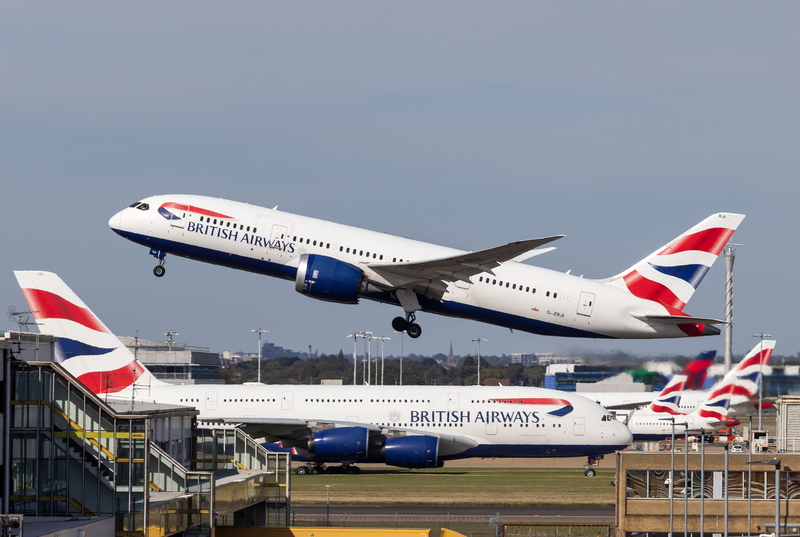
British Airways has filed the route with the Boeing 787-8, its smallest long-haul aircraft. That is a smart move. The 787-8 keeps the market disciplined on capacity while still offering a proper premium product, and that matters on a route like London Heathrow (LHR) to St. Louis (STL), which is long enough to need strong premium revenue but not yet proven enough to justify a larger widebody.
In British Airways’ current 204-seat configuration, the Boeing 787-8 carries 31 Club Suites in business class, 37 World Traveller Plus seats, and 136 seats in World Traveller. For airline professionals, that is the key detail. This is not a leisure-heavy launch built around back-cabin volume. It is a controlled long-haul entry with a meaningful premium mix.
The aircraft itself is well suited to the mission. The Boeing 787-8 was built for thinner long-haul sectors where airlines want transatlantic range without overcommitting gauge. On a route of roughly 3,650 nautical miles, that makes it the pragmatic choice rather than the flashy one.

St. Louis gives British Airways a credible secondary-U.S. play
British Airways is not entering St. Louis (STL) on nostalgia alone.
The market has a large metropolitan population, a substantial corporate base, and a respectable amount of existing Europe-bound traffic for an airport of its size. That is why the route makes sense now. St. Louis is large enough to support nonstop demand to London Heathrow (LHR), but still underserved enough that a new nonstop can stand out immediately.
That is especially important in today’s transatlantic market. Airlines are increasingly interested in secondary U.S. cities that can support long-haul flying without the extreme competitive crowding of gateways like New York John F. Kennedy (JFK), Chicago O’Hare (ORD), or Los Angeles (LAX). St. Louis fits that profile well: large enough to matter, but not yet saturated.
Lufthansa ensures BA is not walking into an empty field
British Airways will not have Europe to itself at St. Louis (STL).
Lufthansa is already established on the airport’s Frankfurt Airport (FRA) route and is scheduled to operate up to five weekly flights in peak summer 2026. That changes the texture of the British Airways launch. BA is not creating transatlantic relevance from scratch; it is joining a market that has already shown it can sustain widebody Europe service.
But the two airlines are not really selling the same proposition. Lufthansa’s Frankfurt (FRA) service leans naturally into Star Alliance flows over Germany. British Airways’ Heathrow (LHR) service offers a different kind of network logic, one built around London-origin traffic, premium demand, and onward connectivity through BA’s own hub. That makes the competition more complementary than purely duplicative.
From St. Louis’ perspective, that is the best outcome possible. Instead of one Europe gateway, the airport gets two very different ones.
What British Airways is really testing
The St. Louis launch is not just about adding another U.S. destination. It is about testing whether a well-judged, premium-capable Boeing 787-8 can make a secondary Midwest market work from Heathrow.
That is a useful strategic question for British Airways. The carrier already has one of the broadest U.S. networks of any European airline. At this point, growth is not about finding obvious holes on the map. It is about selecting the next city where Heathrow’s strength, BA’s premium product, and a carefully sized aircraft can combine into a sustainable route.
St. Louis may not be the biggest U.S. market in the network, but that is precisely why it matters. If a route like this works, it reinforces a broader truth about long-haul planning in the 2020s: not every successful transatlantic route needs a giant hub at both ends. Sometimes it just needs the right hub, the right aircraft, and the right level of ambition.
Bottom Line
British Airways’ new London Heathrow Airport (LHR) to St. Louis Lambert International Airport (STL) service is more than a route launch. It is a carefully structured long-haul test with the right aircraft, the right airport, and a market that is large enough to support demand without being overcrowded.
The Boeing 787-8 gives British Airways a disciplined way to enter St. Louis, while Heathrow (LHR) gives the route the kind of premium and connecting strength that a smaller London airport never could. Add in Lufthansa’s existing Frankfurt Airport (FRA) service, and St. Louis becomes something it has not been for a long time: a U.S. secondary city with genuine long-haul choice to Europe.