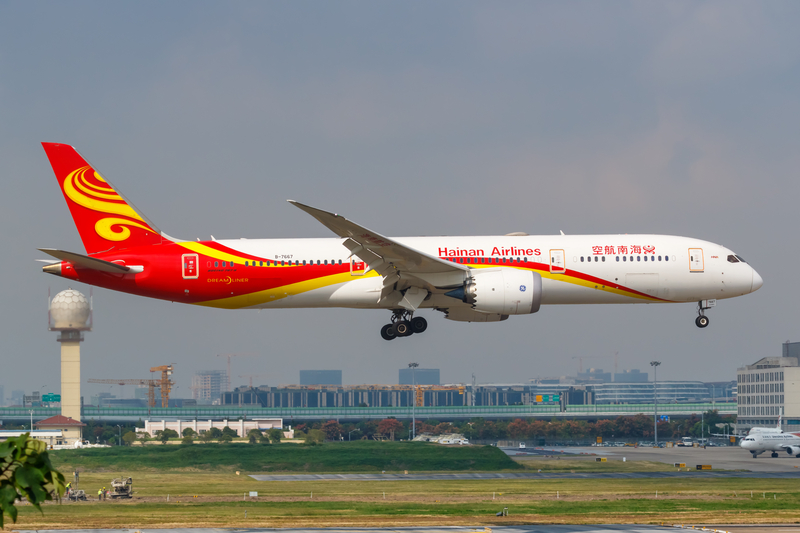
A Hainan Airlines Boeing 787-9 Dreamliner operating a long-haul service from Brussels Airport (BRU) to Beijing Capital International Airport (PEK) was forced to return to BRU shortly after departure on Friday following a technical issue onboard.

The aircraft involved was Boeing 787-9, registered B-1546, operating as HU492. Hainan Airlines said the crew elected to turn back as a precaution and handled the situation in accordance with established procedures. The aircraft landed safely back in Brussels, and the airline stated it is arranging assistance for affected passengers and working to ensure they can continue to their final destination.
What we know about the HU492 return
Hainan Airlines confirmed the return was triggered by a mechanical issue, though no specific system was identified in the initial statement. That is fairly typical in the early phase of an operational event: airlines tend to avoid naming a component until maintenance has completed troubleshooting and confirmed whether the issue was sensor-driven, a caution message, or a fault requiring parts replacement.
Read our stories in your inbox
Two aviation newsletters. Zero fluff.
The flight returned shortly after departure and landed safely at Brussels (BRU). Hainan Airlines reported the aircraft was on the ground again at 9:17 p.m. Beijing Time, which corresponds to the early evening in Belgium—consistent with a standard long-haul departure window from BRU.
Why a precautionary return is common on long-haul widebodies
For a long-haul sector like BRU–PEK, a return decision is often made early for one reason: risk management gets more expensive the farther you go.
If a caution message appears shortly after takeoff, the crew and airline operations control have a relatively simple choice:
-
return to the departure airport with full maintenance capability, spare parts access, and passenger support infrastructure, or
-
continue and potentially face a diversion to an alternate where widebody support, parts availability, and passenger handling may be more complex.
For airline professionals, this is where ETOPS-style decision logic becomes relevant even if the route itself is not oceanic. The 787 is designed for long-range dispatch reliability, but the philosophy remains the same: if you can resolve a technical abnormality at your home station or a major international airport early, you avoid multiplying downstream risk.

The aircraft: Boeing 787-9 Dreamliner
The Boeing 787-9 is the stretched variant of the Dreamliner family and is widely used for long-haul missions in the 6,000–7,500 nautical mile class. Hainan Airlines has been one of China’s notable Dreamliner operators, using the type on intercontinental routes where efficiency and cargo capability matter.
From an operational standpoint, the 787-9’s strengths on routes like BRU–PEK include:
-
Fuel efficiency relative to older-generation widebodies
-
Long-range performance with strong payload flexibility
-
High dispatch reliability in mature fleets
-
A cabin environment that is generally well regarded on long sectors (pressurization, humidity, and reduced fatigue factors)
That said, even modern widebodies will occasionally return due to a technical caution. Many turnbacks are triggered by issues that are not safety-critical in the immediate sense—but are significant enough that dispatch rules, maintenance requirements, or crew judgment make continuation undesirable.
Passenger handling: what typically happens next
Hainan Airlines said it is making arrangements to support affected passengers and ensure they reach their destination safely. In practice, for a long-haul disruption out of BRU, that usually means a combination of:
-
rebooking onto the next available Hainan-operated flight (if capacity exists),
-
placing passengers on partner or interline options via other hubs, or
-
operating a recovery flight once the aircraft is cleared or a substitute aircraft is positioned.
Because the flight was bound for Beijing (PEK), re-accommodation options may depend heavily on available seats, bilateral agreements, and whether the airline can position another widebody to BRU quickly.
Bottom Line
Hainan Airlines flight HU492 from Brussels (BRU) to Beijing (PEK) returned to BRU shortly after departure on Friday after the crew reported a technical issue. The aircraft, a Boeing 787-9 Dreamliner (B-1546), landed safely, and the airline said the situation was handled in line with standard procedures while passenger arrangements are being made. Events like this are operationally disruptive, but they are also a routine example of conservative long-haul decision-making—address the problem early, at a major airport, before the flight is committed deep into the route.
Keep reading FlyMag
Get the Daily Brief in the morning or the Route Watch weekly recap on Fridays. Or both.