The United States has expanded its sanctions campaign against Iran’s Mahan Air by targeting companies and an individual accused of supporting the airline’s sales, cargo, and commercial activities in China, India, and Russia.
The U.S. Department of the Treasury’s Office of Foreign Assets Control added four companies and one Chinese national connected with Mahan Air to the Specially Designated Nationals and Blocked Persons List on July 30, 2026.
Mahan Air itself has been under U.S. sanctions since 2011. The latest action does not directly ground the Tehran-based carrier or revoke its authority to operate flights. Instead, Washington is attempting to isolate the overseas intermediaries that help Mahan sell tickets, arrange cargo, communicate with freight forwarders, and maintain a commercial presence outside Iran.
Read our stories in your inbox
Two aviation newsletters. Zero fluff.
The U.S. Treasury described the designations as part of a wider effort to disrupt networks supporting Mahan Air and Iran’s Islamic Revolutionary Guard Corps.
Five Mahan Air-Linked Targets Added to U.S. Sanctions List
The new Mahan Air-related designations cover:
- Shanghai Wings International Logistics Co., based in China
- Shanghai Elite International Travel Co., based in China
- Tang Xin, a Chinese national also known as Mike Tang
- Skiez Travels and Logistics Private Limited, based in India
- Air Cargo Pro Limited, based in Russia
OFAC says Shanghai Wings has acted as a general sales agent for Mahan Air and coordinated the transportation of electronics from China to Iran. Tang Xin is identified as Shanghai Wings’ managing director and is accused of coordinating travel services for the Iranian airline.
Tang is also the executive director and 50% owner of Shanghai Elite International Travel, which OFAC says represents Mahan Air in China. Shanghai Elite was sanctioned because it is owned or controlled by Tang or acts on his behalf.
India-based Skiez Travels and Russia-based Air Cargo Pro were also identified as Mahan Air general sales agents in their respective markets. The entities’ names, addresses, registration details, and sanctions classifications are included in OFAC’s July 30 SDN List update.
The companies and Tang Xin have been designated under Executive Order 13224, as amended, for allegedly providing financial, material, technological, or commercial support to Mahan Air.
What a General Sales Agent Does for an Airline
A general sales agent, commonly called a GSA, serves as an airline’s commercial representative in a market where the carrier may not maintain a complete local corporate organization.
Depending on the agreement, a GSA can sell passenger tickets, market flights, manage travel agency relationships, provide customer support, coordinate cargo bookings, communicate with freight forwarders, and help settle local payments.
Those services can be especially important for a sanctioned airline. Mahan Air may continue operating an aircraft between Tehran Imam Khomeini International Airport (IKA) and an overseas destination, but the route becomes commercially more difficult if local companies, banks, freight agents, and travel agencies are unwilling or unable to handle its transactions.
Treasury’s action therefore targets more than the public-facing ticket counter. It reaches into the commercial infrastructure that allows an international airline to turn available aircraft capacity into passenger and cargo revenue.
Washington Repeats Longstanding Allegations Against Mahan Air
The U.S. government has sanctioned Mahan Air since October 12, 2011, when Treasury accused the carrier of providing transportation, financial, and personnel-travel services to the Islamic Revolutionary Guard Corps-Quds Force.
Treasury alleged at the time that Mahan Air transported IRGC-Quds Force personnel for military training, facilitated covert travel, moved funds, and supported arms shipments. The original 2011 Mahan Air designation prohibits U.S. persons from conducting commercial or financial transactions with the airline and blocks property it holds under U.S. jurisdiction.
In its latest announcement, Treasury again alleged that Mahan Air has supported the movement of IRGC personnel, military equipment, unmanned aerial vehicle systems, and weapons.
These descriptions reflect the U.S. government’s allegations and legal basis for the sanctions. The July announcement did not include responses from Mahan Air or the newly designated companies.
What the New Sanctions Mean
Any property or interests in property belonging to the designated parties that are located in the United States—or held by a U.S. person—must be blocked and reported to OFAC.
U.S. persons are generally prohibited from providing or receiving funds, goods, or services involving the sanctioned companies and individual unless OFAC issues a license or an exemption applies.
The restrictions also extend through OFAC’s 50% rule. A company that is owned, directly or indirectly, 50% or more by one or more blocked persons is generally treated as blocked even when it is not separately named on the sanctions list.
Foreign businesses are not automatically prohibited from every transaction solely because they are located outside the United States. However, the practical consequences can still be extensive.
International banks, insurance providers, payment processors, aircraft service companies, freight forwarders, and travel agencies may sever relationships to avoid processing a transaction through the U.S. financial system or exposing themselves to secondary sanctions.
Treasury warned that foreign financial institutions knowingly facilitating significant transactions for the designated parties could face restrictions on their access to U.S. correspondent or payable-through accounts. Civil penalties can also be imposed on a strict-liability basis, meaning a company does not necessarily need to have intentionally violated the rules to face enforcement.
Mahan Air’s Aircraft Have Also Been Targeted
The July designations follow earlier U.S. action against Mahan Air’s aircraft and aviation-supply network.
On April 21, 2026, OFAC added two Mahan Air Boeing 777-200ERs—registered EP-MTB and EP-MTE—to its sanctions list. Both aircraft were separately identified as property linked to the airline and exposed parties dealing with them to potential secondary-sanctions risks.
The Boeing 777-200ER is a twin-engine, long-range widebody designed for high-capacity international routes. Its acquisition gave Mahan Air a newer long-haul platform than many aircraft in its existing fleet, which remains heavily centered on older Airbus A340-family jets.
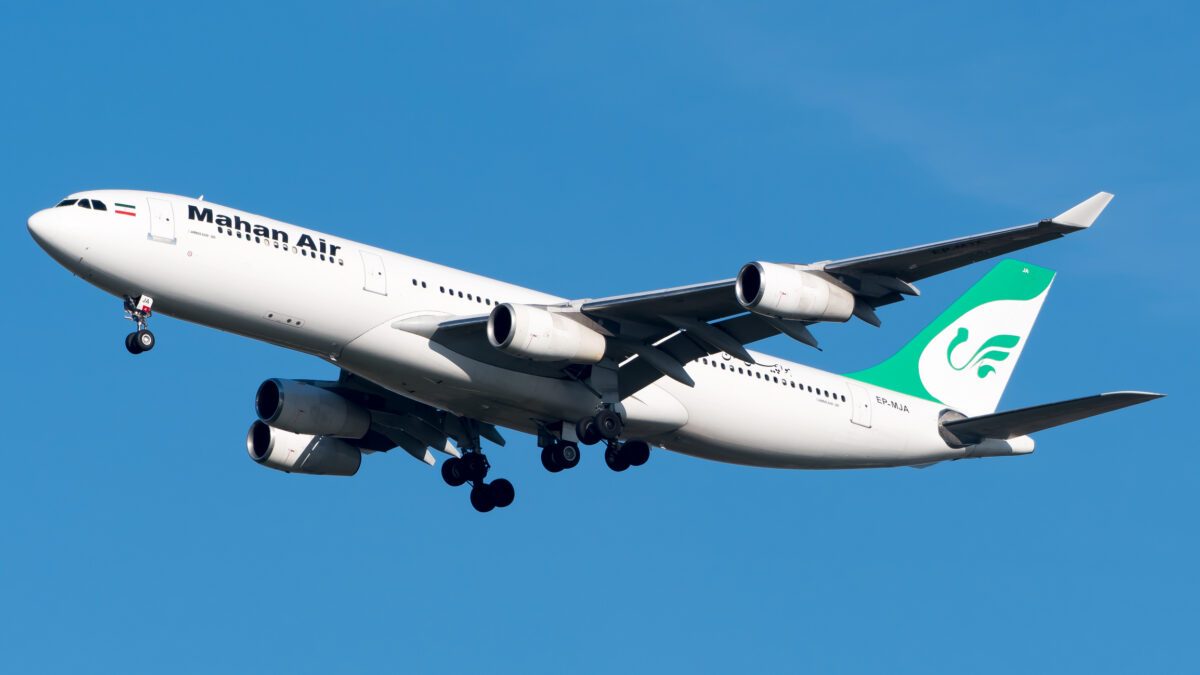
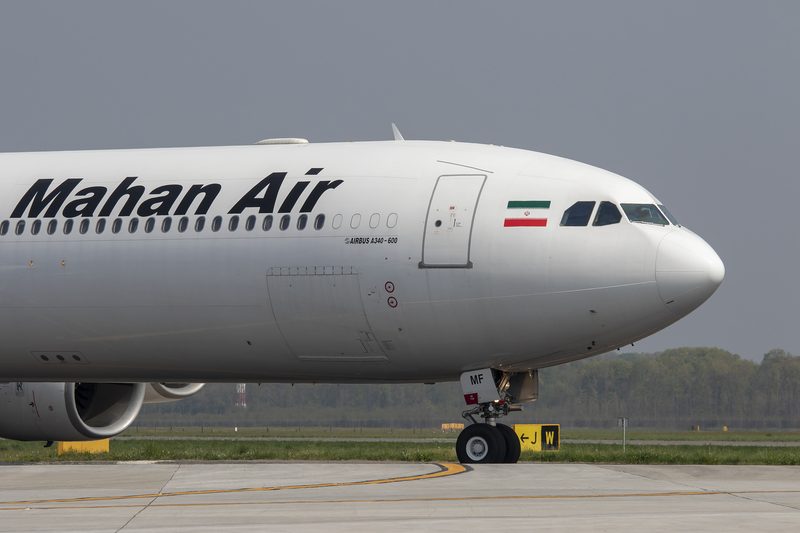
Mahan Air’s fleet includes several versions of the four-engine Airbus A340, including the A340-200, A340-300, and A340-600. It has also operated Airbus A300s, BAe 146 regional jets, and other aging aircraft acquired through the secondary market. Current fleet records show the A340 family continuing to form a major part of its long-haul capability.
The contrast between the 777 and A340 is significant. The 777-200ER uses two engines and was designed for more efficient long-distance operations, while the older A340 relies on four engines and is generally more expensive to operate and maintain.
Sanctions complicate access to engines, avionics, spare parts, technical support, insurance, and financing for both aircraft families. Targeting the businesses that arrange procurement, logistics, cargo, and ticket sales adds another layer of pressure beyond sanctioning the airframes themselves.
Commercial Pressure Extends Beyond U.S. Airspace
Mahan Air does not operate scheduled service to the United States, and the latest sanctions do not depend on the airline entering U.S. airspace.
The carrier’s operations are centered in Tehran, including Mehrabad International Airport (THR) and Imam Khomeini International Airport (IKA). Its international network has historically extended across the Middle East, Central Asia, South Asia, China, and other regional markets.
The effectiveness of the sanctions therefore depends largely on the willingness of overseas institutions to isolate Mahan Air.
A bank in China or India may not be subject to U.S. law in exactly the same way as an American institution. However, a bank that relies on dollar clearing, maintains U.S. correspondent accounts, or conducts business with American companies has strong incentives to avoid transactions involving an OFAC-designated airline or agent.
That influence is one reason Washington has repeatedly targeted Mahan Air’s foreign GSAs. In 2020, Treasury designated Shanghai Saint Logistics for representing the airline in China and described it as the seventh Mahan Air sales agent sanctioned since 2018. The latest action shows that new intermediaries have continued to emerge even as earlier companies were cut off.
The Sanctions Do Not Automatically Cancel Flights
Passengers should not interpret the designation as an immediate announcement that every Mahan Air flight has been canceled.
OFAC does not control foreign airport slots or directly issue Iranian air operator certificates. Mahan Air can continue flying where local governments permit it and where airports, handlers, fuel suppliers, and other service providers remain willing to support the operation.
The impact is more likely to appear through commercial and operational friction.
Ticket distribution may become more difficult in countries where a sanctioned sales agent represented the airline. Cargo customers may need to find another booking channel. Banks may reject payments, and travel agencies may remove Mahan Air inventory to reduce compliance risks.
The airline could respond by appointing replacement agents, handling more transactions directly, or shifting business toward companies with little exposure to the United States. OFAC’s strategy is to make each replacement more costly, less capable, and increasingly vulnerable to a future designation.
A Broader Sanctions Action Against the IRGC
The July 30 announcement included one additional target not directly presented as a Mahan Air sales representative.
OFAC sanctioned Iran-based DadeNegar Startup Studio, accusing the technology company of operating as an IRGC-affiliated front that helped gather information for military targeting.
That brought the full action to six designated companies and individuals. Five were connected with Mahan Air’s commercial support network, while DadeNegar was targeted separately for its alleged work with the IRGC.
Keeping those two parts of the announcement distinct is important. Shanghai Wings, Shanghai Elite, Skiez Travels, Air Cargo Pro, and Tang Xin were targeted because of their alleged relationships with Mahan Air. DadeNegar was not identified as an airline sales or cargo agent.
Bottom Line
The United States has sanctioned four overseas companies and one Chinese individual accused of supporting Mahan Air’s passenger sales, cargo, travel, and logistics activities.
Shanghai Wings International Logistics, Skiez Travels and Logistics, Air Cargo Pro, and Tang Xin were designated for allegedly providing material or commercial support to Mahan Air. Shanghai Elite International Travel was sanctioned because of its ownership and control links to Tang.
The action does not directly ground Mahan Air or cancel its flights from Tehran Mehrabad International Airport (THR) and Imam Khomeini International Airport (IKA). Its purpose is to make those operations increasingly difficult to sell, finance, supply, and support outside Iran.
Mahan Air has been under U.S. sanctions since 2011, while individual aircraft—including Boeing 777-200ERs EP-MTB and EP-MTE—have also been separately targeted.
The latest designations demonstrate that Washington is no longer focused only on the airline itself. It is pursuing the travel agencies, cargo representatives, executives, and logistics companies that allow a sanctioned carrier to function as an international commercial operation.