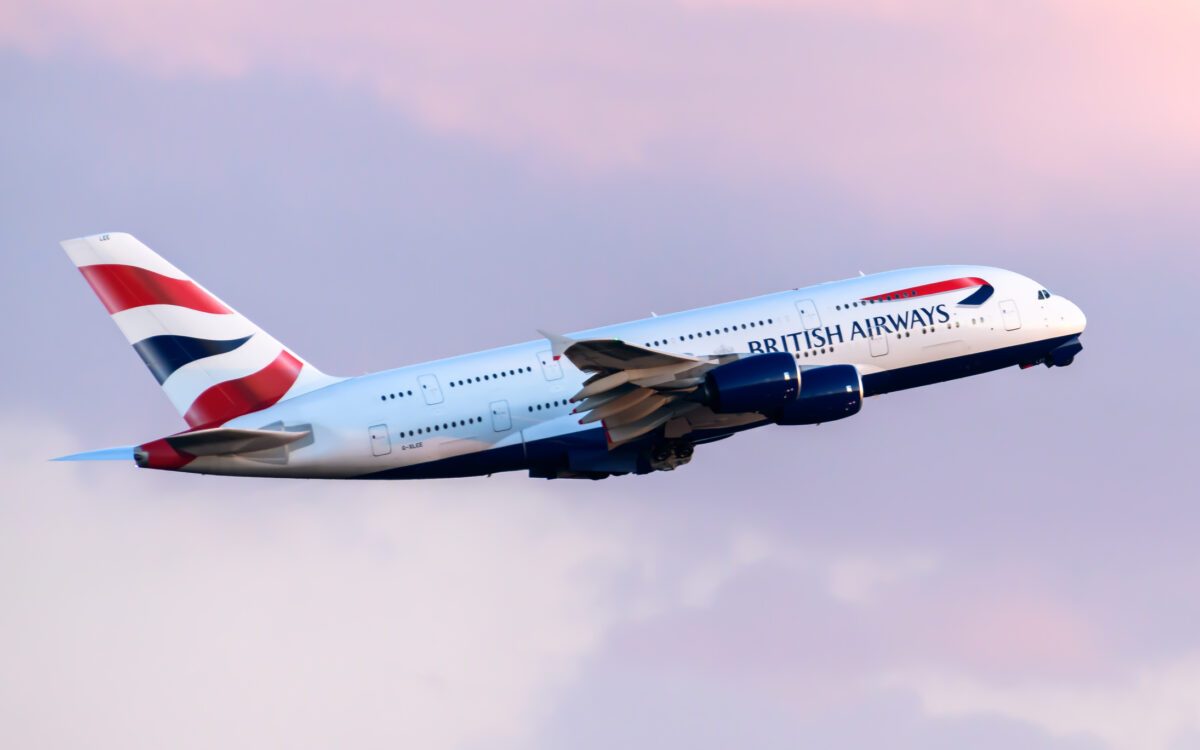
British Airways will reduce its scheduled Airbus A380 network to four destinations during the 2026-27 winter season, removing the type from flights to Dubai, Los Angeles and Washington compared with last winter.
A FlyMag review of the airline’s published timetable and aircraft allocations shows approximately five daily A380 departures from London Heathrow (LHR) across the core November-to-February period. That is down from about seven daily departures during the equivalent months a year earlier.
Miami (MIA) will receive two daily A380 rotations. Johannesburg (JNB), San Francisco (SFO) and Singapore (SIN) will each retain one daily service. The winter schedule begins on October 25, 2026, and runs through March 27, 2027, although individual aircraft assignments remain subject to operational changes.
Read our stories in your inbox
Two aviation newsletters. Zero fluff.
Dubai, Los Angeles and Washington Lose the A380
The three cities losing British Airways A380 service are:
The changes concern aircraft deployment rather than the cancellation of all British Airways service to those cities.

At Los Angeles (LAX), the A380 comes off BA269 and BA268 from October 25. The Boeing 777-300ER takes over, leaving British Airways’ three daily LAX rotations scheduled with that aircraft during the winter. The current schedule has the A380 returning to Los Angeles with the start of the summer 2027 season on March 28.
Washington Dulles (IAD) will be served with Boeing 787 and 777 equipment. The A380 had already become a limited presence on the route, appearing during part of the previous winter rather than operating throughout the season. No return of the type to IAD is currently scheduled within British Airways’ published booking window.
Dubai (DXB) is the more unusual withdrawal because it has historically been a natural A380 market from Heathrow: dense demand, restricted slots and substantial premium traffic. British Airways now plans to resume its Dubai operation on November 3 with one daily rotation, using the Boeing 787 rather than the A380.
The smaller aircraft is also consistent with a broader reduction in British Airways’ Dubai schedule. The airline’s current winter plan is considerably below the multiple daily frequencies that it has operated in more typical seasons.
Four Routes Account for the Winter Program
Miami will become the center of British Airways’ winter A380 operation. Both BA207/BA206 and BA209/BA208 are scheduled with the double-decker, giving the Florida gateway two daily services and accounting for 40% of the airline’s planned A380 departures from Heathrow.
The concentration makes operational and commercial sense. Miami combines strong winter leisure demand with premium traffic and extensive connections through British Airways’ Atlantic joint business. Two 469-seat aircraft provide almost 1,900 seats in both directions each day before any cabin refurbishment changes the available capacity.
Johannesburg retains the A380 on BA57 and BA56. British Airways has removed the type from the other daily pairing, BA55 and BA54, leaving one A380 and one smaller widebody on the South African route. The remaining superjumbo departure preserves substantial overnight capacity between Heathrow and Johannesburg while releasing an aircraft from the second rotation.
San Francisco keeps the A380 on BA285 and BA284. The aircraft remains well suited to the long transatlantic sector, where British Airways can combine local premium demand with connecting traffic over Heathrow while using one slot for a large block of capacity.
Singapore also retains one daily A380 pairing, BA11 and BA12. British Airways restored the type to the route in September 2026. Its return gives the airline additional capacity on one of its longest trunk routes while other British Airways services continue with twin-engine widebodies.
Cabin Work Is Reshaping the Schedule
British Airways’ A380 reduction comes as the airline prepares to modernize all 12 aircraft. Its current A380 specification provides 469 seats across First, Club World, World Traveller Plus and World Traveller.
The refurbishment is intended to address the aircraft’s biggest product weakness: its older Club World business-class seats. While much of British Airways’ Heathrow long-haul fleet now has Club Suite, the A380 still carries the previous-generation product with limited direct aisle access.
British Airways has made clear that the rebuilt A380 will allocate substantially more space to premium cabins. An IAG investor presentation shows premium cabins increasing from 60% to 73% of the aircraft’s economy-equivalent floor area, a 22% rise. That is a more significant change than a simple replacement of old seats with new ones.
The same program introduces British Airways’ new First suite. The airline has described a 79-inch bed, a powered privacy door, a 32-inch screen and center suites that can open into a shared space. Club Suite brings a 1-2-1 arrangement, direct aisle access and a closing door to an aircraft that has fallen behind the rest of the carrier’s premium fleet.
Taking A380s out of the flying program for cabin work inevitably tightens the operating fleet. The aircraft’s scale also makes substitutions conspicuous: replacing one 469-seat A380 with a Boeing 787 or 777 can remove a large amount of economy capacity even when the replacement offers a newer business-class product.
British Airways has not tied every route change solely to refurbishment. Seasonal demand, aircraft availability and wider network adjustments also influence assignments. The schedule nevertheless creates room for aircraft to pass through a lengthy cabin program while preserving A380 capacity on the routes where the airline appears to value it most.
A Smaller but More Concentrated Network
The A380 remains a specialized tool at Heathrow. Airbus lists a maximum range of about 8,000 nautical miles, giving the aircraft ample capability for every route in British Airways’ winter program. Its more important advantage for the airline is the ability to place several hundred passengers on one departure from a heavily constrained hub.
That advantage is strongest when demand can reliably fill the aircraft and support its large premium cabins. British Airways is therefore concentrating the fleet on five daily rotations rather than spreading limited availability across a larger group of destinations.
The airline is expanding its wider long-haul network at the same time. Its winter 2026 plan calls for a 9% increase in long-haul flights from London, including new service to Melbourne and Colombo and additional frequencies in several markets. The A380 cuts are consequently a fleet-allocation decision within a growing network, not a broad retreat from long-haul flying.
Bottom Line
Passengers gain a more predictable A380 offering in Miami, Johannesburg, San Francisco and Singapore, but the reduction increases the consequences of disruption. With only 12 aircraft and five daily departures on long sectors, British Airways has limited room to absorb an unserviceable jet without substituting a smaller widebody or consolidating customers onto another flight.
The more important shift is economic. British Airways is not restoring the A380 as a mass-market capacity machine. It is rebuilding the aircraft around premium floor space and deploying it selectively where Heathrow slots, business-class demand and connecting traffic can support that strategy. Fewer economy seats may reduce the superjumbo’s headline capacity, but a much larger premium footprint should improve its revenue potential.
Los Angeles is the route to watch next because the A380 is already filed to return on March 28, 2027. Dubai and Washington have no equivalent near-term reinstatement in the current schedule. As refurbished aircraft re-enter service, their first regular assignments will show whether British Airways rebuilds the network it has cut or keeps the A380 concentrated on a smaller group of high-volume, high-yield markets.