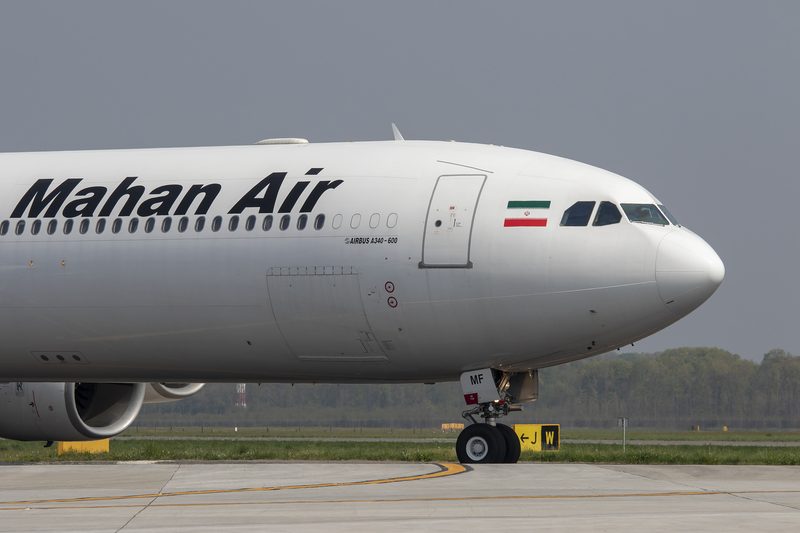
The United States has expanded its sanctions campaign against Iran’s aviation and procurement networks by targeting two Boeing 777-200ERs linked to Mahan Air, along with executives and affiliated entities tied to the carrier’s wider operations.

For aviation readers, the most important detail is that Washington did not simply sanction people and companies around the airline. It also moved directly against two relatively new additions to Mahan Air’s long-haul fleet, Boeing 777-200ERs registered EP-MTB and EP-MTE. That makes the action notable not just politically, but operationally, because it strikes at the aircraft Mahan has been trying to induct into service as part of its fleet expansion.
This is less a symbolic move than a targeted effort to complicate how the airline sustains, deploys, and grows its newest widebody assets.
Read our stories in your inbox
Two aviation newsletters. Zero fluff.
Two Boeing 777-200ERs Are Now Directly In The Crosshairs
The two aircraft named by the U.S. Treasury are EP-MTB and EP-MTE, both Boeing 777-200ERs.
That matters because the 777-200ER is not just another legacy type in Mahan Air’s fleet. It represents one of the airline’s most significant attempts in recent years to add more capable long-haul aircraft. Widebodies of this class bring much more payload and range than the older Airbus A300s, A310s, and A340s that have long formed much of the Iranian carrier’s international backbone.

EP-MTE had already entered operational use for Mahan Air, while EP-MTB had only recently become active in test flying and had not yet begun revenue service. By sanctioning both aircraft now, the United States is signaling that newly inducted fleet assets are just as much a target as the airline’s executives and procurement channels.
In practical terms, that raises the risk around parts sourcing, maintenance support, insurance exposure, and any international transaction involving the aircraft.
The Sanctions Also Reach Into Mahan Air’s Corporate Structure
The action does not stop with the aircraft.
U.S. authorities also designated Sepehr Kaveh Kish International Trading Company, described as Mahan Air’s controlling shareholder, along with board members Gholam Abbas Ataei Aghdam and Jamshid Hosseinzadeh. Mohammad Hossein Mahdian was also named for his role in managing passenger and cargo services for the airline.
That broadens the significance of the sanctions considerably. Rather than treating Mahan Air as just an operating carrier, the U.S. is targeting the ownership, governance, and service-management structure surrounding it. For airlines under sanctions, those surrounding corporate relationships are often as important as the air operator certificate itself, because they shape how aircraft are financed, serviced, staffed, and commercially managed.
This means the latest action is aimed not only at stopping movement of the aircraft, but at making the broader Mahan ecosystem harder to sustain.
Saman Air Services And Chabok FZCO Were Also Named
Two other entities stand out in the latest designations: Saman Air Services and Dubai-based Chabok FZCO.
Saman Air Services was sanctioned for allegedly facilitating shipments involving Conviasa, the Venezuelan airline that is already under U.S. sanctions. Chabok FZCO, meanwhile, was designated for allegedly sourcing sensors and other aircraft components on behalf of Mahan Air.
That second point is especially important from an aviation perspective. Aircraft sanctions are one thing. Parts procurement is another. Modern airline operations depend on steady access to components, sensors, repairs, and maintenance support, even for carriers operating older fleets. When U.S. authorities target a company accused of sourcing aircraft parts for Mahan, they are attacking one of the most vulnerable links in the chain: sustainment.
For a sanctioned airline trying to keep a mixed fleet of older Airbuses and newly acquired Boeing 777-200ERs flying, that can be more disruptive than the headline aircraft designation alone.
The 777 Story Has Been Unusual From The Start
These two aircraft are part of the much-publicized batch of five Boeing 777-200ERs that were funneled toward Iran in 2025 through a controversial transfer chain involving a purported startup in Madagascar.
That context matters because the aircraft were already politically sensitive long before this week’s sanctions. They had become a test case for how Iran could still obtain modern long-haul aircraft despite export controls, sanctions pressure, and intense scrutiny around civil aviation transfers.
By naming EP-MTB and EP-MTE specifically, Washington is now tightening the net around one of the most visible fleet-acquisition stories involving Iran in recent years.
For industry observers, this is not just about two tails. It is about sending a signal that even once aircraft reach Iran and enter a local registry, they remain exposed to aggressive secondary sanctions risk.
Not Every Mahan 777 Has Been Hit
One detail worth noting is that not all of Mahan Air’s recently acquired Boeing 777-200ERs were sanctioned in this round.
EP-MTC, another active Mahan 777-200ER, was not included in the latest U.S. action. The remaining two aircraft from the original batch have not yet entered Iranian service and have not been re-registered in Iran.
That selective approach suggests the U.S. is moving against aircraft based on a mix of ownership, operational linkage, and timing rather than simply blacklisting the entire batch at once. It also means there is still room for further sanctions action if additional aircraft are formally inducted into the fleet.
Operationally, that creates uncertainty not just for Mahan Air, but for any counterparties or intermediaries who might become involved with the remaining airframes.
Why The 777-200ER Matters So Much To Mahan Air
The Boeing 777-200ER is a particularly important aircraft for an airline like Mahan because it gives the carrier a more capable long-haul platform than many of the older widebodies in its fleet.
The type offers strong payload-range performance and is well suited to medium- and long-haul missions linking Tehran Imam Khomeini Airport (IKA) with destinations across Asia. In Iranian airline service, a 777-200ER can be especially valuable because it brings a more modern cabin platform, greater cargo potential, and stronger economics than some legacy quadjets still operating in the country.
That is what makes the sanctions move strategically meaningful. The U.S. is not merely targeting old assets already trapped inside an aging fleet. It is targeting the aircraft most likely to strengthen Mahan’s future international operation.
This Is Also About UAV Networks, Not Just Civil Aviation
The Treasury action frames the sanctions around alleged links to the proliferation of Iranian unmanned aerial vehicles and related procurement networks.
That broader framing is important because it explains why the aircraft themselves were named. In Washington’s view, Mahan Air is not being treated as a normal civilian airline with isolated compliance problems. It is being treated as part of a wider logistics and support ecosystem tied to sanctioned state and paramilitary activity.
That distinction matters because it affects how aggressively the U.S. is likely to pursue secondary sanctions, parts interdiction, and pressure on any third-country actors who facilitate operations. Once an airline is placed inside that broader security context, the threshold for enforcement becomes much lower and the consequences for counterparties become much more severe.
The Latest Action Fits A Long Pattern
Mahan Air has been under U.S. sanctions since 2011 over alleged ties to the Islamic Revolutionary Guard Corps-Quds Force.
That long history is important because it shows this is not a sudden shift in policy. The new designations are an escalation in targeting, not a change in direction. What has changed is the specific focus on newly acquired 777-200ERs and the procurement channels supporting them.
In other words, the U.S. is adapting its sanctions posture to the airline’s evolving fleet, rather than merely relying on old designations to do the work.
Bottom Line
The latest U.S. sanctions against Mahan Air are significant because they go beyond naming executives and associated companies. They directly target two Boeing 777-200ERs, EP-MTB and EP-MTE, aircraft that represent some of the most important additions to the airline’s long-haul fleet in years.
By combining aircraft designations with measures against shareholders, board members, service managers, and parts-sourcing entities, Washington is trying to do more than punish Mahan Air politically. It is trying to make the airline’s newest widebody expansion harder to finance, support, and sustain.
For Mahan, that raises the cost and complexity of operating its most strategically valuable aircraft. For the wider industry, it is another reminder that in heavily sanctioned aviation markets, fleet acquisition is only the beginning. Keeping the aircraft flying is the harder part.
Keep reading FlyMag
Get the Daily Brief in the morning or the Route Watch weekly recap on Fridays. Or both.