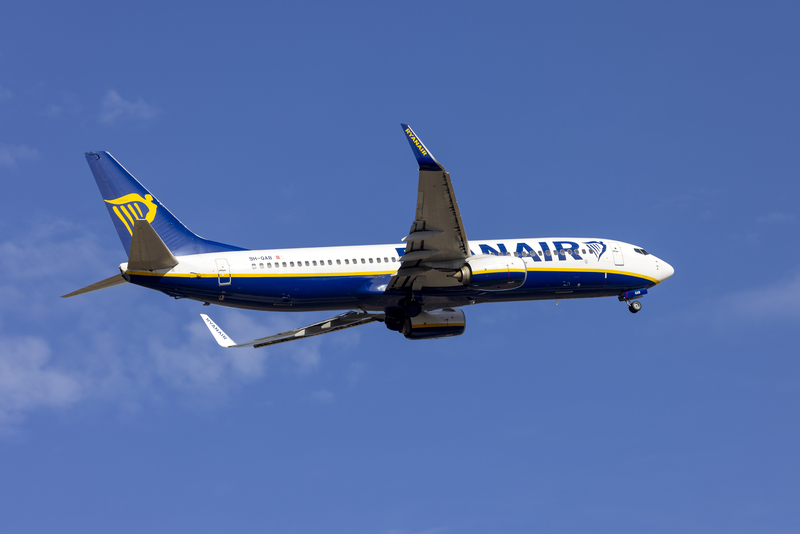
A Ryanair Boeing 737-800 operating from Spain to western France declared a low-fuel emergency on July 6 after its arrival into Nantes was interrupted by a separate runway incident involving an Iberia Regional aircraft.
Ryanair flight FR5448 was operating from Seville Airport (SVQ) to Nantes Atlantique Airport (NTE) when the crew discontinued the approach to Nantes and diverted to Brest Bretagne Airport (BES). The aircraft, Boeing 737-8AS EI-EBK, had been tracking toward NTE when the airport’s only runway became unavailable following the emergency return of an Air Nostrum-operated Iberia CRJ1000.
The Ryanair aircraft landed safely at Brest (BES). Later that night, after the Nantes runway had reopened, flight-tracking data shows the same aircraft continued from Brest (BES) to Nantes (NTE), landing shortly before midnight local time.
Read our stories in your inbox
Two aviation newsletters. Zero fluff.
For passengers, it was an exhausting disruption. For airline professionals, the sequence is a sharp example of how quickly a single-runway airport can become constrained when an aircraft emergency, runway debris, and a low-fuel diversion all intersect.
FR5448 Was Already Committed to Nantes When the Runway Closed
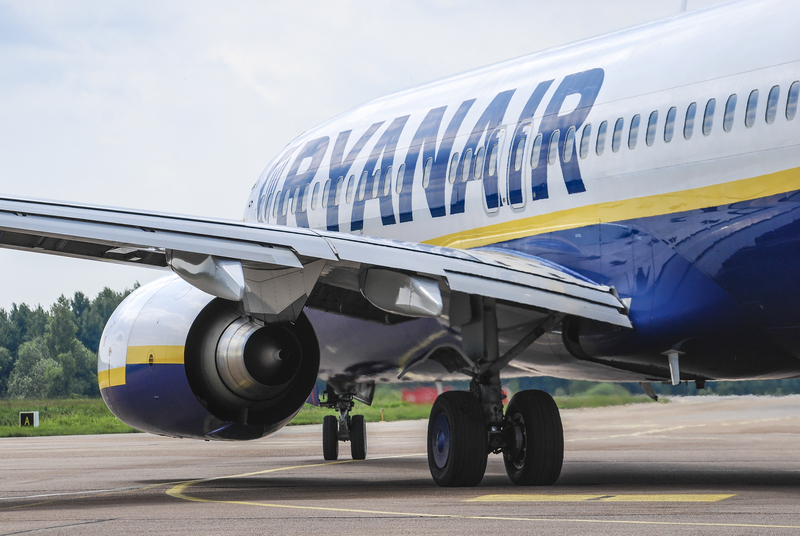
Ryanair flight FR5448 departed Seville (SVQ) for Nantes (NTE) using one of the airline’s Boeing 737-800 aircraft. Flight-tracking data lists the aircraft as EI-EBK, a Boeing 737-8AS, which is Ryanair’s 737-800 variant within the Boeing 737 Next Generation family.
Ryanair’s 737-800 is the backbone of the carrier’s European operation. The airline configures the type with 189 seats in a single-class cabin, giving it the high-density economics that define Ryanair’s short- and medium-haul model. On a routine Seville-Nantes sector, the aircraft is well within its normal operating profile.
The issue was not aircraft performance or weather. The problem was airport availability.
As FR5448 approached Nantes (NTE), the runway became blocked after an Air Nostrum CRJ1000 operating as Iberia flight IB1222 returned to Nantes following a reported technical issue after takeoff. With the runway unavailable, the Ryanair crew went around and entered a period of air traffic control coordination while the situation on the ground developed.
That is the moment when fuel planning becomes dynamic. A flight may depart with all required legal fuel, including trip fuel, contingency fuel, alternate fuel, final reserve fuel, and any additional fuel required by the crew or dispatcher. But a late go-around, an unexpected runway closure, and a diversion to another airport can quickly consume the buffer that had been planned for a normal arrival.
Why Brest Became the Safe Option
Once Nantes (NTE) could not accept the aircraft, the Ryanair crew diverted to Brest (BES), a suitable alternate in Brittany with the runway and airport infrastructure required to receive the 737-800.
This is where the language matters. A low-fuel emergency does not mean an aircraft is out of fuel. It means the crew has determined that the fuel state requires priority handling and that the aircraft should not be subjected to additional delay. Declaring an emergency gives air traffic control a clear signal: this aircraft needs direct routing, priority vectors, and an immediate landing plan.
For FR5448, Brest (BES) provided that plan. The aircraft landed safely, and the diversion removed the flight from an uncertain holding situation near Nantes.
That decision may have been frustrating for passengers who expected to land at Nantes, but operationally it was the conservative and appropriate outcome. When a destination runway is blocked and the fuel state is tightening, diverting is not a failure. It is the system working as designed.
Nantes’ Single Runway Left No Backup
The disruption was amplified by the physical layout of Nantes Atlantique Airport (NTE). The airport operates with a single main runway, designated 03/21. Aviation airport data lists the runway at 2,900 meters, or 9,514 feet, long and 45 meters, or 148 feet, wide.
That runway is more than adequate for normal commercial operations, including Boeing 737, Airbus A320-family, regional jet, cargo, and occasional widebody activity. The limitation is not length. It is redundancy.
At a single-runway airport, any disabled aircraft, runway inspection, debris concern, or surface contamination event can stop all arrivals and departures. There is no parallel runway to shift traffic onto while airport operations, fire crews, or maintenance teams inspect the surface.
That is exactly what appears to have happened at Nantes (NTE). Once debris was reported and the runway needed inspection, inbound aircraft had limited choices: hold, divert, or return to origin depending on fuel, position, and operational constraints.
For FR5448, holding was no longer the best option. Brest (BES) became the safer operational answer.
The Iberia Regional CRJ1000 Was the Trigger
The runway closure was linked to Iberia flight IB1222, operated by Air Nostrum under the Iberia Regional brand. The aircraft involved was a Mitsubishi/Bombardier CRJ1000, registered EC-MUG according to flight-tracking data.
The CRJ1000 is the largest member of the CRJ family and the highest-capacity aircraft in Air Nostrum’s regional fleet. Iberia lists the type with 100 seats, two General Electric engines, a range of 2,761 km, and short- to medium-haul route capability.
IB1222 was scheduled to operate from Nantes (NTE) to Adolfo Suárez Madrid-Barajas Airport (MAD). Instead, the aircraft returned to Nantes after departure. AirLive reported that the CRJ1000 experienced an engine issue linked to debris from a tire burst during takeoff, with debris later found on the runway.
That debris detail is critical. Even if an aircraft is able to taxi clear after landing, the runway may still remain closed until airport teams complete a full inspection. Foreign object debris can damage engines, tires, landing gear, flight controls, and other aircraft systems. For an airport operator, reopening a runway before confirming the surface is clear is not an option.
A Small Incident Can Create a Large Network Effect
The operational chain at Nantes shows how one aircraft event can rapidly affect multiple unrelated flights.
IB1222’s return made the runway unavailable. FR5448 then had to go around and divert. Other inbound aircraft would have faced similar decisions based on their own fuel states, alternate airports, crew duty limits, passenger connections, and aircraft rotations.
This is why single-runway disruption is so consequential. At a multi-runway hub, an incident on one runway may reduce capacity but not necessarily stop the airport. At Nantes (NTE), the available commercial runway was the system. Once it was closed, the airport’s arrival and departure capacity effectively fell to zero until the runway could be inspected and reopened.
The result was a cascading evening of diversions, delays, and cancellations. For passengers, those disruptions can feel chaotic. For operations teams, they are the predictable outcome of a runway closure at a constrained airport during an active evening schedule.
The Boeing 737-800 Handled the Diversion as Expected
From an aircraft perspective, the Ryanair 737-800 was doing exactly what a 737-800 is built to do: operate short- and medium-haul European sectors with high utilization, quick turnarounds, and dense seating.
The Boeing 737-800 remains one of the most widely used narrowbodies in Europe. Ryanair’s 189-seat configuration is designed for efficiency, not luxury, and the aircraft’s reliability is central to the airline’s ability to run a high-frequency, low-cost network.
But high utilization also means that disruption can echo through the schedule. Once EI-EBK diverted to Brest (BES), the aircraft was no longer where Ryanair needed it to be. The continuation to Nantes (NTE) later that night helped recover the aircraft and passengers, but the original timing had already been lost.
That is one of the hidden costs of diversions. The aircraft lands safely, which is always the priority, but the airline still has to reposition the aircraft, manage passengers, reset crew and aircraft rotations, and recover the next sectors.
The Fuel Emergency Should Be Read Carefully
The most important point is that the aircraft landed safely.
A declared low-fuel emergency is serious, but it should not be sensationalized. Public tracking data and aviation news reports show that the crew requested priority handling after the Nantes go-around and runway closure. They do not publicly establish how much fuel remained on landing, whether the aircraft was below final reserve, or what exact fuel state existed at each point in the diversion.
That matters because fuel terminology is precise. Pilots and dispatchers plan around regulatory reserves, alternates, expected routing, holding, weather, and contingencies. When conditions change after the aircraft is already airborne, the crew may declare an emergency to ensure there is no further delay. That is a protective action.
The public sees a 7700 squawk and the word “emergency.” The operational reality is a crew using the correct procedure to remove uncertainty and preserve safety margin.
Nantes Reopened Later That Night
After the Iberia Regional aircraft returned and runway debris was reported, Nantes operations were suspended while the runway was inspected. AirLive reported that the inspection was completed around 22:30 local time and that traffic resumed around 23:00.
Flight-tracking data shows the Ryanair aircraft later departed Brest (BES) and completed a short flight to Nantes (NTE), landing at 23:55 local time. That final sector is important because it shows the diversion was not the end of the journey. Ryanair ultimately moved the aircraft and passengers to the intended destination once Nantes became available again.
For passengers, that likely meant a very late arrival and a deeply frustrating evening. For the crew and operations teams, it was a recovery operation after two separate aircraft events collided in the same narrow window.
Bottom Line
Ryanair flight FR5448 became caught in a fast-moving airport disruption at Nantes Atlantique Airport (NTE) after an Iberia Regional CRJ1000 returned to the field and runway debris forced a closure of the airport’s single runway.
The Ryanair Boeing 737-800, operating from Seville (SVQ) to Nantes (NTE), went around, declared a low-fuel emergency, and diverted safely to Brest (BES). Once Nantes reopened, the aircraft later continued to its original destination.
The incident is a useful reminder that diversions are often the result of several decisions stacking up at once: a blocked runway, limited airport redundancy, fuel planning, ATC coordination, and the need to protect safety margins. For passengers, it was a long and unexpected detour. For airline professionals, it was a textbook example of why runway availability and fuel state can quickly become the two most important variables in an otherwise routine flight.
Keep reading FlyMag
Get the Daily Brief in the morning or the Route Watch weekly recap on Fridays. Or both.