Volaris has opened June with one of the most concentrated transborder growth moves in its recent history, launching 10 new U.S. routes in just two days.

The Mexican ultra-low-cost carrier began five new U.S.-bound routes on June 1 and another five on June 2, adding service from Guadalajara (GDL), Querétaro (QRO), Puebla (PBC), and San Luis Potosí (SLP). The new flights reach Detroit (DTW), Salt Lake City (SLC), Los Angeles (LAX), Houston Intercontinental (IAH), Orlando (MCO), Dallas/Fort Worth (DFW), San Antonio (SAT), Newark (EWR), and Chicago Midway (MDW).
The timing is not accidental. Mexico, the United States, and Canada are preparing for an exceptionally busy travel period around the 2026 FIFA World Cup, and Volaris is using the moment to deepen cross-border connectivity outside Mexico City. None of the 10 new routes originates at Mexico City International Airport (MEX), which is perhaps the most important strategic point in the entire announcement.
Read our stories in your inbox
Two aviation newsletters. Zero fluff.
Instead, Volaris is leaning into regional Mexico: industrial cities, fast-growing secondary airports, family-travel markets, and communities with deep links to the United States.
The 10 New U.S. Routes
The 10 routes launched over June 1 and June 2 are part of a wider 33-route June 2026 expansion by Volaris. An 11th U.S. route, Querétaro (QRO) to Denver (DEN), is scheduled to follow on June 3.

For the first two days of the launch wave, the new U.S. routes are:
| Route | Start Date | Frequency | Filed Aircraft |
|---|---|---|---|
| Guadalajara (GDL) – Detroit (DTW) | June 1, 2026 | 3 weekly | Airbus A320neo |
| Guadalajara (GDL) – Salt Lake City (SLC) | June 1, 2026 | 3 weekly | Airbus A320neo |
| Puebla (PBC) – Los Angeles (LAX) | June 1, 2026 | 4 weekly | Airbus A320neo |
| Querétaro (QRO) – Houston Intercontinental (IAH) | June 1, 2026 | 3 weekly | Airbus A320neo |
| Querétaro (QRO) – Orlando (MCO) | June 1, 2026 | 2 weekly | Airbus A320neo |
| Querétaro (QRO) – Dallas/Fort Worth (DFW) | June 2, 2026 | 3 weekly | Airbus A320neo |
| Querétaro (QRO) – San Antonio (SAT) | June 2, 2026 | 3 weekly | Airbus A320neo |
| Puebla (PBC) – Newark (EWR) | June 2, 2026 | 4 weekly | Airbus A320neo |
| Puebla (PBC) – Houston Intercontinental (IAH) | June 2, 2026 | 3 weekly | Airbus A320neo |
| San Luis Potosí (SLP) – Chicago Midway (MDW) | June 2, 2026 | 4 weekly | Airbus A320neo |
The route list says a lot about Volaris’ priorities. These are not prestige routes built around Mexico City (MEX), Cancún (CUN), or the largest U.S. coastal gateways alone. They are community-driven routes connecting regional Mexican cities with U.S. markets that have strong family, business, industrial, and leisure ties.
Guadalajara Adds Detroit And Salt Lake City
Guadalajara (GDL) remains one of Volaris’ most important airports and one of the strongest Mexico–U.S. gateways outside the capital.
The new Guadalajara (GDL)–Detroit (DTW) route gives Volaris access to a major Midwest metro with deep automotive, manufacturing, and Mexican-American community ties. Detroit (DTW) is also a powerful airport in its own right, dominated by Delta Air Lines, but with enough international and visiting-friends-and-relatives demand to support targeted low-cost service.
United Extends Palermo Into Winter, Showing Sicily May Be More Than Just A Summer Bet
The Guadalajara (GDL)–Salt Lake City (SLC) route is equally notable because it marks Volaris’ arrival in Utah. Salt Lake City (SLC) is not one of the traditional first-choice U.S. gateways for Mexican carriers, but the market has grown in importance because of population growth, regional economic expansion, and demand from Mexican communities across Utah and the Mountain West.
For Volaris, both routes fit the same logic. Guadalajara (GDL) is large, well connected, and culturally central. It can support a broad range of U.S. routes that combine visiting-friends-and-relatives demand with leisure and some business traffic. Adding Detroit (DTW) and Salt Lake City (SLC) gives the airline more reach into U.S. regions where nonstop Mexico service is still relatively limited compared with markets such as Los Angeles (LAX), Chicago (ORD/MDW), Houston (IAH/HOU), and Dallas/Fort Worth (DFW).
Querétaro Gets The Biggest U.S. Push
Querétaro (QRO) is the clear winner in this launch wave.
The airport gains four U.S. routes in the first two days alone: Houston (IAH), Orlando (MCO), Dallas/Fort Worth (DFW), and San Antonio (SAT). A fifth U.S. route, Denver (DEN), follows on June 3 as part of the broader expansion.
That is a major step for Querétaro Intercontinental Airport (QRO), which has become increasingly important thanks to the region’s manufacturing, aerospace, automotive, technology, and business base. Querétaro is one of Mexico’s strongest industrial growth markets, and air service has been catching up with that economic reality.
The Texas routes are especially logical. Houston (IAH), Dallas/Fort Worth (DFW), and San Antonio (SAT) all have strong Mexico demand, large Mexican-American communities, and substantial business links. San Antonio (SAT), in particular, has close cultural and family ties with Mexico, while Houston (IAH) and Dallas/Fort Worth (DFW) are major commercial gateways with deep energy, industrial, and corporate links.
Orlando (MCO) is different. That route is more leisure-oriented, with Florida tourism, theme-park demand, and family travel playing a larger role. For Volaris, it diversifies Querétaro’s U.S. network beyond Texas and gives central Mexico a nonstop option to one of the largest leisure destinations in the United States.
Puebla Is No Longer Just A Secondary Alternative
Puebla (PBC) also receives a major boost, with new service to Los Angeles (LAX), Newark (EWR), and Houston (IAH).
Puebla International Airport (PBC) has long lived in the shadow of Mexico City (MEX). The two cities are close enough that many international travelers have historically used Mexico City’s much larger airport and then continued by road. But that model is not ideal for passengers who live in Puebla, Tlaxcala, parts of Veracruz, or surrounding regions.
Volaris is trying to change that.
The new Puebla (PBC)–Los Angeles (LAX) route taps into one of the largest Mexico–U.S. travel markets. Southern California has enormous Mexican community ties, and Los Angeles (LAX) remains one of the most important gateways for travel between the U.S. and Mexico.
Puebla (PBC)–Newark (EWR) is more unusual and strategically interesting. Newark gives Volaris access to the New York metropolitan area, including New Jersey, New York City, and parts of Pennsylvania and Connecticut. For passengers with family roots in central Mexico, a nonstop to Puebla (PBC) can remove the need to connect through Mexico City (MEX), Cancún (CUN), or another Mexican gateway.
Puebla (PBC)–Houston (IAH) adds a Texas link with both family and business relevance. Houston is one of the strongest U.S. markets for Mexico service, and Volaris’ route gives Puebla passengers access to a major U.S. metro without a Mexico City transfer.
For Puebla, the broader message is clear: Volaris wants to make PBC a more serious international gateway for central Mexico.
San Luis Potosí Adds Chicago Midway
San Luis Potosí (SLP) gains new service to Chicago Midway (MDW), operating four times weekly.
This is another route built around community, industry, and geography. San Luis Potosí has a strong manufacturing base, including automotive and logistics activity, and Chicago has one of the largest Mexican communities in the United States. The choice of Midway (MDW), rather than Chicago O’Hare (ORD), also fits Volaris’ low-cost model.
Midway (MDW) is heavily associated with Southwest Airlines and short-haul domestic flying, but it can work well for point-to-point international service where cost, convenience, and local catchment matter. For many travelers in the Chicago area, especially those in the city and southwest suburbs, MDW can be easier than O’Hare.
The SLP–MDW route also builds on Volaris’ existing presence in San Luis Potosí. The city is becoming a more useful cross-border node, with U.S. demand that extends beyond the most obvious Texas markets.
Four weekly flights suggest Volaris sees enough traffic to support a meaningful schedule, but not yet enough to justify daily service. That is a sensible starting point for a specialized transborder market.
Why Mexico City Is Missing
The absence of Mexico City (MEX) from the route list is one of the most important details.
Mexico City remains one of the most important aviation markets in Latin America, but it is also constrained, congested, and politically complicated. Volaris has every reason to grow where it can add capacity more efficiently, avoid some of the pressure at MEX, and stimulate new demand closer to passengers’ homes.
That is exactly what this expansion does.
Instead of forcing passengers from Puebla, Querétaro, San Luis Potosí, or western Mexico to backtrack through Mexico City (MEX), Volaris is building more nonstop access from regional airports. This is classic ultra-low-cost stimulation: open a nonstop route, price it aggressively, reduce travel time, and bring passengers into the market who may not have flown before or who previously endured long ground transfers.
It also gives Volaris more defensible niches. Competing head-to-head from Mexico City (MEX) can be expensive and slot-constrained. Building new cross-border routes from underserved regional airports gives the airline more opportunity to create demand rather than simply fight for existing traffic.
The A320neo Is The Right Launch Aircraft
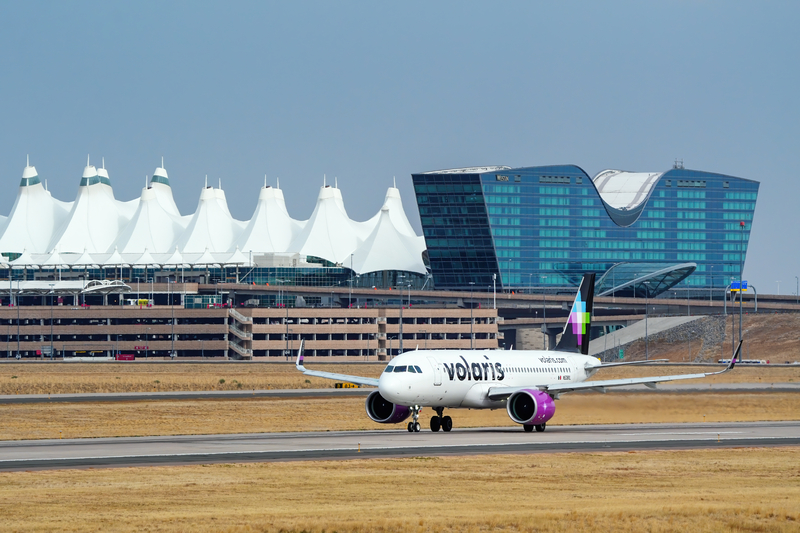
The newly launched routes are filed with Airbus A320neo aircraft, which makes sense for Volaris’ strategy.
The A320neo is a high-efficiency narrowbody that Volaris configures with an average of 186 seats. It gives the airline enough capacity for price stimulation while keeping trip costs lower than older-generation aircraft. Its fuel efficiency is especially important in 2026, with Volaris and other airlines facing elevated jet fuel prices.
For routes such as Querétaro (QRO)–Orlando (MCO), Puebla (PBC)–Newark (EWR), and San Luis Potosí (SLP)–Chicago Midway (MDW), the A320neo is a strong fit. These are medium-haul international sectors where unit cost matters and where the airline needs to keep fares low enough to stimulate VFR and leisure demand.
The aircraft also provides commonality. Volaris operates an all-Airbus A320-family fleet, including A320s, A320neos, A321s, and A321neos. As of the first quarter of 2026, Volaris had 155 aircraft, with NEO-family aircraft representing two-thirds of the fleet. That commonality supports crew training, maintenance planning, scheduling flexibility, and cost control.
The A321 and A321neo remain important across Volaris’ broader U.S. network, especially on higher-demand routes. The larger A321neo averages 238 seats in Volaris service, giving the carrier a powerful low-unit-cost tool where demand is deep enough. But for new route launches, the A320neo is often the more balanced aircraft.
Transborder Flying Is A Higher-Yield Priority
Volaris’ latest U.S. expansion also fits the airline’s financial strategy.
In April 2026, the carrier said international traffic was growing faster than domestic traffic, while domestic capacity was being adjusted amid elevated fuel prices. Management specifically pointed to prioritizing the higher-yielding transborder segment.
That is exactly what these routes represent.
Mexico’s domestic market is large, but it can be extremely price-sensitive and competitive. Transborder routes to the United States often have stronger revenue potential because of family travel, labor mobility, cross-border business links, and passengers willing to pay for nonstop convenience.
The VFR market is especially important. Many travelers flying between Mexico and the U.S. are visiting family rather than taking discretionary vacations. That demand can be resilient, particularly on routes connecting Mexican regional cities with U.S. communities where migration and family ties are strong.
Volaris has built much of its U.S. strategy around those flows. The June 2026 expansion doubles down on that approach.
World Cup Timing Adds Another Layer
The expansion also arrives ahead of a historic travel period.
The 2026 FIFA World Cup will be hosted across Mexico, the United States, and Canada, with Mexico hosting matches in Mexico City, Guadalajara, and Monterrey. Volaris’ new routes are not all directly tied to host-city traffic, but the tournament will raise overall travel demand, awareness, and cross-border movement across North America.
Guadalajara (GDL) is particularly relevant because it is one of Mexico’s World Cup host cities. New U.S. links from GDL to Detroit (DTW) and Salt Lake City (SLC) give the city added reach ahead of the tournament.
More broadly, the World Cup creates a favorable backdrop for airlines to build brand awareness and stimulate travel between Mexico and the U.S. Even routes not directly serving host-city traffic can benefit from the larger travel environment, especially when families, fans, and tourists combine visits across multiple cities.
For Volaris, the timing is useful. The carrier is not waiting until the tournament starts to add capacity. It is putting the routes into the market early enough to build awareness and booking patterns.
Regional Airports Are The Strategy
This expansion is best understood as a regional-airport strategy.
Guadalajara (GDL) is already a major Mexican gateway, but Querétaro (QRO), Puebla (PBC), and San Luis Potosí (SLP) are the more interesting pieces. These cities have significant demand but historically less nonstop international service than their catchment areas might justify.
Volaris is betting that passengers will choose a nearby nonstop over a longer ground journey to Mexico City (MEX), León/Guanajuato (BJX), Guadalajara (GDL), or Monterrey (MTY). That is a reasonable bet in many of these markets.
The airport pairs also show how Mexico–U.S. traffic has evolved. This is not just about the biggest cities. It is about connecting mid-sized industrial and family markets directly. Querétaro to San Antonio. Puebla to Newark. San Luis Potosí to Chicago Midway. Guadalajara to Salt Lake City.
Those are the kinds of routes that can be missed by traditional hub-and-spoke thinking but make sense for a disciplined ultra-low-cost carrier.
The Risks Are Still Real
The expansion is ambitious, and not every route is guaranteed to succeed.
Low-frequency international routes can be difficult to build. A two-weekly service such as Querétaro (QRO)–Orlando (MCO) may appeal to flexible leisure travelers but can be less useful for business passengers or those needing specific travel dates. Even three- and four-weekly routes require careful scheduling to match community travel patterns.
Seasonality is another factor. Summer demand may be strong, especially around school holidays and World Cup-related travel, but Volaris will need to assess how these markets perform in shoulder periods and winter.
Competition will vary by route. Some markets have little or no nonstop competition, which helps Volaris. Others involve large airports where passengers have many one-stop alternatives or existing nonstop service from other airlines.
Fuel remains the other major risk. Volaris is using efficient A320neo-family aircraft, but longer transborder routes still require enough fare revenue to offset fuel burn, airport costs, crew costs, and utilization demands.
The airline’s advantage is flexibility. If one route underperforms, Volaris can redeploy aircraft elsewhere in its all-Airbus network.
A Stronger U.S. Footprint
With this launch wave, Volaris is reinforcing its role as one of the most important foreign airlines in the U.S.–Mexico market.
The airline is not trying to replicate Aeromexico’s full-service model or the hub strength of U.S. majors such as American Airlines, United Airlines, and Delta Air Lines. Its proposition is different: low fares, point-to-point connectivity, high aircraft density, and a focus on passengers who care most about price and nonstop access.
That model is well suited to many Mexico–U.S. markets.
The route additions also show Volaris becoming more comfortable with U.S. airports beyond the obvious gateways. Detroit (DTW), Salt Lake City (SLC), Orlando (MCO), San Antonio (SAT), Newark (EWR), Chicago Midway (MDW), Dallas/Fort Worth (DFW), Houston (IAH), and Los Angeles (LAX) all serve different demand pools.
Together, they give Volaris a broader cross-border network and more ways to connect Mexican regional cities directly with U.S. communities.
Bottom Line
Volaris launched 10 new U.S. routes over June 1 and June 2, 2026, adding cross-border service from Guadalajara (GDL), Querétaro (QRO), Puebla (PBC), and San Luis Potosí (SLP).
The routes connect those Mexican cities with Detroit (DTW), Salt Lake City (SLC), Los Angeles (LAX), Houston (IAH), Orlando (MCO), Dallas/Fort Worth (DFW), San Antonio (SAT), Newark (EWR), and Chicago Midway (MDW). All 10 are filed with Airbus A320neo aircraft, giving Volaris a fuel-efficient, 186-seat platform for thinner transborder markets.
The most important point is that this expansion avoids Mexico City (MEX). Volaris is building around regional Mexican airports, where nonstop U.S. service can save passengers time, stimulate demand, and connect communities that have historically relied on ground transfers or one-stop itineraries.
The strategy also aligns with Volaris’ financial priorities. The airline has been trimming domestic capacity while protecting higher-yielding transborder flying, and these new routes deepen that U.S. focus just as North America prepares for a major World Cup travel cycle.
Not every route will be easy. Frequencies are modest, competition varies, and fuel costs remain a challenge. But the direction is clear: Volaris sees regional Mexico–U.S. flying as one of its best growth opportunities, and June 2026 marks one of its biggest steps yet in that strategy.