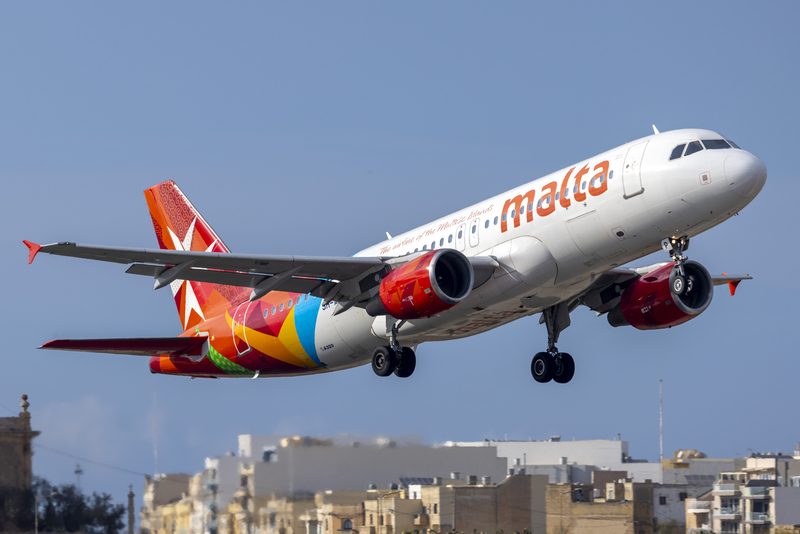
KM Malta Airlines is moving to add more capacity from Brussels Airport (BRU) and London Gatwick Airport (LGW) after a sharp spike in demand from Maltese voters abroad seeking to return home for the May 30 general election.
At one level, this is a straightforward election-travel story. At another, it is a revealing look at how quickly a relatively small national carrier can come under pressure when a politically driven travel window collides with limited seat capacity and highly concentrated demand.
For aviation readers, the significance lies in the speed of the demand surge and the fact that KM Malta is now actively trying to secure more slots at two of Europe’s most constrained and operationally sensitive airports.
Read our stories in your inbox
Two aviation newsletters. Zero fluff.
The Demand Spike Was Immediate
The airline’s special election fare scheme appears to have triggered an unusually strong booking response almost as soon as it opened.
Current reporting indicates that 763 passengers booked the €90 return fare on the first day alone, with demand especially heavy from the United Kingdom and Belgium. That matters because it shows the airline is not dealing with a gradual rise in bookings. It is dealing with a concentrated travel surge tied to a narrow electoral timetable.
That kind of pressure is difficult for any airline to absorb smoothly, especially when the peak dates are effectively fixed by the political calendar rather than by flexible seasonal travel demand.
Brussels And Gatwick Are The Critical Pressure Points
The two airports drawing the most attention are London Gatwick (LGW) and Brussels (BRU).
That is not surprising. Both cities have significant Maltese communities and naturally generate strong outbound demand when elections bring overseas voters back to the island. For KM Malta Airlines, those are exactly the sorts of markets where even a modest shortfall in available seats becomes politically visible very quickly.
The fact that the carrier is now seeking additional slots at both airports shows the pressure is not theoretical. The airline clearly believes existing capacity may not be enough to absorb the demand concentrated around the election period.
KM Malta Has Already Added Extra Flights
The airline is not just exploring options. It has already taken concrete steps.
KM Malta Airlines has confirmed special election fares and additional flights for eligible voters travelling between May 20 and June 3, with flight additions focused around the most critical travel days in late May and early June. That tells you the carrier is already in reactive mode, trying to strengthen the operation around a highly specific and politically sensitive travel peak.
This is important because it means the issue has moved beyond ordinary seasonal scheduling. The airline is now effectively tailoring parts of its operation around the voting calendar.
The Fare Scheme Is Highly Targeted
The discounted fare itself is also worth noting.
The €90 return fare is only available to registered voters appearing on the Electoral Commission list, along with eligible dependants, and bookings are being handled through a dedicated call center rather than standard open-market channels. That creates a tightly controlled and very specific product rather than a general public promotion.
From an airline-planning perspective, this kind of fare is unusual because it is not purely commercial. It sits in the space where transport policy, public expectation, and electoral logistics overlap.
That makes the route and capacity decisions around it more politically charged than a normal fare sale would be.
The Pressure Is Not Just About Price — It Is About Timing
One reason demand is proving so difficult to manage is that the travel window is unusually rigid.
Passengers are not simply choosing convenient leisure dates. They are trying to travel within a narrow band that allows them to return to Malta, participate in the election process, and then depart again. That naturally creates booking concentration around the same few days, especially the period close to the early-voting weekend and election day itself.
In airline terms, that is a much harder problem than ordinary seasonal demand. A small carrier can often spread leisure traffic across a wider date range. It cannot do that easily when nearly everyone wants the same flights.
The Issue Has Already Become Politically Sensitive
The strong demand has quickly spilled into the public and political arena.
Reports indicate that some voters have struggled to find available seats or even get through to the airline as demand surged. That, in turn, has prompted criticism and calls from political figures to ensure all eligible overseas voters can realistically travel home. Some have even suggested that similar arrangements should be expanded to include other airlines if KM Malta cannot absorb the pressure alone.
That is a notable shift. Once a fare and capacity issue begins to affect election access, the airline is no longer just managing customer service. It is operating in the middle of a public-democratic expectation.
Slot Constraints Make The Problem Harder Than It Sounds
On paper, the solution looks simple: add more flights.
In reality, Brussels Airport (BRU) and London Gatwick Airport (LGW) are not places where capacity can always be added casually at short notice. Slot access, aircraft availability, crew planning, and operational timing all matter. That means KM Malta Airlines can want more flights and still face structural limits on how quickly it can deliver them.
That is what makes the current effort to secure additional slots so important. It shows the airline is trying to solve the problem, but also that solving it depends on infrastructure and airport access, not just willingness.
This Is A Small-Airline Stress Test
In a broader sense, the episode functions as a stress test for KM Malta Airlines.
National carriers of this scale often operate comfortably within their regular market pattern, but unusual demand surges expose their limits quickly. Election traffic is one of those unusual surges. It creates a public obligation feel around a commercial airline product, and it compresses the network’s flexibility into a very short booking and travel window.
That is why this situation matters beyond the election itself. It shows what happens when a relatively small airline is asked to behave, for a few weeks, almost like a public transport utility.
Bottom Line
KM Malta Airlines’ effort to add more flights from London Gatwick (LGW) and Brussels (BRU) ahead of Malta’s May 30 general election is a sign of just how strong and concentrated overseas voting demand has become. The airline has already added extra flights and launched a tightly targeted €90 return fare, but demand has still outpaced available capacity in some of the most important markets.
For the airline, this is an operational challenge. For Malta, it has quickly become something broader: a test of how easily overseas voters can get home when electoral demand collides with the practical limits of airline capacity.
Keep reading FlyMag
Get the Daily Brief in the morning or the Route Watch weekly recap on Fridays. Or both.