Bamboo Airways has removed publicly bookable scheduled flights from its reservation system for August 2026, leaving the financially troubled Vietnamese carrier dependent on a small number of charter operations.

Since August 1, searches on the airline’s website for major domestic routes—including Hanoi Noi Bai International Airport (HAN)–Ho Chi Minh City Tan Son Nhat International Airport (SGN), Hanoi Airport (HAN)–Da Nang International Airport (DAD), and Ho Chi Minh City Airport (SGN)–Da Nang Airport (DAD)—have returned a “no flights found” message.
The disappearance of scheduled inventory does not mean Bamboo Airways has formally ceased all flying. The airline continues to operate selected charter services that are not available for individual purchase through its public booking platform. However, Bamboo has not published a normal operating schedule for August or provided a firm date for the return of scheduled passenger service.
Read our stories in your inbox
Two aviation newsletters. Zero fluff.
Macau Charters Continue With a Single Airbus A321
Bamboo Airways operated charter Flight QH9588 from Da Nang Airport (DAD) to Macau International Airport (MFM) on August 1 using Airbus A321ceo VN-A227.
The flight was sold under a charter arrangement in which a travel company or commercial partner contracted the entire aircraft rather than Bamboo selling individual seats directly to passengers.
Another Da Nang Airport (DAD)–Macau Airport (MFM) charter is scheduled for August 20. Flight QH9588 is listed to depart Da Nang at 12:30 p.m. and arrive in Macau at 3:20 p.m. The return, QH9589, is scheduled to leave Macau at 4:40 p.m. and reach Da Nang at 5:35 p.m.
After returning from Macau, the same Airbus A321 is scheduled to operate QH146 from Da Nang Airport (DAD) to Hanoi Airport (HAN). Vietnamese reporting identifies that rotation as the final flight in the current Macau charter series before the aircraft is expected to stop operating from August 22. Bamboo could still arrange additional private charters, but no wider schedule has been announced.
The reliance on a charter contract reduces Bamboo’s commercial risk because the partner purchasing the capacity assumes responsibility for filling the seats. It is fundamentally different from a scheduled flight, where the airline must sell enough individual tickets to cover the aircraft, crew, fuel, airport, and handling costs.
Only One of Three Aircraft Is Reportedly Flying
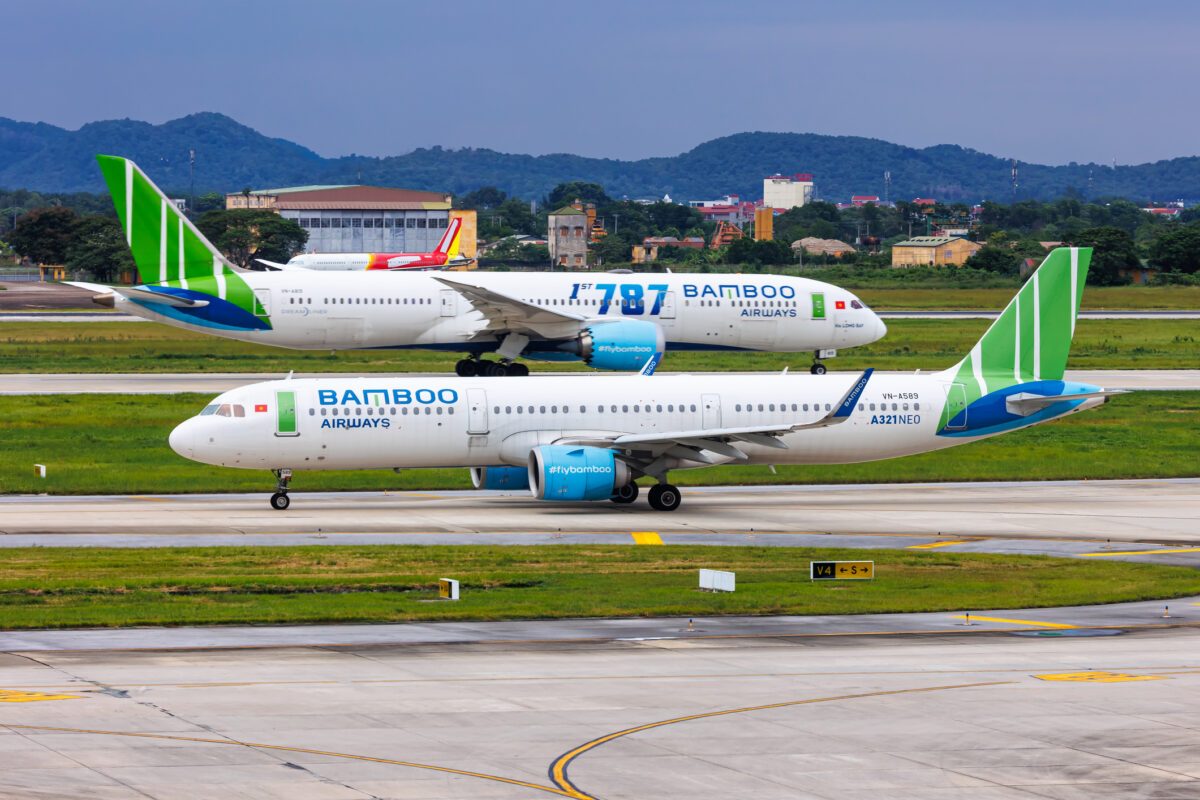
Bamboo Airways’ fleet has fallen to just three aircraft: one Airbus A321ceo, one Airbus A320neo, and one Airbus A320ceo.
Only one aircraft—VN-A227—has reportedly been handling the airline’s recent flying, while the other two remain parked. That leaves Bamboo with almost no operational resilience. A technical fault, crew shortage, weather disruption, or airport delay affecting the active aircraft can disrupt every subsequent flight assigned to it.
That problem was visible on July 28, when VN-A227 operated six consecutive flight sectors linking Hanoi Airport (HAN), Ho Chi Minh City Airport (SGN), Da Nang Airport (DAD), and Macau Airport (MFM). Five of the six flights were delayed by approximately two to three hours as delays accumulated across the aircraft’s schedule.
VN-A227 is an Airbus A321-211 equipped with wingtip Sharklets. The aircraft was produced in 2013 and previously operated for EVA Air before joining Bamboo Airways.
Bamboo configures the A321ceo with 192 seats: eight in business class and 184 in economy. The carrier’s official fleet specifications list a maximum range of approximately 3,697 miles and a cruise speed of Mach 0.82.
The A321 provides more capacity than Bamboo’s two A320-family aircraft, making it the logical choice when an entire charter flight has already been sold. However, repeatedly assigning one aircraft across domestic and international sectors creates a fragile operation with no immediate replacement when a disruption occurs.
Passengers Face Cancellations and Long Refund Delays
Bamboo Airways issued an apology on July 28 after repeated cancellations and schedule changes affected both domestic and international passengers.
The airline said it accepted responsibility for the disruption and would process refunds for affected customers. It also warned that the unusually large number of claims would result in longer processing times.
Passengers who purchased directly through Bamboo’s website, mobile application, or ticket offices may receive an electronic voucher within seven to 14 business days. Customers requesting cash refunds by email could wait as long as 90 business days after submitting all required documents.
Tickets purchased through travel agencies or third-party booking services must generally be handled by the original seller. Bamboo has directed affected customers to its passenger support and refund information center.
The delay creates a difficult situation for travelers who must purchase replacement flights on short notice. Some passengers have reported buying more expensive tickets from Vietnam Airlines, Vietjet Air, or other carriers while their original Bamboo payments remain tied up in the refund process.
Travel agencies have also raised concerns about deposits and ticket-sale funds still being held by Bamboo, adding another layer of uncertainty beyond passengers with individual reservations.
Operational Performance Deteriorated Before August
The withdrawal of scheduled flights followed a sharp deterioration in Bamboo’s reliability.
According to Civil Aviation Authority of Vietnam data cited by Vietnamese business media, Bamboo operated 725 flights during June 2026. Approximately 241 were delayed, producing a delay rate of roughly 33%.
That placed Bamboo among Vietnam’s weakest-performing airlines for on-time operations during the month. The shortage of available aircraft meant that even relatively minor disruptions could continue through multiple rotations rather than being absorbed by a spare jet.
Bamboo’s official website was still advertising domestic fares through July 31, including services from Hanoi Airport (HAN) to Da Nang Airport (DAD) and Cam Ranh International Airport (CXR), and from Ho Chi Minh City Airport (SGN) to Da Nang Airport (DAD) and Phu Cat Airport (UIH). The advertised travel dates ended precisely when public August availability disappeared.
Dreamliner Revival Plans Were Aspirational
The reduction to one active narrowbody comes only months after Bamboo publicly discussed rebuilding its fleet and potentially returning to long-haul flying.
In March 2026, the airline said it hoped to add eight to 10 aircraft per year and eventually restore a fleet of approximately 30 airplanes. It also disclosed discussions between founder Trinh Van Quyet and Boeing regarding the possible revival of earlier Boeing 787-9 Dreamliner purchase agreements.
At the same time, Bamboo said it was considering leasing Boeing 737 MAX aircraft to support future narrowbody operations. Those were exploratory plans, not completed aircraft acquisitions or confirmed delivery agreements.
That distinction is important. Bamboo had previously ordered Boeing 787-9s and operated several leased Dreamliners, but the widebody fleet was removed during its restructuring. The airline’s former 787s supported long-haul services from Vietnam to airports including London Gatwick Airport (LGW), Frankfurt Airport (FRA), Melbourne Airport (MEL), and Sydney Kingsford Smith Airport (SYD).
Reviving a 787 operation would require significantly more than securing an aircraft. Bamboo would need financing, trained flight crews, maintenance support, spare parts, long-haul sales infrastructure, overseas station agreements, and enough working capital to absorb the cost of developing intercontinental routes.
The current inability to sustain a small scheduled Airbus operation makes a near-term Dreamliner return increasingly difficult, regardless of the airline’s longer-term intentions.
A Dramatic Reversal From Bamboo’s Expansion Years
Bamboo Airways began commercial operations in January 2019 and rapidly developed one of Vietnam’s most ambitious airline networks.
At its peak, the carrier operated more than 40 aircraft from the Airbus A320 family, Embraer E190 family, and Boeing 787-9 Dreamliner fleet. Its network extended to approximately 20 Vietnamese and 18 international destinations.
Bamboo attempted to combine competitive fares with features normally associated with full-service airlines, including business class, complimentary baggage, inflight meals, lounges, and a long-haul premium product.
The airline’s international ambitions ultimately proved difficult to sustain. Long-haul routes to Australia, Germany, and the United Kingdom were removed in late 2023 as Bamboo entered a major restructuring. Its fleet was reduced to single-aisle Airbus aircraft, while scheduled international operations were largely replaced by charters and selected regional flights.
FLC Group regained control of Bamboo Airways in September 2025 after the previous investor group said it no longer had the financial capacity to manage the airline. At that time, Bamboo still operated seven Airbus aircraft across a reduced domestic network while maintaining only limited charter flying internationally.
Less than a year later, the fleet has fallen from seven aircraft to three, with only one reportedly active.
Debt and Aircraft-Leasing Pressure Remain Central
Bamboo’s shrinking fleet is closely connected to its financial position and relationships with aircraft lessors.
Vietnamese financial reporting shows substantial unpaid obligations to banks, airport operators, lessors, and other aviation service providers. The Airports Corporation of Vietnam recorded Bamboo as its largest source of difficult-to-recover short-term receivables at the end of 2025.
Aircraft lessors can repossess or decline to renew leases when an airline fails to meet its payment obligations. For an airline without owned aircraft or immediate access to replacement capacity, the loss of only a few leased jets can rapidly make an existing schedule impossible to operate.
Vietnamese aviation authorities have held discussions with Bamboo and other stakeholders regarding the airline’s operations and outstanding financial commitments. According to local reporting, those talks had not produced a complete solution by the beginning of August.
Has Bamboo Airways Shut Down?
Bamboo Airways has not formally declared bankruptcy, announced its liquidation, or disclosed that it is surrendering its air operator certificate.
It is therefore premature to say the airline has completely ceased operations. Charter flights can continue without seats appearing in the public reservation system, and Bamboo could restore scheduled flights if it secures aircraft, financing, and regulatory approval for a revised timetable.
Nevertheless, removing all publicly bookable scheduled flights is an extremely serious development. A scheduled passenger airline depends on future ticket sales for cash flow, customer confidence, and commercial relevance. Remaining active primarily through occasional charters represents a dramatically smaller business.
The absence of a published August schedule also prevents passengers, travel agents, and commercial partners from knowing whether the interruption will last weeks, months, or become permanent.
Bottom Line
Bamboo Airways has removed scheduled passenger flights from public sale for August 2026, with its website returning no availability on major domestic routes from Hanoi Airport (HAN), Ho Chi Minh City Airport (SGN), and Da Nang Airport (DAD).
The airline has not completely stopped flying. Limited charter operations continue, including Da Nang Airport (DAD)–Macau Airport (MFM) flights operated with Airbus A321ceo VN-A227.
Bamboo’s fleet has shrunk to three Airbus aircraft, and only the 192-seat A321 is reportedly active. That leaves the carrier without meaningful backup capacity and makes a reliable scheduled network exceptionally difficult to maintain.
The airline has apologized to affected passengers and promised refunds, but some customers may wait as long as 90 business days for cash repayment. Bamboo has not provided a timetable for restoring scheduled service.
Only months ago, the company was discussing renewed Boeing 787-9 deliveries and leased 737 MAX aircraft. Those plans were never finalized, and the immediate challenge is now far more basic: retaining enough aircraft and working capital to operate a dependable airline.
Bamboo Airways has not formally shut down, but its transition from a nationwide scheduled carrier to an operation centered on a single aircraft and occasional charters places its future in serious doubt.