Taipei’s Taiwan Taoyuan International Airport (TPE) is built for throughput: two long, parallel precision-approach runways, tightly banked arrival waves, and just enough spare capacity to recover quickly when the operation stays intact. On February 8, 2026, that margin disappeared in minutes.

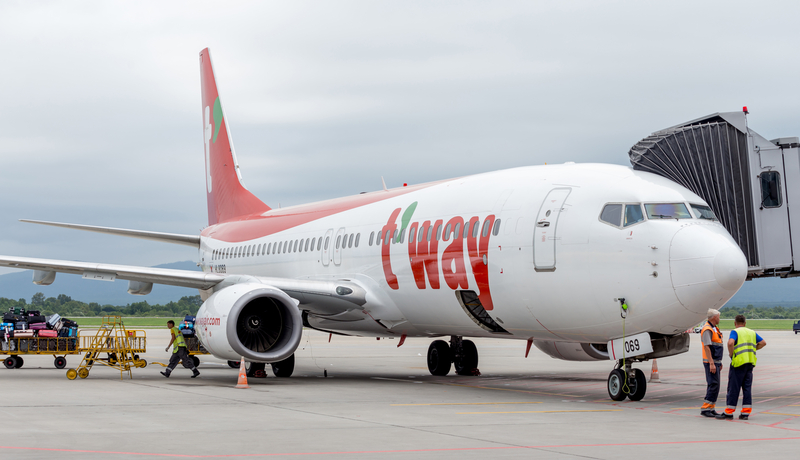
A T’way Air Boeing 737-800 arriving as TW687 from Jeju (CJU) suffered a right main-landing-gear tire detachment on touchdown. The aircraft remained under control, vacated safely, and passengers disembarked without injury. But the tire and associated debris on the runway triggered a chain reaction that any operations team will recognize: runway closure, forced single-runway sequencing, airborne holding, and rapidly tightening fuel margins—culminating in three separate flights declaring “Mayday” due to low fuel within a very short window.
What happened on the runway at TPE
According to the airport operator, TW687 touched down on the north runway at 3:52 p.m. local time. During rollout, the aircraft shed a tire from the right main gear, leaving debris behind. The crew taxied clear and stopped at stand A2 by 3:54 p.m., with no injuries reported.
Read our stories in your inbox
Two aviation newsletters. Zero fluff.
From there, the operational priorities were non-negotiable. A runway contaminated by tire carcass fragments, wheel assembly parts, or shrapnel-like rubber and metal is a classic FOD scenario: it threatens engines, tires, and landing gear of every aircraft behind it. Taoyuan International Airport Corporation suspended operations on the north runway immediately and began a full sweep, marking and removing debris. The north runway returned to service at 5:35 p.m., after roughly 100 minutes of restricted capacity.
In isolation, a 100-minute runway closure doesn’t sound catastrophic. At a two-runway hub in an arrival bank, it’s more than enough to tip the whole system into delay propagation.
Why losing one runway at TPE is such a big deal
TPE’s parallel runways are not “nice to have”—they’re the backbone of the airport’s arrival and departure rhythm. The field operates with:
-
Runway 05L/23R (commonly described as the “north” runway), about 3,660 meters long
-
Runway 05R/23L (the “south” runway), about 3,800 meters long
When one runway drops out, the airport doesn’t just lose slots; it loses flexibility:
Arrival rate compression. Controllers must merge all arrivals and departures onto one runway, which immediately increases spacing requirements. Even before you add wake turbulence categories and runway occupancy time, the runway becomes a single choke point for the entire movement area.
Ground-side saturation risk. As arrivals stack up, gates and taxiways get stressed. Late inbound aircraft push turn times into the next bank, and late outbound aircraft miss departure windows—especially painful on routes with tight enroute restrictions or long-haul departure sequencing.
Fuel becomes the limiting factor. Holding patterns burn contingency fuel rapidly. Most crews arrive with legal reserves that anticipate typical arrival sequencing—not an extended one-runway constraint during a peak wave. This is how a mechanical anomaly on one aircraft can force unrelated flights into declarations within the hour.
Punches Thrown Before Takeoff: EVA Air Probes Alleged Cockpit Assault During LAX Taxi
The “Mayday” cluster: three flights hit the fuel wall
The most eye-catching detail wasn’t the tire itself—it was what followed later in the evening as the arrival queue swelled.
Local reporting cites three separate flights issuing “Mayday” calls due to low fuel between approximately 6:52 p.m. and 7:00 p.m.:
-
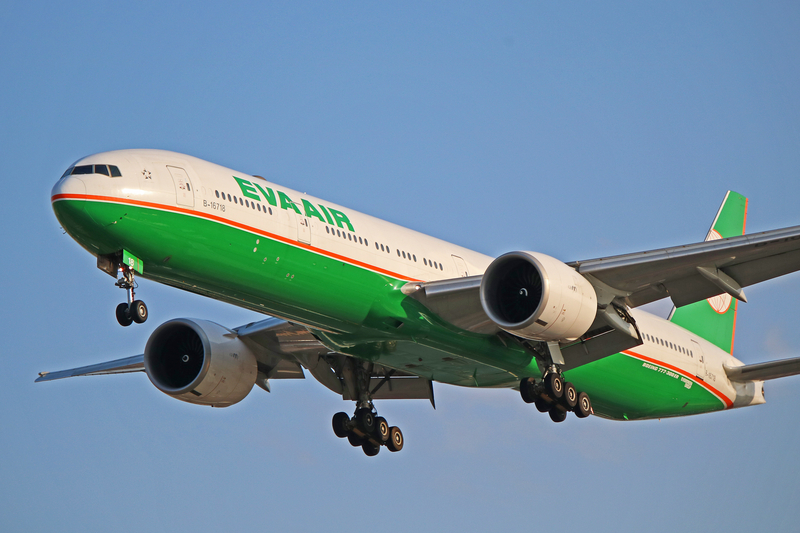
EVA Air BR392, operating Ho Chi Minh City (SGN) to Taipei (TPE), declared Mayday first
-
EVA Air BR007, operating San Francisco (SFO) to Taipei (TPE), followed minutes later
-
Hong Kong Airlines HX26, on a regional inbound to TPE, then made multiple Mayday calls
For industry readers, the key point is not that “planes almost ran out of fuel” (they didn’t). A fuel Mayday is a procedural trigger indicating the aircraft cannot accept further delay without compromising final reserve requirements. It is a statement to ATC: “This flight must be sequenced to land now.” When three flights reach that point almost back-to-back, it’s a clear signal that airborne delay has crossed from “inconvenient” into “operationally critical.”
The aircraft: Boeing 737-800, and why a tire detachment is treated as FOD until proven otherwise
T’way Air’s TW687 was operated by a Boeing 737-800 (737-8)—the workhorse variant of the Next Generation 737 family. In typical LCC configuration, the -800 runs high cycles, high utilization, and fast turnarounds. That matters because landing-gear and wheel assemblies are heavily cycle-driven components: tires, brakes, wheel halves, bearings, and torque procedures live and die by disciplined inspection and maintenance practice.
A main-gear tire detachment on landing can stem from several categories, and investigators typically work them in parallel:
-
Tire condition and pressure management. Underinflation increases sidewall flex and heat buildup; overheat events can weaken structure.
-
Brake-related thermal stress. High-energy stops, repeated brake applications, or brake drag can elevate wheel well temperatures and contribute to tire failure modes.
-
Foreign object damage prior to landing. A cut or puncture from FOD at origin (or during taxi) can propagate under landing load.
-
Wheel assembly / retention issues. Incorrect installation, torque procedure deviation, or component fatigue can create abnormal load paths.
-
Operational factors. High crosswind landings, hard touchdowns, or lateral loads during rollout can exacerbate underlying weaknesses.
Even when the landing is stable and the aircraft taxis clear, airports treat the event as a runway contamination until every fragment is accounted for—because the second-order risk is often higher than the first-order event. A loose metal fragment can become an engine ingestion hazard. A chunk of rubber can puncture another aircraft’s tire at rotation speed. That’s why runway closures after wheel/tire incidents are common, and why the sweep is methodical rather than fast.
The measurable impact at TPE: delays stayed contained, but the system was stressed
Despite the headline chaos, the airport’s reported impact was relatively limited in raw numbers: around 14 flights were affected (eight arrivals and six departures), and most delays were held to under 20 minutes once the runway reopened and the arrival bank was worked down.
The outlier was Japan Airlines JL8671, which reportedly landed shortly after TW687 and then sat for roughly an hour awaiting clearance while debris removal continued. That detail is operationally telling: even when the runway is reopened, taxiway routing, runway crossings, and tug availability can keep certain aircraft trapped in the wrong place at the wrong time—especially if the airport prioritizes sweeping and verifying lighting and surface integrity.
What this means for T’way Air: maintenance scrutiny and schedule knock-on risk
For the airline, the near-term stakes are less about the airport’s delay metrics and more about traceability and maintenance credibility. A tire detachment is not automatically a systemic safety failure, but it does trigger the kind of questions regulators and lessors take seriously:
-
When was the last wheel/tire change, and under what maintenance program?
-
Were torque and installation procedures documented and independently checked?
-
Were there any prior tire-pressure or brake-temperature anomalies recorded?
-
What did post-landing inspection reveal about the wheel, hub, and remaining tire assembly?
Operationally, any aircraft held for inspection in an LCC rotation plan can create immediate knock-on cancellations. A single grounded frame can wipe out multiple sectors in a day, and the passenger-cost curve escalates quickly once reaccommodation, duty-of-care, and compensation obligations stack up.
T’way Air has said it is cooperating with authorities and apologized to affected passengers. In the airline world, the apology is the easy part; the harder part is demonstrating robust control of the maintenance chain and restoring confidence that the event was contained, understood, and unlikely to recur.
Bottom Line
A tire detachment on a single T’way Air 737-800 landing at Taipei Taoyuan (TPE) didn’t injure anyone and didn’t become an accident—but it did expose how quickly a hub operation can tighten when runway redundancy disappears. With the north runway closed for roughly 100 minutes, TPE was forced into a one-runway arrival squeeze at the wrong time of day. The result was predictable to anyone who runs an operation: holding, compounding delay, and eventually three fuel Mayday declarations as reserve margins eroded. It’s a reminder that in peak banks, the runway isn’t just pavement—it’s the metering valve for the entire airport.
Keep reading FlyMag
Get the Daily Brief in the morning or the Route Watch weekly recap on Fridays. Or both.