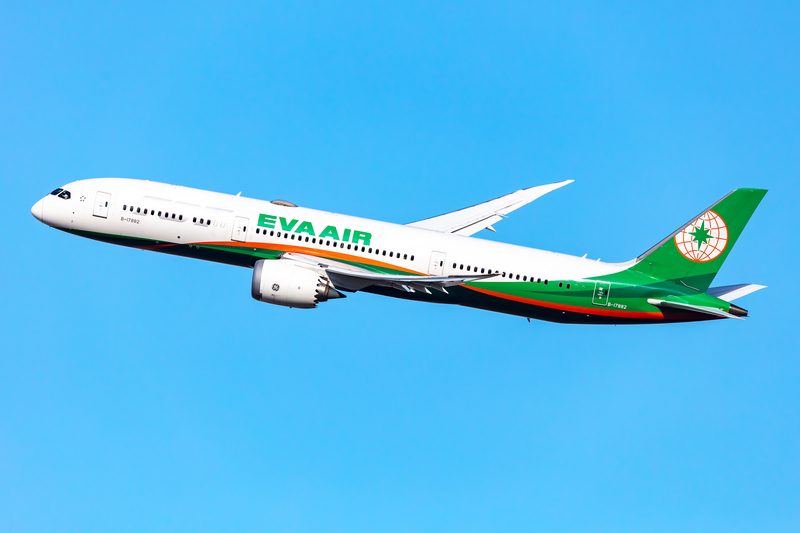
EVA Air has launched nonstop service between Washington Dulles International Airport (IAD) and Taiwan Taoyuan International Airport (TPE), giving the U.S. capital region its first direct passenger link to Taipei.

The new route marks a major North American expansion for EVA Air and makes Washington Dulles (IAD) the carrier’s 10th gateway in North America. For Dulles, it adds another long-haul Asian network carrier and strengthens the airport’s role as the primary international gateway for Washington, D.C., Northern Virginia, and the broader Mid-Atlantic region.
The service is being operated four times weekly with the Boeing 787-9 Dreamliner, configured with Royal Laurel Class, Premium Economy, and Economy Class. It is the first scheduled nonstop flight between Washington, D.C. and Taipei, and it gives passengers on both sides of the Pacific a faster path between two politically, commercially, and technologically important regions.
Read our stories in your inbox
Two aviation newsletters. Zero fluff.
EVA Air’s 10th North American Gateway
Washington Dulles (IAD) joins a North American network that already includes Los Angeles (LAX), San Francisco (SFO), Seattle (SEA), New York (JFK), Houston Intercontinental (IAH), Dallas/Fort Worth (DFW), Chicago O’Hare (ORD), Vancouver (YVR), and Toronto Pearson (YYZ).
That makes the IAD–TPE route more than a symbolic add. EVA is building a broad North American footprint around major business, technology, diaspora, and Star Alliance markets. Dulles fits that strategy well.
Washington, D.C. is home to federal government agencies, international organizations, defense and technology contractors, major universities, research institutions, law firms, think tanks, and multinational corporations. Northern Virginia also has one of the largest technology corridors in the United States, with substantial demand for travel to East Asia.
For Taiwan-originating passengers, Washington Dulles (IAD) offers access to the U.S. capital region without a connection over New York (JFK), Chicago (ORD), Los Angeles (LAX), San Francisco (SFO), or another gateway. For U.S.-originating passengers, Taipei (TPE) becomes a nonstop Asian hub option with onward connections across East Asia and Southeast Asia.
The Schedule: Late Evening Arrival, Early Morning Return
EVA Air operates the route as BR004 from Taipei (TPE) to Washington Dulles (IAD) and BR003 from Washington Dulles (IAD) to Taipei (TPE).
BR004 departs Taipei Taoyuan (TPE) at 19:30 on Mondays, Wednesdays, Fridays, and Saturdays, arriving at Washington Dulles (IAD) at 22:30 the same day. The westbound return, BR003, leaves Washington Dulles (IAD) at 01:50 on Tuesdays, Thursdays, Saturdays, and Sundays, arriving in Taipei (TPE) at 05:45 the following day.

The schedule is built around long-haul connectivity. The evening departure from Taipei (TPE) supports connections from EVA’s wider Asian network, while the late arrival at Dulles (IAD) still allows passengers to reach the Washington region the same night. The early-morning IAD departure is less convenient for local passengers, but it allows the aircraft to return to Taiwan in time for onward Asian connections over Taipei (TPE).
That is the network logic behind the flight. EVA is not only serving local Washington–Taipei traffic. It is using Taipei (TPE) as a connecting hub for passengers traveling between the U.S. capital region and cities across Japan, South Korea, Southeast Asia, mainland Asia, and beyond.
The Aircraft: EVA’s Three-Class Boeing 787-9
EVA is using its three-class Boeing 787-9 Dreamliner on the Washington Dulles (IAD)–Taipei (TPE) route.
The aircraft seats 278 passengers: 26 in Royal Laurel Class, 28 in Premium Economy, and 224 in Economy. EVA lists Royal Laurel seat pitch at 44 inches with a 76-inch bed length, Premium Economy pitch at 42 inches, and Economy pitch between 31 and 33 inches.
That cabin layout is particularly important on a route of this length. The great-circle distance between Washington Dulles (IAD) and Taipei (TPE) is roughly 7,850 miles, and the scheduled westbound journey from IAD to TPE is nearly 16 hours. That makes onboard product a real competitive factor, not just a marketing detail.
The Boeing 787-9 is well suited to the mission. Built with extensive composite materials and powered in EVA’s fleet by GE Aerospace GEnx-1B engines, the Dreamliner gives the airline the range and efficiency needed for long, thin intercontinental routes. The aircraft’s cabin altitude, larger windows, improved humidity, and lower noise profile also help on ultra-long sectors where passenger fatigue becomes part of the travel experience.
For EVA, the 787-9 gives the route the right balance. It has enough premium capacity for business and government-related travel, enough Economy seats for leisure and visiting-friends-and-relatives demand, and lower trip costs than a larger Boeing 777-300ER.
Premium Economy Is A Major Part Of The Story
EVA’s Premium Economy product deserves specific attention because the airline has a long history with the cabin category.
EVA was one of the pioneers of premium economy, introducing its original Evergreen Deluxe Class in the early 1990s. The new Washington (IAD) service features the airline’s latest generation of Premium Economy on the 787-9, giving the route a cabin that sits meaningfully between Economy and Royal Laurel Class.
That matters on IAD–TPE because the route is long enough for passengers to trade up, but not every traveler or company will pay for business class. Premium Economy can be especially attractive for government travelers, academics, small-business owners, leisure passengers taking a major Asia trip, and corporate travelers whose policies do not allow long-haul business class.
With 42 inches of pitch, EVA’s 787-9 Premium Economy is positioned as a serious long-haul product rather than a marginal extra-legroom seat. On a nearly 16-hour westbound flight, that distinction matters.
It also gives EVA a strong revenue tool. Premium Economy often performs well on long-haul routes because it captures passengers who want more comfort but are priced out of business class. For a new route from Washington Dulles (IAD), that cabin could be one of the keys to building sustainable yields.
Why Dulles Works For EVA
Washington Dulles (IAD) is the right airport for this route.
While Reagan National (DCA) is closer to central Washington, it is constrained by perimeter rules and is not designed for long-haul intercontinental service. Dulles (IAD), by contrast, is the region’s long-haul international airport, with the runway length, customs facilities, widebody gates, and global network needed to support a route like Taipei (TPE).
Dulles is also a major United Airlines hub, which matters because both United and EVA are members of Star Alliance. That creates potential connectivity on the U.S. side, especially for passengers traveling beyond Washington to cities across the Mid-Atlantic, Southeast, Midwest, and Northeast.
The partnership angle is not just about frequent-flyer points. It affects how a route can be sold. A nonstop IAD–TPE flight becomes more powerful if passengers can connect beyond Washington on United or beyond Taipei on EVA and its partners.
For the Metropolitan Washington Airports Authority, the new EVA flight also strengthens Dulles’ Asia portfolio. IAD already has long-haul service to major international markets, but nonstop Taipei access adds a different kind of connectivity: a direct link to one of Asia’s most important technology economies.
Taipei Is More Than A Destination
Taipei (TPE) is the endpoint printed on the ticket, but for many passengers it will function as a gateway.
Taiwan Taoyuan International Airport (TPE) is EVA’s primary hub and one of East Asia’s most efficient connecting airports. From TPE, EVA offers onward access across Northeast Asia, Southeast Asia, and selected long-haul markets. That gives Washington-area travelers a new one-stop path to cities such as Bangkok, Manila, Ho Chi Minh City, Hanoi, Singapore, Osaka, Seoul, and other regional destinations.
The route also supports Taiwan-bound demand directly. Taiwan’s importance in semiconductors, electronics, supply chains, trade, higher education, and U.S.–Asia policy gives the IAD–TPE market a business and strategic dimension that goes beyond tourism.
For Taiwan travelers, Washington offers government, diplomacy, education, technology, museums, and East Coast leisure itineraries. EVA has also promoted the route as part of broader East Coast travel options, using Washington and New York together for tourism flows.
That two-way demand profile is important. The best long-haul routes rarely depend on one narrow passenger segment. IAD–TPE can draw from government, business, education, leisure, visiting-friends-and-relatives, and connecting traffic.
A Ceremonial Launch With Diplomatic Weight
The inaugural event at Washington Dulles (IAD) reflected the route’s political and commercial significance.
EVA Air President Clay Sun was joined by airport and government officials, including Metropolitan Washington Airports Authority President and CEO Jack Potter, Virginia Department of Aviation Director Gregory W. Campbell, MWAA airline business development leadership, and Alexander Tah-ray Yui of the Taipei Economic and Cultural Representative Office in the United States.
Han Kuo-Yu, President of Taiwan’s Legislative Yuan, also participated in the ceremony and led a cross-party delegation on the historic return flight to Taipei (TPE). The inaugural arrival at Dulles (IAD) received a ceremonial water cannon salute, followed by ribbon-cutting, traditional performances, and an exchange of commemorative gifts.
Those details are more than ceremonial color. Air routes between capitals and major political centers often carry diplomatic symbolism, especially when they connect regions with deep economic and security ties. In that sense, EVA’s Washington route is both a commercial service and a visible marker of Taiwan–U.S. connectivity.
Competitive Implications Across The Pacific
EVA’s new route adds another player to the East Coast–Asia market, but it is not trying to duplicate the network strategies of every transpacific competitor.
U.S. carriers generally rely on hubs such as New York (JFK/EWR), Chicago (ORD), San Francisco (SFO), Los Angeles (LAX), Seattle (SEA), and Dallas/Fort Worth (DFW) for Asia service. Asian carriers often build U.S. networks around their home hubs and carry passengers onward across Asia.
EVA’s advantage is Taipei (TPE). It is geographically well positioned for many Southeast Asia connections, and EVA has built a reputation for strong onboard service, premium economy, reliability, and Star Alliance connectivity.
For Washington-area passengers, the new flight removes the need to backtrack through another U.S. gateway before crossing the Pacific. For Asian travelers, it creates a direct path into the U.S. capital region without connecting through the West Coast or Northeast.
That nonstop convenience can be decisive, especially on itineraries that are already long. A passenger traveling from Washington (IAD) to Southeast Asia over Taipei (TPE) may still have a substantial journey, but avoiding an extra domestic connection can make the trip materially easier.
Cargo And High-Value Traffic Should Not Be Overlooked
The passenger cabin gets the attention, but belly cargo could also support the route’s economics.
Taiwan is deeply tied to high-value electronics, semiconductors, precision manufacturing, and time-sensitive supply chains. The Washington region, Northern Virginia, Maryland, and the broader Mid-Atlantic have strong demand tied to technology, defense, biotech, government contracting, and research institutions.
The Boeing 787-9 does not offer the cargo volume of a 777-300ER, but it still provides useful long-haul belly capacity. On a route connecting Taiwan’s technology economy with the U.S. capital region, that capacity can matter.
Long-haul route performance is often built from multiple revenue streams: premium cabins, economy traffic, partner feed, cargo, corporate contracts, and connecting itineraries. EVA’s IAD–TPE service has potential across all of those categories.
Bottom Line
EVA Air’s new Washington Dulles (IAD)–Taipei (TPE) nonstop is one of the more strategically important Asia route launches at Dulles in recent years.
The four-weekly service gives Washington its first direct passenger link to Taipei and makes IAD EVA’s 10th North American gateway. Operated with a three-class Boeing 787-9 Dreamliner, the route offers 278 seats, including Royal Laurel Class and EVA’s latest Premium Economy cabin.
For passengers, the appeal is simple: no more connection through another U.S. gateway to reach Taiwan. For EVA, the route strengthens its North American network and adds a politically and commercially important East Coast market. For Washington Dulles, it reinforces IAD’s role as the capital region’s long-haul international airport.
The route is built around more than tourism. It connects government, technology, education, trade, diaspora, and onward Asian traffic through a Star Alliance framework. That gives EVA’s new IAD–TPE flight the kind of demand mix that can make a long-haul route more than a headline launch.
Keep reading FlyMag
Get the Daily Brief in the morning or the Route Watch weekly recap on Fridays. Or both.