Air Premia has launched nonstop service between Seoul Incheon International Airport (ICN) and Washington Dulles International Airport (IAD), giving the South Korean carrier a new East Coast foothold and completing a much more balanced U.S. network.

The service began on April 24 and now operates four times weekly, on Mondays, Wednesdays, Fridays, and Sundays. For Air Premia, this is more than a routine route addition. It is a strategic move that extends the airline beyond its earlier U.S. focus on the West Coast and Hawaii and gives it a stronger presence in one of the most important diplomatic, business, and long-haul travel markets in the United States.
For aviation readers, the significance is clear. Washington is not just another dot on the map. It is the route that makes Air Premia look more like a serious transpacific long-haul player rather than a niche operator with a few well-chosen U.S. sectors.
Read our stories in your inbox
Two aviation newsletters. Zero fluff.
Washington Dulles Gives Air Premia A Stronger East Coast Position
Before the launch of Washington Dulles International Airport (IAD), Air Premia’s U.S. network was concentrated around Los Angeles International Airport (LAX), San Francisco International Airport (SFO), Daniel K. Inouye International Airport (HNL), and Newark Liberty International Airport (EWR).
That meant the airline already had a presence in the United States, but not yet a truly rounded one. Adding Dulles changes that. It gives the carrier another East Coast entry point and puts it in a region with a large Korean community, significant premium demand, and strong long-haul relevance.
That matters because network credibility is not just about route count. It is also about geography. Washington helps Air Premia look more complete in the U.S. market.
The Four-Weekly Schedule Suggests Measured Confidence
Air Premia is launching the route at four weekly frequencies rather than daily service.
That is a sensible choice. A four-times-weekly pattern allows the airline to build market presence without taking on the full risk of a daily long-haul commitment from the outset. It also suits a carrier still scaling its intercontinental network carefully rather than flooding new routes with capacity.
For a transpacific service, this is often the right first step. It allows the airline to test local demand, connection patterns, and yield quality before deciding whether more frequency is justified.
In other words, the launch is ambitious, but not reckless.
The Boeing 787-9 Is Central To The Strategy
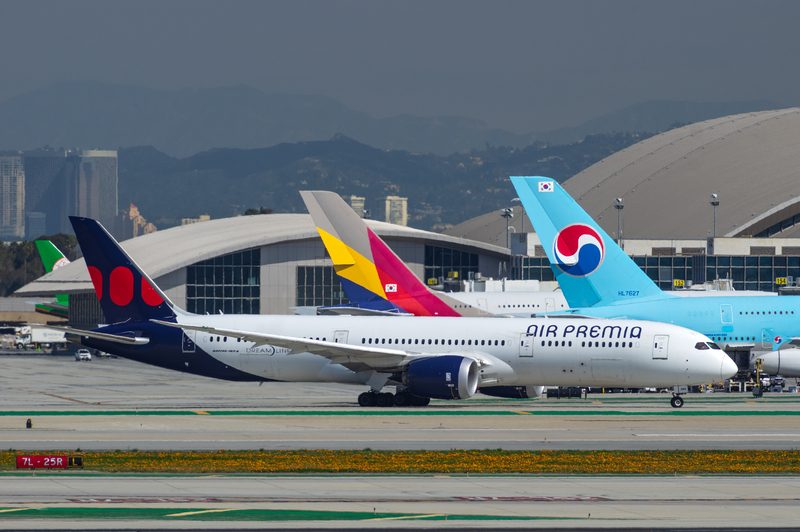
The new IAD route is being flown with the Boeing 787-9, which remains the backbone of Air Premia’s long-haul fleet.
That matters because the 787-9 is exactly the kind of aircraft a young long-haul airline needs for U.S. expansion. It offers the range for nonstop transpacific flying, good operating economics, and a cabin large enough to support a differentiated product without the overhead of a larger widebody.
Air Premia’s 787-9 layout is also central to its identity. The airline promotes what it calls a “wide premium” model, effectively positioning itself between a traditional full-service carrier and a low-cost long-haul operator. That means more generous seating and a stronger premium-economy proposition than many travelers might expect at its price point.
The aircraft choice supports that strategy well.
This Route Is Also A Statement About Product Positioning
Air Premia is not trying to compete with the biggest Korean carriers by simply copying their model.
Instead, it is leaning into a long-haul proposition built around spacious premium economy and a simpler two-cabin structure. That product is particularly relevant on routes like Seoul Incheon Airport (ICN) to Washington Dulles Airport (IAD), where there is enough stage length for comfort to matter, but also enough fare sensitivity that many passengers may not want to pay for full business class on a legacy airline.
That gives Air Premia a potentially attractive middle-ground position in the market.
Washington Has Broader Strategic Value Than A Leisure Destination
Unlike Honolulu or even some West Coast flying, Washington Dulles International Airport (IAD) is not primarily a leisure route play.
This is a market with diplomatic traffic, government-linked travel, business demand, education flows, and a large population base. That does not automatically guarantee success, but it does make the route strategically different from a pure leisure or diaspora service.
For Air Premia, that is useful. It broadens the type of traveler the airline can realistically target in the United States and helps it move beyond the idea that its network is only built around obvious Korean transpacific flows.
The “31 Years” Detail Matters More Than It Sounds
Officials around the launch have highlighted that this is the first time in 31 years that a Korean carrier has added a route to Washington.
That detail matters because it underscores how unusual the market move actually is. It is not simply another Seoul-U.S. route in a crowded field. It is a restoration of Korean-airline growth into Washington after a very long gap.
That gives the launch a symbolic dimension as well as a commercial one. It tells the market that Air Premia is willing to enter places where larger incumbents have not recently expanded.
Air Premia’s U.S. Network Now Looks Much More Intentional
With Washington in place, the airline now serves five U.S. destinations: Los Angeles (LAX), San Francisco (SFO), Honolulu (HNL), Newark (EWR), and Washington Dulles (IAD).
That is still a focused network, but it now looks much more intentional than incidental. It covers both coasts, includes leisure and business-oriented markets, and gives Air Premia a broader base from which to build its brand in North America.
That is what makes the Dulles launch important. It is not just a fifth U.S. route. It is the route that makes the first four look like part of a real strategy.
Bottom Line
Air Premia’s launch of nonstop service between Seoul Incheon Airport (ICN) and Washington Dulles Airport (IAD) is a meaningful step in the airline’s U.S. expansion. Operating four times weekly on the Boeing 787-9, the route gives the carrier a stronger East Coast presence, broadens its traffic mix, and reinforces its “wide premium” long-haul model.
For a relatively young airline, Washington is a smart addition. It adds status, balance, and strategic depth to a U.S. network that now looks far more complete than it did before.
Keep reading FlyMag
Get the Daily Brief in the morning or the Route Watch weekly recap on Fridays. Or both.