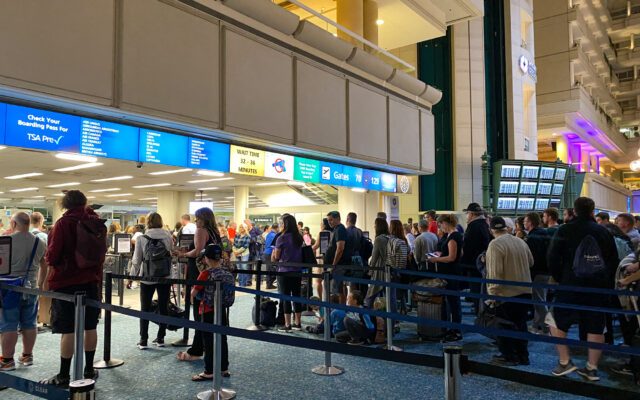
A routine security check at Nairobi’s Jomo Kenyatta International Airport (NBO) turned into an unusually revealing wildlife-trafficking case this week after Kenyan authorities arrested a 27-year-old Chinese national allegedly attempting to leave the country with more than 2,200 live ants concealed in his luggage.
According to court filings, officials recovered 2,238 live ants, with 1,948 packed in test tubes and the remainder wrapped in soft tissue paper. On its face, it is an unusual airport crime story. But the case points to something much larger: wildlife smuggling is no longer limited to ivory, rhino horn, reptiles, or exotic birds. Increasingly, it is extending into smaller, less visible species that can still command meaningful prices in niche international markets.
For airport and aviation professionals, that matters because it shows how routine passenger screening can intersect with wildlife enforcement in ways that are far less obvious than traditional contraband detection.
Read our stories in your inbox
Two aviation newsletters. Zero fluff.
The Case Was Uncovered During A Routine Airport Check
The arrest took place at Jomo Kenyatta International Airport (NBO), Kenya’s main international gateway and one of East Africa’s most important aviation hubs. Authorities say the suspect was stopped during a standard security process before officials discovered the ants in his baggage.
That detail is important. This was not a major cargo seizure or a months-long customs sting at a freight warehouse. It was an airport passenger-interdiction case, which underlines how commercial aviation remains one of the most practical channels for moving live wildlife across borders, especially when the species involved are small, concealable, and unlikely to draw immediate attention.
In this case, the concealment method appears to have been designed around volume and survival. Test tubes and soft wrapping are not random packaging choices. They suggest an attempt to transport the insects in a controlled enough condition to keep them alive through the journey.
This Was Not Just Odd — It May Point To Organized Trafficking
Prosecutors told the court that immigration officials had already placed a stop order on the man’s passport because of alleged evasion of arrest in Kenya the previous year. Authorities also told the court that he identified three individuals who allegedly supplied him with the ants.
That changes the tone of the case considerably.

What might otherwise look like an eccentric smuggling attempt begins to look more like part of a wider procurement chain. Kenyan authorities have also pointed to a similar ant shipment intercepted in Bangkok during the same week, raising the possibility that this is not an isolated incident but part of a broader trafficking pattern.
For enforcement agencies, that is where the real concern lies. Once repeated sourcing, transport methods, and multiple international endpoints start appearing, the issue shifts from curiosity to networked wildlife crime.
Why Ants Are Being Smuggled At All
To a general audience, the idea of smuggling ants may sound absurd. To people familiar with the exotic pet trade, it is less surprising.
Certain ant species, especially queen ants and colony-forming species with distinctive behavior, are sought after by collectors who build formicariums and maintain live colonies as pets or hobby specimens. The attraction is not ornamental in the traditional sense. It is behavioral. These insects are valued for colony-building, caste behavior, and the ability to create self-sustaining miniature societies in captivity.
That niche demand can create a surprisingly lucrative market, especially when the species is unusual, region-specific, or difficult to obtain legally. Kenyan officials have previously warned that indigenous ants are being targeted for collectors in Europe and Asia, and reports tied to this case indicate the seized insects were allegedly destined for those markets.
This is a reminder that wildlife trafficking does not have to involve large animals to be commercially meaningful.
Kenya Has Seen Ant-Smuggling Cases Before
What makes the Nairobi airport case especially notable is that it does not stand alone.
Kenyan prosecutors have already handled other ant-trafficking cases in recent years, including a 2025 case involving four men accused of attempting to traffic 5,440 giant African harvester queen ants. An earlier 2023 case also involved smuggling attempts linked to France. In both instances, the focus was on species prized in the exotic pet trade, particularly those indigenous to East Africa.
That history matters because it shows pattern, not novelty.
Kenya’s wildlife authorities are no longer dealing with a one-off bizarre seizure. They are dealing with a repeat enforcement category. And once a crime pattern becomes repeatable, airports become even more important as intervention points.
The Airport Angle Is More Important Than It May Look
From an aviation standpoint, this is exactly the sort of case that highlights the broader role of airport policing and security coordination.
Jomo Kenyatta International Airport (NBO) is primarily discussed in the context of passenger flows, cargo throughput, and East African connectivity. But international airports are also frontline enforcement environments where immigration, aviation security, customs, wildlife authorities, and police often overlap. The ant seizure is a good example of how those systems can intersect when a suspicious travel pattern, a stop order, or a baggage check produces a result that goes far beyond ordinary screening.
It also illustrates a challenge for airports everywhere: illicit trade increasingly involves items that are easier to hide, easier to transport, and less visually obvious than the contraband categories most people instinctively think of.
That means effective interdiction depends not just on technology, but on intelligence-sharing, behavioral scrutiny, and coordinated follow-up once something unusual is found.
Small Species, Big Ecological Stakes
There is also an ecological angle that should not be dismissed just because the animals involved are insects.
Under Kenyan law, wildlife protections extend to indigenous insects as well as larger animals, and export requires permits from the Kenya Wildlife Service. Removing large numbers of reproductive or colony-forming ants from local ecosystems can have consequences that are disproportionate to their size. Ants play major roles in soil turnover, seed movement, nutrient cycling, and food-web dynamics. In other words, this is not a harmless hobby trade.
That is one reason authorities increasingly frame these cases not merely as customs violations, but as biopiracy and wildlife crime.
The market may be niche, but the ecological implications are not.
Bottom Line
The arrest at Nairobi Jomo Kenyatta International Airport (NBO) over more than 2,200 live ants is one of those stories that sounds strange at first and serious on second reading.
What appears to be an unusual passenger smuggling case is actually a sharp example of how wildlife trafficking is evolving. The species are smaller, the concealment is easier, and the end market is more specialized, but the underlying dynamics are familiar: organized sourcing, international demand, airport transit, and the exploitation of live animals for profit.
For the aviation sector, it is also a reminder that airports are not just transport nodes. They are enforcement chokepoints. And sometimes the most revealing seizures are not the biggest ones, but the ones hidden in plain sight.