Lufthansa (LH) is expanding deeper into Southeast Asia with a new nonstop between Frankfurt (FRA) and Kuala Lumpur (KUL), a move that strengthens its long-haul hub bank structure at FRA while targeting one of the region’s most durable mixes of demand: corporate traffic, inbound tourism, and high-volume VFR flows.

The service is scheduled to begin October 25, 2026, timed for the start of the Northern Hemisphere winter season, and it will operate year-round—a notable commitment for a market that many European carriers still treat as seasonal or connection-dependent.
Route basics: start date, frequency, flight numbers, timing
Lufthansa is filing the route at five flights per week, operating daily except Tuesdays and Thursdays. Tickets are already on sale.
Read our stories in your inbox
Two aviation newsletters. Zero fluff.
The published schedule is designed around Lufthansa’s late-evening FRA departure bank and early-morning FRA arrival bank—exactly where network carriers extract the most value from long-haul flying:
-
LH704: departs Frankfurt (FRA) 21:30, arrives Kuala Lumpur (KUL) 16:40 the following day (local time)
-
LH705: departs Kuala Lumpur (KUL) 23:55, arrives Frankfurt (FRA) 06:00 the following day (local time)
For airline planners, that 06:00 arrival into FRA is particularly useful: it typically aligns with the morning “Europe wide” connection wave—when FRA distributes passengers to dozens of short-haul points across Germany and the wider region.
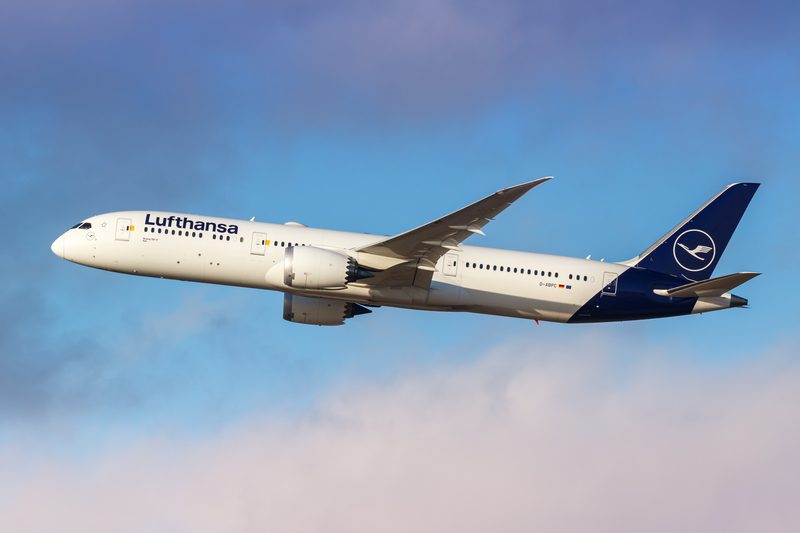
Aircraft assignment: Boeing 787-9 Dreamliner, 287 seats, three classes
The route will be operated by Lufthansa’s Boeing 787-9 Dreamliner (B789). Lufthansa is explicitly positioning the 787-9 as the “right” tool for growth markets where the carrier wants widebody product and cargo capability without the trip-cost burden of larger aircraft.
Lufthansa’s 787-9 configuration on this route is listed at 287 seats across three classes, and it will feature the airline’s new Allegris long-haul cabin concept. In practical terms, this is Lufthansa combining two strategic priorities:
-
Fuel and emissions efficiency—the 787’s composite-heavy airframe and modern high-bypass engines are built for lower fuel burn on long stage lengths.
-
Product reset—Allegris is Lufthansa’s flagship cabin modernization program, intended to lift yield, not just fill seats.
From an operational standpoint, the 787-9 also fits FRA well: it’s a widebody that can be deployed flexibly across a network, and it supports reliable long-haul utilization without requiring A380/747-style gate and turnaround complexity.
Why Kuala Lumpur (KUL) now: demand signals Lufthansa can monetize
KUL isn’t a niche point. It’s a large, multi-segment market that plays to Lufthansa’s strengths:
-
Tourism scale and seasonality resistance: Malaysia has been posting strong visitor numbers, and KUL is the natural gateway for first-time visitors and repeat travelers alike.
-
Corporate and industrial links: Germany remains one of Malaysia’s key European commercial partners, with a meaningful base of German corporate presence on the ground—precisely the kind of traffic that values nonstop service and dependable schedule timing.
-
Connectivity on both ends: FRA is Lufthansa’s long-haul super-hub. KUL is also a major Southeast Asian hub airport with broad onward connectivity in the region, which supports both point-to-point demand and connecting flows.
In other words, Lufthansa doesn’t need KUL to be purely a leisure route to make the numbers work. It can carry premium traffic, cargo, and high-volume leisure at the same time—especially with an evening FRA departure and late-night KUL departure that suit long-haul passenger behavior.
The Southeast Asia network picture: a fourth Lufthansa Group destination
With KUL added, Lufthansa frames the city as its fourth Lufthansa Group destination in Southeast Asia, alongside:
That matters because it clarifies the airline’s regional thesis: Lufthansa isn’t attempting to “cover” Southeast Asia the way Gulf carriers do via one-stop connectivity. Instead, it is building a selective set of high-demand nonstop points where a European network carrier can sustain widebody economics and premium consistency from FRA.
Just as importantly, Lufthansa has highlighted that—across Lufthansa Group home markets (Germany, Austria, Switzerland, Belgium, and Italy)—it expects to be the only carrier offering nonstop service to Malaysia. That is a classic yield strategy: be the nonstop option in a market where alternatives tend to require a connection through another hub.
The product angle: Allegris and why it matters on a 10–12 hour sector
KUL is far enough from FRA that onboard product materially influences purchase behavior—especially in premium cabins and premium-adjacent upsell categories.
Allegris is Lufthansa’s attempt to reset long-haul comfort and monetization across the fleet, with a multi-billion-euro investment that touches every cabin. Even without getting into seat-by-seat specifics, the direction is clear:
-
more segmentation within Business and Premium Economy,
-
more privacy and space options,
-
and a cabin “standard” Lufthansa can deploy consistently across new-growth routes.
For industry readers, the important nuance is that Lufthansa is pairing network expansion with product expansion. That typically signals confidence: airlines do not usually commit to year-round service into a new long-haul market with a flagship product unless the revenue model supports it.
What to watch between now and launch
Even with a route announced and selling, the details that airline professionals track will unfold closer to October 2026:
-
Exact days-of-week and seasonal adjustments: “Daily except Tue/Thu” is the opening pattern. Airlines often tweak for demand peaks, slot constraints, and aircraft rotations as the season approaches.
-
787-9 allocation and subfleet consistency: Lufthansa’s 787-9 fleet is growing, and the airline has been working through certification and rollout steps for Allegris-equipped aircraft. By late 2026, the expectation is more stable availability—but fleet assignment is still a moving piece.
-
Competitive response: KUL is a market where connections via Middle East hubs are abundant. A new nonstop can pressure connecting fares and re-shape corporate travel policies in Germany and neighboring regions.
Bottom Line
Lufthansa’s new Frankfurt (FRA)–Kuala Lumpur (KUL) nonstop, launching October 25, 2026, is a strategically clean addition: five flights weekly (daily except Tuesdays and Thursdays), timed for connectivity at FRA, operated by a 287-seat Boeing 787-9 Dreamliner with the Allegris cabin.
For Lufthansa, the route is about more than adding another pin on the map. It’s a statement that Southeast Asia growth can be captured with next-generation widebody economics, modern premium product, and hub-bank discipline—without relying on a one-stop model through third-country hubs.