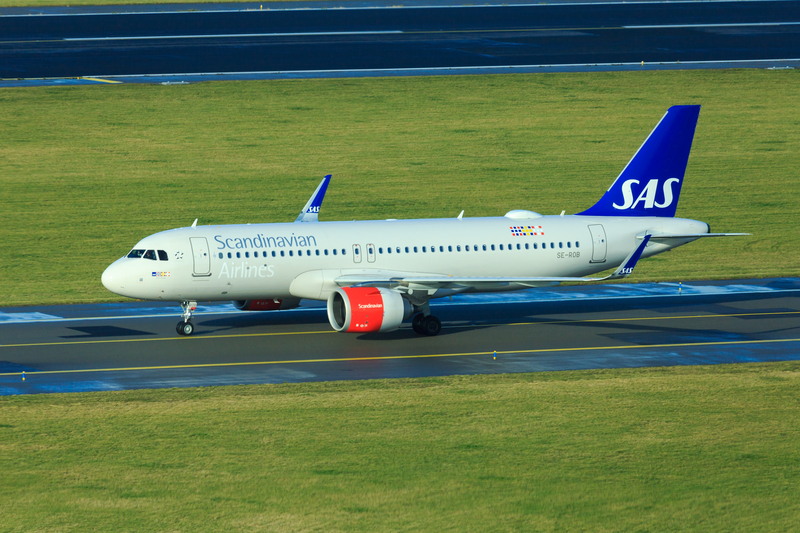
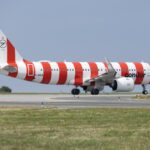
A routine domestic hop in Norway turned into a textbook “smoke in cabin” event when Scandinavian Airlines flight SK4416 diverted to Trondheim Airport Værnes (TRD) after an overheated power bank produced smoke onboard. The aircraft—an Airbus A320neo (SE-RUO)—was en route from Oslo Gardermoen (OSL) to Tromsø (TOS) when the crew reported smoke shortly after noon local time and elected to land at TRD under a full emergency response.

The diversion highlights a reality airline safety teams have been drilling into procedures for years: lithium-ion battery incidents are time-critical, unpredictable, and best handled with conservative decision-making—even when flames never fully develop.
Read our stories in your inbox
Two aviation newsletters. Zero fluff.
What Happened on SK4416
Shortly after departure from OSL, cabin crew detected smoke associated with a passenger power bank—the portable lithium-ion battery packs commonly used to charge phones and tablets. Early reports initially suggested the issue might have been in the cockpit, but authorities later clarified the smoke source was in the passenger cabin.
The crew declared an emergency and diverted to Trondheim (TRD), landing safely around 12:38–12:40 local time. Emergency services met the aircraft on arrival, and the device was removed and handed over to fire crews.

Several crew members were assessed for smoke exposure after landing and later released. No passenger injuries were reported, though medical support was offered as a precaution.
Why an Overheating Power Bank Is Treated as High Risk
In-flight smoke events are treated with zero tolerance, and lithium batteries are in a category of their own. When a power bank overheats, the primary concern is thermal runaway—a self-sustaining failure mode where internal temperatures rise rapidly and can trigger:
-
Dense, irritating smoke (often the first and most operationally disruptive symptom)
-
Intense localized heat that can damage seats, panels, or overhead bins
-
Fire that can re-ignite even after initial cooling attempts
-
Toxic byproducts that make smoke inhalation the immediate medical hazard
Cabin crews are trained to move fast because cooling a lithium battery is not like extinguishing a paper or fabric fire. The goal is to stop temperature escalation, isolate the device from flammable materials, and reduce smoke exposure.
Cabin Crew Response: Containment, Cooling, and “Land as Soon as Practicable”
Even when an incident appears “contained,” most airlines operate under a conservative rule set: smoke + unknown heat source = land at the nearest suitable airport.
On many carriers, standard response includes some combination of:
-
Using water or other cooling methods to reduce heat and prevent re-ignition
-
Isolating the device in a containment bag or fire-resistant container (if carried)
-
Monitoring for recurrence (because lithium batteries can flare back up)
-
Coordinating with the flight deck so the diversion airport is ready with fire/medical support
In this case, local emergency officials indicated the crew could not bring the device’s temperature down sufficiently, which is exactly the scenario that drives a diversion decision.
Why Trondheim Was the Right Diversion Field
For an OSL–TOS sector, Trondheim (TRD) is a logical “nearest capable” option. It offers:
-
Full emergency response capability
-
Proven handling for narrowbody operations
-
Rapid access to medical teams for smoke exposure assessments
-
Operational flexibility to clear the aircraft, remove the device, and complete safety checks before continuing
This is what airlines want in a diversion: a controlled environment where the immediate risk is offloaded to ground responders and the aircraft can be assessed without pressure.
The Aircraft: Airbus A320neo (SE-RUO)
The flight was operated by an Airbus A320neo, a workhorse narrowbody in SAS’ domestic and short-haul European network. The A320neo’s systems and cabin materials are designed around modern fire protection standards, but lithium battery events are less about aircraft design and more about the energy density of the device and the proximity to passengers, cabin furnishings, and confined airflow.
Importantly, the aircraft type is not the story here—the device is. Overheating power banks can create the same operational hazard on any aircraft if they enter thermal runaway.
The Operational Takeaway: A Small Device Can Trigger a Major Diversion
From an airline-ops perspective, the chain reaction is familiar:
-
Smoke/heat event in the cabin
-
Immediate crew response and cockpit coordination
-
Emergency declaration to prioritize landing
-
Diversion, medical evaluation, and device removal
-
Post-event checks before the flight can safely continue
Even when there are no serious injuries, these events create delays, missed connections, crew duty-time complications, and aircraft scheduling knock-ons. But the industry consensus is clear: diverting early is cheaper than gambling on an evolving cabin hazard.
Bottom Line
SAS flight SK4416 from Oslo (OSL) to Tromsø (TOS) diverted to Trondheim (TRD) after a passenger power bank overheated, producing smoke onboard an Airbus A320neo (SE-RUO). Crew members were evaluated for smoke exposure and released, passengers were not reported injured, and the device was removed by emergency responders. It’s a sharp reminder that lithium-ion battery incidents don’t need flames to become serious—smoke, heat, and uncertainty are enough for crews to make the only decision that matters in the moment: get the aircraft on the ground quickly at the best available airport.
Keep reading FlyMag
Get the Daily Brief in the morning or the Route Watch weekly recap on Fridays. Or both.