Norse Atlantic Airways is adding a special one-off transatlantic flight from Oslo to New York to carry Norwegian supporters to one of the most anticipated matches of the 2026 FIFA World Cup.

The airline moved quickly after Norway’s dramatic 2-1 victory over Ivory Coast, which sent the national team into a Round of 16 meeting with Brazil on July 5 at New York/New Jersey Stadium in East Rutherford. The match has created an immediate surge in Norwegian travel demand, and Norse is responding with what it calls an “Airline on Demand” operation.
The special flight will depart Oslo Airport, Gardermoen (OSL) on Friday evening and arrive in New York the same evening local time, giving supporters time to reach the New York/New Jersey area before Sunday’s match. Norse has not emphasized the airport name in its announcement, but the carrier’s New York operation is closely tied to John F. Kennedy International Airport (JFK), where it also operates transatlantic service from London Gatwick (LGW).
Read our stories in your inbox
Two aviation newsletters. Zero fluff.
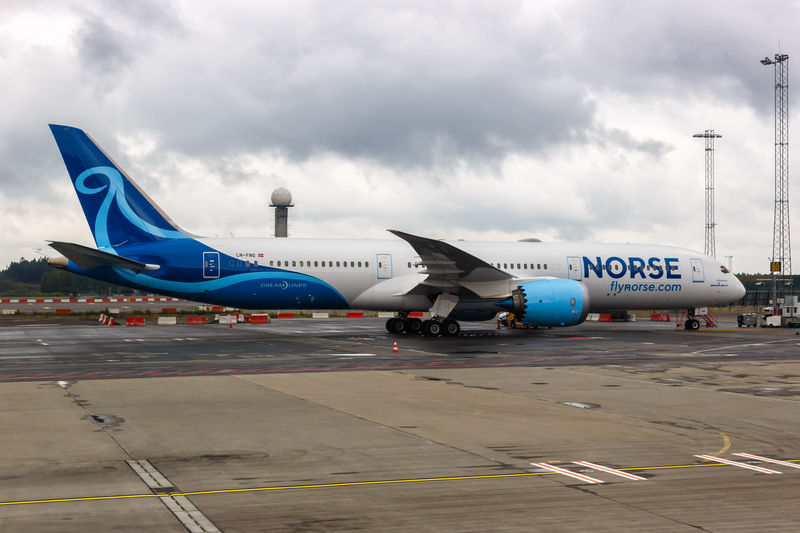
The flight will be operated by a Boeing 787-9 Dreamliner configured for 338 passengers, turning what would normally be a scheduled long-haul aircraft rotation into a dedicated football-supporter airlift.
A Rapid Response To Norway’s World Cup Surge
Norse said it began work to redeploy aircraft and crew just minutes after Norway secured qualification.
That speed is the real aviation story. A one-off widebody flight is not as simple as adding a bus departure. The airline needs aircraft availability, crew scheduling, flight planning, airport slots, ground handling, catering, fuel planning, passenger processing, and U.S. arrival coordination. It also needs to sell the flight quickly enough to justify the operation.
Norse’s CEO, Eivind Roald, framed the decision as part of the airline’s “Explorer’s Airline” identity and its ambition to operate as an “Airline on Demand.” In this case, that phrase is not just marketing language. It describes a very specific operational move: using a long-haul widebody aircraft to chase a sudden demand spike created by a major sporting event.
The timing is also unusually tight. Norway beat Ivory Coast on June 30. Tickets for the Norse flight went on sale July 1. The aircraft is scheduled to depart Oslo (OSL) on Friday evening, with the match taking place Sunday afternoon local time.

For supporters, that creates a compressed but workable travel pattern: fly from Oslo (OSL) to New York on Friday, attend the match on Sunday, then return or continue onward depending on ticketing and travel plans.
The Aircraft: Norse’s Boeing 787-9 Dreamliner
The special flight will use Norse Atlantic’s Boeing 787-9 Dreamliner.
The aircraft is central to the airline’s business model. Norse operates a uniform long-haul fleet of Boeing 787-9s, giving it a widebody aircraft with the range and efficiency to connect Europe with North America, Africa, and Asia. The type is well suited to an Oslo (OSL)–New York sector, which is comfortably within the 787-9’s operating capability.
Norse’s 787-9 cabin is configured with 338 seats across two cabins: 56 Premium seats and 282 Economy seats. Premium is arranged in a 2-3-2 layout, while Economy uses the standard 3-3-3 configuration common on many Boeing 787 operators.
That 338-seat layout is important. It gives Norse a large aircraft for a sudden, event-driven demand spike without the complexity of operating multiple narrowbody flights through a connection. It also allows the airline to sell both higher-comfort Premium seats and lower-cost Economy seats to fans with different budgets.
The Dreamliner’s cabin features also help on a flight like this. The 787 offers larger electronically dimmable windows, lower cabin altitude than older-generation aircraft, improved humidity, modern inflight entertainment, and long-haul range. Those features matter less on a routine short sector, but they matter on a transatlantic overnight or evening flight where passengers are trying to arrive rested enough for a major event weekend.
From Longship To Dreamliner
Norse is leaning heavily into its brand identity for the flight.
The airline’s name and visual identity draw from Norse explorers who crossed the Atlantic in longships. Its aircraft use the callsign “Longship,” and the company is planning a special onboard program tied to that heritage and to Norway’s World Cup run.
That is smart brand work. The match is not just another sports fixture for Norwegian fans. It connects modern Norway’s football moment with a strong national story: crossing the Atlantic, facing Brazil, and revisiting one of the most famous results in Norwegian football history.
Norway beat Brazil 2-1 at the 1998 World Cup, a result still remembered as one of the country’s greatest football achievements. The 2026 meeting is not a replay of that match, and Brazil will again be the favorite. But for supporters, the historical parallel makes the trip more emotional and more marketable.
Norse appears to understand that. The airline is not merely selling transport from Oslo to New York. It is selling a same-week opportunity to be part of a national sporting moment.
Why New York Makes The Operation Work
The match will be played at New York/New Jersey Stadium, better known commercially as MetLife Stadium, in East Rutherford, New Jersey.
That makes the New York airport system the natural target for Norwegian supporters. The area is served by New York JFK (JFK), Newark Liberty International Airport (EWR), and LaGuardia (LGA), although long-haul international widebody service is concentrated at JFK and EWR. Norse’s own transatlantic New York operation is built around JFK, including its daily London Gatwick (LGW)–New York JFK service.
For travelers going to East Rutherford, the airport choice is not only about flight time. It affects ground transport, hotel location, matchday logistics, and return plans. Newark (EWR) is geographically closer to the stadium, but JFK has broader international long-haul capacity and is already part of Norse’s network.
That is why the special flight’s New York arrival is useful even if the stadium itself is in New Jersey. The New York metropolitan area has the hotel capacity, rail links, road access, and event infrastructure needed to absorb a sudden wave of international supporters.
A Demand Spike Airlines Can Actually Monetize
World Cup knockout matches create unusual airline demand because the market appears almost overnight.
Unlike a scheduled holiday season, airlines do not know weeks in advance exactly which national teams will advance or where supporters will need to fly. When a team qualifies, searches spike, fares rise, and available seats disappear quickly. That is exactly the kind of short-window demand that can make a one-off widebody flight financially attractive.
For Norse, this is a chance to monetize spare or movable aircraft capacity while strengthening its brand in Norway. It also gives the airline a high-visibility example of flexible long-haul flying, which is increasingly important to its strategy.
Norse is not a traditional hub-and-spoke legacy carrier. It is a long-haul low-cost airline with a relatively small widebody fleet, scheduled transatlantic flying, charter activity, and ACMI or wet-lease work. That makes flexibility central to the business. If the airline can move aircraft into demand spikes, whether for sports, charters, seasonal markets, or partner flying, it can create revenue beyond the fixed scheduled network.
This World Cup flight is a very public test case for that idea.
London Gatwick Remains The Backup Path
Norse also highlighted its daily London Gatwick Airport (LGW)–New York JFK (JFK) service as an alternative for supporters traveling from elsewhere in Europe or for Norwegians who need more flexibility.
That detail is commercially important. The special Oslo (OSL) flight has only 338 seats. Demand from Norwegian supporters may exceed that quickly, especially if fans are also traveling from other parts of Norway, Scandinavia, and Europe.
By pointing passengers toward London Gatwick (LGW), Norse can capture additional demand without needing to add more one-off Oslo capacity. Travelers could position from Oslo, Bergen, Trondheim, Stavanger, Copenhagen, Stockholm, or elsewhere to London, then use Norse’s scheduled LGW–JFK flight.
This also helps Norse sell its existing network. A special flight creates attention, but the daily Gatwick service provides the scalable capacity. For the airline, the World Cup moment becomes both a charter-style opportunity and a marketing platform for scheduled service.
A Different Kind Of Sports Charter
Sports charters are common in aviation, but this flight is slightly different.
Team charters usually move players, staff, equipment, and officials. Supporter charters move fans, often through tour operators or club partners. Norse’s flight sits somewhere between a public scheduled special and a fan charter. It is being sold directly, first-come, first-served, and built around one specific match.
That model could become more common during major global events. The 2026 World Cup is spread across the United States, Canada, and Mexico, creating long distances between venues and unpredictable supporter flows. Airlines that can move quickly may find opportunities after every knockout-round result.
For aviation planners, this raises interesting questions. Which airlines have aircraft available? Which can get slots quickly? Which can sell seats fast enough? Which markets have fans willing to pay last-minute long-haul fares? Which carriers have the brand connection to make the flight feel like part of the event?
Norse checks several of those boxes for Norway.
Why The Route Is Operationally Plausible
Oslo (OSL)–New York is a familiar transatlantic market and a relatively straightforward mission for the 787-9.
Norse’s inaugural commercial flight in 2022 was between Oslo and New York, and the airline has deep operational experience in the transatlantic market. The 787-9 has the range for the sector without performance stress, and both Oslo (OSL) and New York’s long-haul airports are capable of handling the aircraft type.
That does not mean the special flight is simple. A late-added international widebody operation still requires coordination across several teams. But compared with creating an entirely new station or sending an aircraft to an unfamiliar destination, Oslo–New York is within Norse’s established operating universe.
That is one reason the airline could move quickly after Norway’s win. The route, aircraft, and market all fit capabilities Norse already has.
A Smart Moment For Norse’s Norwegian Identity
Norse Atlantic is headquartered in Norway but operates a highly international business. Its network includes Europe, the United States, Asia, and South Africa, and its commercial model is not purely Norway-focused.
This World Cup flight lets the airline reconnect directly with Norwegian national identity in a way few route announcements can.
The “Longship” callsign, the Norse explorer branding, the Oslo departure, the New York arrival, and the Brazil rematch narrative all align unusually well. That kind of brand fit is rare. Most one-off flights are functional. This one has a story.
For a relatively young airline still building recognition, that matters. It gives Norse a chance to be seen not just as a low-cost transatlantic carrier, but as a Norwegian airline capable of responding to a national moment.
Passenger Experience Will Be Part Of The Product
Norse says it is planning special onboard activities for supporters, making the flight part of the fan experience rather than just transport.
That could include themed announcements, music, supporter engagement, rowing-inspired moments, or other Norway-focused programming. The airline has not detailed every element publicly, but the intent is clear: the trip begins at Gardermoen, not at the stadium.
That approach makes sense because the passengers are not typical long-haul travelers. Many will be fans traveling on short notice, likely wearing national colors, heading to a once-in-a-generation World Cup match, and willing to treat the aircraft as part of the event atmosphere.
There is also a practical side. A plane full of energized supporters requires thoughtful cabin management. Crew will need to balance celebration with safety, rest, service delivery, and long-haul procedures. A well-planned onboard program can channel the excitement positively.
The Wider Market Reaction
Norwegian travel demand to New York surged after the Ivory Coast win, with local reporting pointing to sharp increases in flight searches and high demand across airlines.
That is expected. Norway’s run has become a national story, and Brazil is one of the biggest draws in world football. The matchup also features two global stars in Erling Haaland and Brazil’s attacking core, making the ticket one of the strongest Round of 16 events in the New York/New Jersey market.
For airlines, this kind of demand is valuable but perishable. Seats need to be available within days. Once the match is played, the demand disappears or shifts to the next venue if Norway advances. That is why rapid deployment matters.
If Norway beats Brazil, the next challenge for airlines could be even more complicated: moving supporters again, potentially to another U.S. city on very short notice.
Bottom Line
Norse Atlantic’s special Oslo (OSL)–New York World Cup flight is a clever example of event-driven long-haul aviation.
The airline is using a 338-seat Boeing 787-9 Dreamliner to carry Norwegian supporters across the Atlantic for Norway’s Round of 16 match against Brazil on July 5 at New York/New Jersey Stadium. The flight departs Oslo Airport, Gardermoen (OSL) on Friday evening and arrives in New York the same evening local time.
This is more than a fan charter. It is a brand statement. Norse is using its Norwegian identity, Dreamliner fleet, and transatlantic flexibility to respond to a sudden national travel surge within days of Norway’s 2-1 win over Ivory Coast.
Operationally, the route fits Norse’s strengths. Commercially, the timing is ideal. Emotionally, the story is almost too good for an airline named after Atlantic-crossing explorers: Norway faces Brazil again, 28 years after its famous 1998 World Cup win, and Norse is putting a “Longship” across the ocean to get fans there.
For supporters, the value is obvious: a direct way from Oslo to New York for one of Norway’s biggest football matches in decades. For Norse, the flight may be just as important as proof of concept — a visible example of how a small long-haul carrier can turn sudden demand into a high-profile, revenue-generating operation.
Keep reading FlyMag
Get the Daily Brief in the morning or the Route Watch weekly recap on Fridays. Or both.