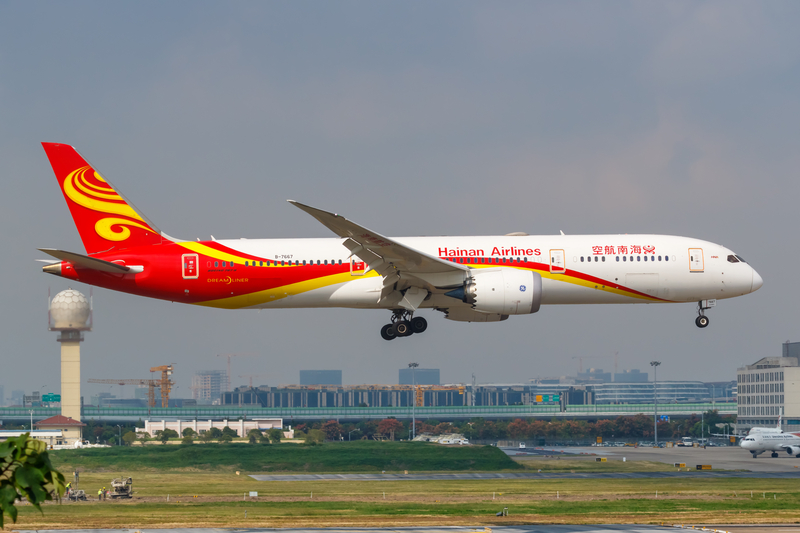
Since late 2023, Hainan Airlines has been running a three-times-weekly Boeing 787-9 rotation that looks—on paper—like a mini, modern Pan Am:
Beijing (PEK) → Boston (BOS) → Brussels (BRU) → Beijing (PEK).
It is not a true around-the-world ticket; BOS→BRU has no local traffic rights (no passengers may be sold solely on that sector). The BRU stop is a technical and crew stop to position the aircraft and team for the return to China without routing over Russian airspace.

Illustrative schedule (Oct 7–13, 2025):
-
HU729 PEK→BOS 14:20–16:20 (15h00) — Wed/Fri/Sun
Read our stories in your inbox
Two aviation newsletters. Zero fluff.
-
HU730 BOS→BRU 18:40–07:30+1 (06h50) — Wed/Fri/Sun
-
HU730 BRU→PEK 09:00–03:10+1 (11h10) — Mon/Thu/Sat
The equipment is a 292-seat 787-9 with Hainan’s denser economy layout than on some of its other Dreamliners.
Why Hainan built this triangle
1) Airspace constraints & winds
With most US-China operators avoiding Russian airspace, ultra-long westbound legs can face punishing headwinds. Hainan’s original nonstop BOS→PEK operation periodically required a technical stop (previously Seattle). Shifting the stop to Brussels:
-
Shortens the demanding trans-Atlantic segment from BOS,
-
Resets crew duty limits under a more predictable plan, and
-
Sets up an EU–China leg that can be flown on permissible routings.
2) Crew duty & operational reliability
Long westbound sectors can break the duty-time bank, especially when holding, re-routes, or winter winds stack up. A planned BRU pause gives:
-
Predictable crew changes and rest,
-
Maintenance opportunities and fuel top-off,
-
Better on-time performance for the long BRU→PEK return.
3) Commercial logic without fifth-freedom sales
Hainan cannot sell BOS↔BRU locally on HU730. Even so, the stop can still be worthwhile:
-
Cargo can be repositioned (subject to permits),
-
Catering, ground services, and crew changes can be optimized,
-
The return BRU→PEK can harness Europe-origin demand already cultivated by Hainan’s separate terminator BRU flights.
A throwback to “circle-the-globe” flying
Classic round-the-world services (Pan Am, TWA, even United’s multi-stop 747-400 missions) stitched together continents before ETOPS twinjets and today’s alliance connectivity. Hainan’s triangle is function over romance—a pragmatic answer to geopolitics and winds—yet it evokes that era’s choreography: long legs, tech stops, and careful crew staging.
What this means for Boston & Brussels
-
Boston (BOS): Keeps a nonstop from Beijing eastbound and becomes a technical stepping-stone westbound. Local BOS demand—students, biotech, tourism—anchors the PEK→BOS leg; the onward ferry to BRU is the price of operational certainty.
-
Brussels (BRU): Gains additional widebody movements and belly-cargo opportunity on a patterned schedule. BRU is already a Hainan station, simplifying handling and contracts.
Why Hainan didn’t just keep the Seattle stop
Seattle once served as the westbound tech stop. Brussels offers different trade-offs:
-
Network symmetry with Hainan’s separate BRU↔PEK service,
-
Crew and contract efficiencies at an established EU base,
-
Seasonal wind and slot flexibility that can make timing more predictable than a coastal US tech-stop in certain periods.
The fleet & cabin angle
Hainan’s 787-9 is the airline’s workhorse for these ultra-long segments. On missions like PEK→BOS (15h+) and BRU→PEK (~11h), the 787-9’s fuel burn and payload-range profile remain favorable versus older widebodies. The denser layout trades some comfort for seat-mile cost, critical when a schedule includes a “dead-sector” with no local revenue.
Regulatory backdrop: traffic rights 101
-
Fifth freedom rights (selling BOS↔BRU seats) require explicit US–China–EU approvals—not granted here.
-
The BRU stop is authorized for technical purposes: fuel, crew, servicing.
-
Separate BRU↔PEK flights do carry local traffic under existing bilateral frameworks.
Will this last?
Probably not indefinitely. Hainan has signaled a desire to restore true nonstops once the wind/airspace equation or fleet planning makes it consistently viable. Tech-stops add cost and complexity and blunt competitiveness against carriers able to run nonstop both ways.
Context: Hainan’s much slimmer US footprint
Pre-pandemic (Oct 2019), Hainan operated double-digit US-China routes (BOS, JFK, LAX, ORD, SEA, SJC, LAS, plus inland China points like Chengdu/Chongqing/Changsha/Xi’an). Today it’s down to a handful of weekly departures:
-
PEK–BOS–BRU–PEK (3x weekly),
-
PEK–SEA (2x weekly),
-
(Other limited patterns depending on season).
The retreat—about 87% below 2019 US frequencies—reflects broader US-China capacity realities, aircraft/crew allocation, and airspace routing constraints.
What to watch next
-
Routing changes: If permissions or geopolitics evolve, a return to BOS nonstops in both directions is the logical end state.
-
Seasonal tweaks: Expect timetable fine-tuning to chase tailwinds and crew-duty efficiency.
-
Cargo pull: If BRU belly freight yields hold, the stopover utility increases even without fifth-freedom passengers.
-
Fleet moves: As more long-haul capacity stabilizes in China, Hainan could redeploy or upgauge, further reducing the need for a European tech stop.
Bottom line
Hainan’s Beijing–Boston–Brussels–Beijing 787 loop isn’t a nostalgic globe-girdling service so much as a clever workaround: respect airspace constraints, tame headwinds, reset crews, and keep Boston connected while preserving a clean, legal return to Beijing. It looks unusual on a map—but for now, it’s how the math and the winds add up.
Keep reading FlyMag
Get the Daily Brief in the morning or the Route Watch weekly recap on Fridays. Or both.