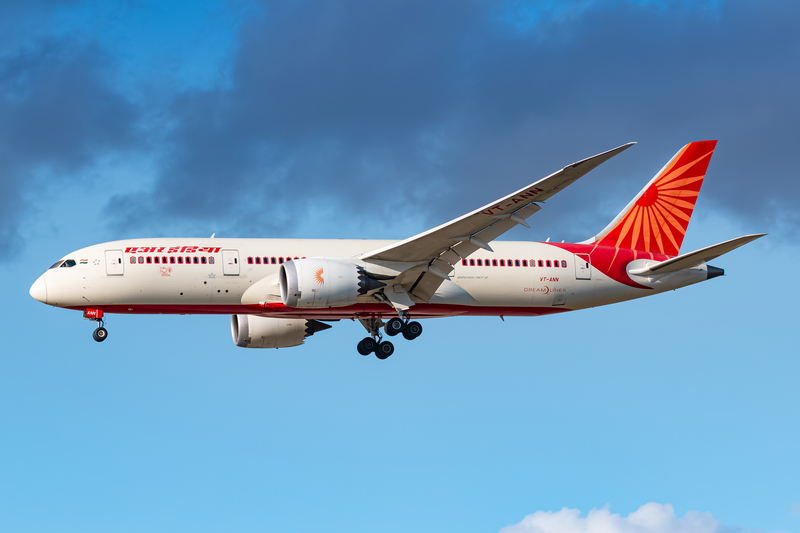
Air India (AI) is set to introduce its first factory-built, “line-fit” Boeing 787-9 Dreamliner into revenue service on February 1, 2026—a meaningful milestone in the carrier’s long-haul refresh. But the debut will come with two temporary cabin limitations that matter to both passengers and network planners: 18 Economy Class seats will be blocked from sale, and the Business Class suite doors will be secured in the open position until outstanding approvals are cleared.

The aircraft’s first commercial assignment is expected on the Mumbai (BOM)–Frankfurt (FRA) corridor, a premium-and-connecting-heavy route where product consistency and reliability are scrutinized by corporate travel, alliance flows, and discerning long-haul frequent flyers.
The two restrictions, explained in practical terms
Air India’s issue is not that the aircraft is unserviceable or the cabin is unfinished—it’s that two specific elements are still working through certification and regulatory interpretation pathways.
Read our stories in your inbox
Two aviation newsletters. Zero fluff.
Business Class: doors “installed,” but not yet “authorized for use”
The new 787-9’s 30 Business Class suites will operate with the sliding privacy doors locked open. The suites remain fully functional as lie-flat seats; the door feature itself is what remains pending approval. That may sound minor, but doors change the certified safety environment: regulators look closely at emergency egress, passenger containment, and how features behave under dynamic loads and evacuation scenarios. Until the paperwork and sign-offs are complete, the safest operational approach is to disable the feature rather than risk a compliance gap.
Economy Class: 18 seats physically blocked and not sold
Air India will also withhold 18 Economy seats from sale. The airline has indicated the underlying seat model—RECARO 3710—is broadly certified and widely used, but a regulatory interpretation tied to those specific positions remains unresolved. In other words, it’s less about the seat design and more about how a specific row or seat group interacts with certification requirements (think: row geometry, proximity to exits, monument clearances, or other installation-specific compliance items). Until that interpretation is formally resolved, those seats stay off limits.
What this means for capacity on BOM–FRA
The new 787-9 is configured for up to 296 passengers in three classes:
-
30 Business
-
28 Premium Economy
-
238 Economy
With 18 Economy seats blocked, the near-term sellable total becomes 278 seats, with 220 Economy seats available for sale immediately.
On a route like BOM–FRA, that reduction is not trivial. It tightens inventory during peak banks, forces revenue management to work with a smaller Economy cabin, and can increase the number of customers pushed into higher fare buckets sooner—especially when the flight is feeding connections beyond FRA.
Why a “certified seat” can still be “unsellable”
This is the part airline professionals tend to appreciate: certification is rarely just about a component. It’s about the component as installed, in that specific cabin, with those monuments, that row pitch, that aisle width, that exit access, and those human-factors assumptions.
A seat can be certified as a product, yet an airline may still need additional sign-off if:
-
the seat is installed in a location that changes evacuation flow or clearance margins,
-
the surrounding cabin architecture introduces a new compliance interpretation,
-
a feature (like a suite door) adds a “new variable” in the emergency environment.
That’s why the airline can confidently say the seat model is proven—while still blocking specific positions until regulators confirm the final interpretation.
Fleet implications: two 787-9 subfleets, plus 787-8 retrofits
Air India’s 787 operation is becoming more layered. The carrier already operates six Boeing 787-9s inherited from Vistara, which are not impacted by this particular set of restrictions and feature a different cabin layout. Alongside them are 26 legacy Boeing 787-8s, which are undergoing retrofit work but are not tied to the 787-9 line-fit certification issues.
Air India also expects to take additional line-fit 787-9 deliveries in 2026, which is why resolving these constraints quickly matters. The longer a “restricted cabin” persists, the harder it becomes to maintain product predictability across routes, especially when customers are actively choosing flights based on the promise of a new suite or refreshed cabin.
Bottom Line
Air India’s first line-fit Boeing 787-9 debut on Mumbai (BOM)–Frankfurt (FRA) marks a major step in the airline’s long-haul product transition—but it will launch with 18 Economy seats blocked and Business Class suite doors fixed open until certification and regulatory interpretation items are cleared. The aircraft will still deliver the new cabin experience across three classes, yet the initial operation is a reminder that modern cabin rollouts are often constrained less by hardware and more by the final mile of feature approval.
Keep reading FlyMag
Get the Daily Brief in the morning or the Route Watch weekly recap on Fridays. Or both.