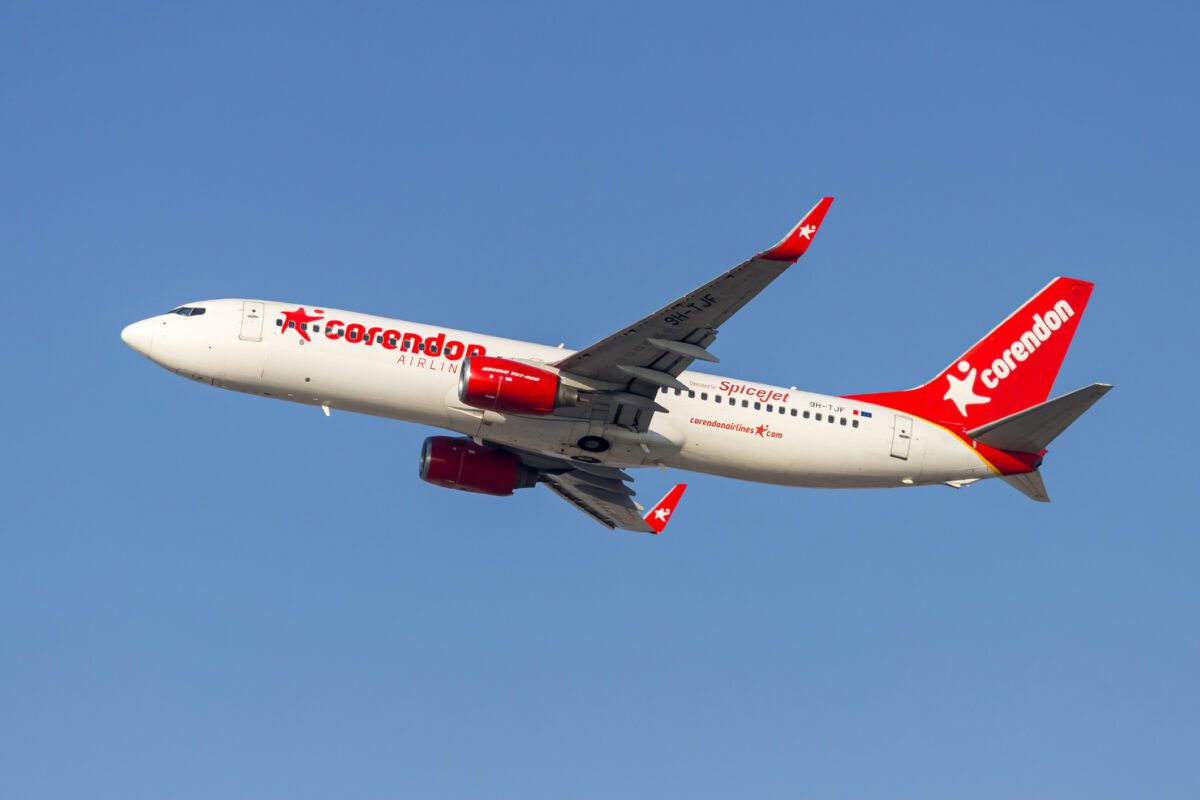
A Corendon Airlines Europe Boeing 737-800 landed safely at Nuremberg (NUE) on Tuesday, October 13, after transmitting the transponder code associated with unlawful interference and losing radio contact with air traffic control.
The alert prompted German authorities to dispatch two Eurofighters to intercept flight XR456, which was operating from Corfu (CFU). Nuremberg suspended arrivals and departures while police and airport emergency teams prepared for the aircraft’s landing.
The 737 landed shortly after noon local time and was directed away from normal terminal operations for security checks. Police subsequently found no threat aboard, and the passengers and crew were permitted to leave the aircraft. The airport reopened after authorities issued an all-clear.
Read our stories in your inbox
Two aviation newsletters. Zero fluff.
Emergency code transmitted over Croatia
Corendon Airlines said the alert followed a brief malfunction involving the aircraft’s radio communication system while it was in Croatian airspace at approximately 9 a.m. UTC. The carrier said no emergency had occurred and that the passengers, crew and aircraft were not in danger.
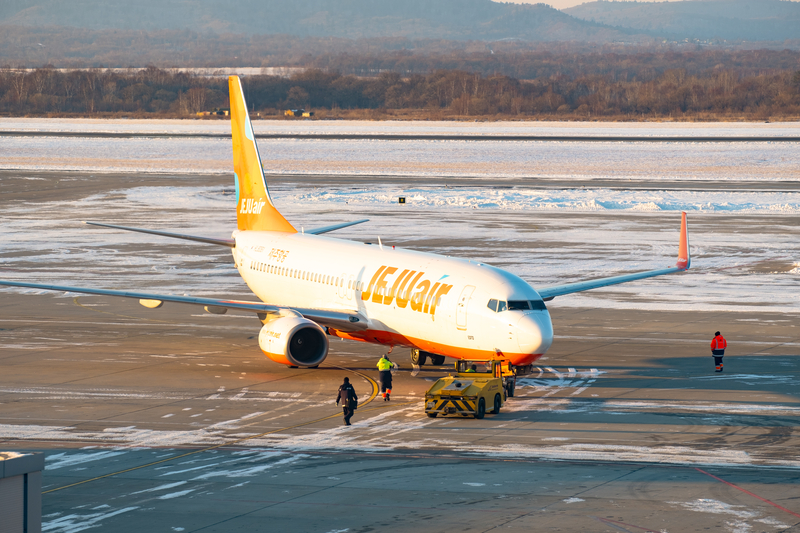
The aircraft was operating as XR456, Corendon Airlines Europe’s scheduled service from the Greek island of Corfu to Nuremberg. The jet was identified as 9H-CXD, a Malta-registered Boeing 737-800 operated by Touristic Aviation Services under the Corendon Airlines Europe name.
Malta’s civil aircraft register lists 9H-CXD as a Boeing 737-800 with manufacturer serial number 38308 and an approved capacity of 189 passengers. The aircraft is registered to Corendon Airlines Europe’s Maltese operating company.
The combination of a 7500 transponder code and an inability to contact the cockpit required controllers and security agencies to treat the flight as a possible unlawful-interference event. The absence of normal radio communication meant the aircraft’s intentions could not immediately be confirmed, even though it continued toward its filed destination.
Eurofighters launched from Neuburg
Two German Air Force Eurofighters intercepted the Boeing and accompanied it through German airspace toward Nuremberg. The fighters came from Tactical Air Wing 74 at Neuburg an der Donau, the unit responsible for quick-reaction alert coverage over southern Germany.
The German Air Force says its Neuburg alert detachment must be able to launch two Eurofighters within 15 minutes. Loss of communication with a civil aircraft is among the principal reasons for a launch. Once alongside, fighter crews can identify the aircraft, inspect it visually and attempt contact by radio or standardized visual signals.
That capability was particularly relevant on XR456 because the aircraft continued on a predictable course to NUE. The intercept allowed authorities to observe the flight while police and airport teams established a controlled response on the ground.
The fighters broke away after the 737 landed. Their deployment was precautionary and did not indicate that German authorities had confirmed a hijacking.
Nuremberg suspends flight operations
Nuremberg Airport halted movements and restricted access as XR456 approached. Emergency vehicles and specialist police units assembled near the aircraft’s assigned parking area, while other traffic was held or sent to alternate airports.

The closure affected several flights during a busy period for the airport. Some inbound services diverted, while departing and arriving aircraft accumulated delays until the runway and operating areas were released. Operations resumed after police completed their initial examination and determined that no danger existed.
Passengers remained aboard XR456 during the checks before being transported to the arrivals area. The isolation of the aircraft limited access to the jet while allowing security teams to assess the cockpit, cabin and occupants without disrupting the terminal itself.
The response was separate from an earlier disruption at Nuremberg on the same day. The airport had reported possible drone sightings during the early morning, although a search involving police and airport authorities did not confirm an unmanned aircraft. The later closure was directly connected to the alert from XR456.
A high-capacity leisure aircraft
The 737-800 is the principal aircraft in Corendon’s European leisure operation. The airline’s published fleet information gives the type a 189-seat, single-class capacity, a maximum takeoff weight of 79,015 kilograms and a maximum range of 2,930 nautical miles.
Those economics make the aircraft well suited to routes linking German bases with Mediterranean leisure destinations. Corendon Airlines Europe operates a substantial fleet of the type and maintains Nuremberg as one of its German crew and aircraft bases.
Boeing’s specifications place the 737-800’s maximum certified passenger capacity at 189, with CFM56-7B engines and a range of up to 2,800 nautical miles under the manufacturer’s standard assumptions. The Corfu-Nuremberg sector uses only a fraction of that capability but fits the aircraft’s high-density short- and medium-haul role.
Corendon attributed Tuesday’s alert to the temporary radio-system problem, while German police continued examining the sequence that produced the 7500 transmission and subsequent communications loss.
Bottom Line
The handling of XR456 shows why a transponder alert cannot be downgraded simply because an aircraft remains on course and appears to be operating normally. Code 7500 carries an unambiguous security implication; when it is followed by silence from the cockpit, controllers have little room to wait for a more complete picture. The Eurofighter launch, airport closure and remote parking procedure were proportionate responses to an event whose cause could only be established after landing.
Corendon and Nuremberg bear the immediate operational cost through delayed aircraft, disrupted rotations and diverted traffic, but the wider significance is procedural. The event crossed several air traffic control regions before reaching Germany, requiring civil and military agencies to maintain a common understanding of an incomplete and changing situation. The investigation will need to establish the relationship between the radio fault and the transponder selection, including whether the two indications came from a single technical problem or separate actions during troubleshooting.
For Nuremberg, the incident also tested the airport’s ability to isolate an arriving narrowbody without allowing a security response to spill into the terminal. The relatively quick return to service suggests that the airport and police were able to contain the event once the aircraft was on the ground. Any technical findings concerning 9H-CXD, particularly those involving its communications or transponder systems, will determine whether the episode remains a one-off malfunction or prompts additional fleet checks.
Keep reading FlyMag
Get the Daily Brief in the morning or the Route Watch weekly recap on Fridays. Or both.