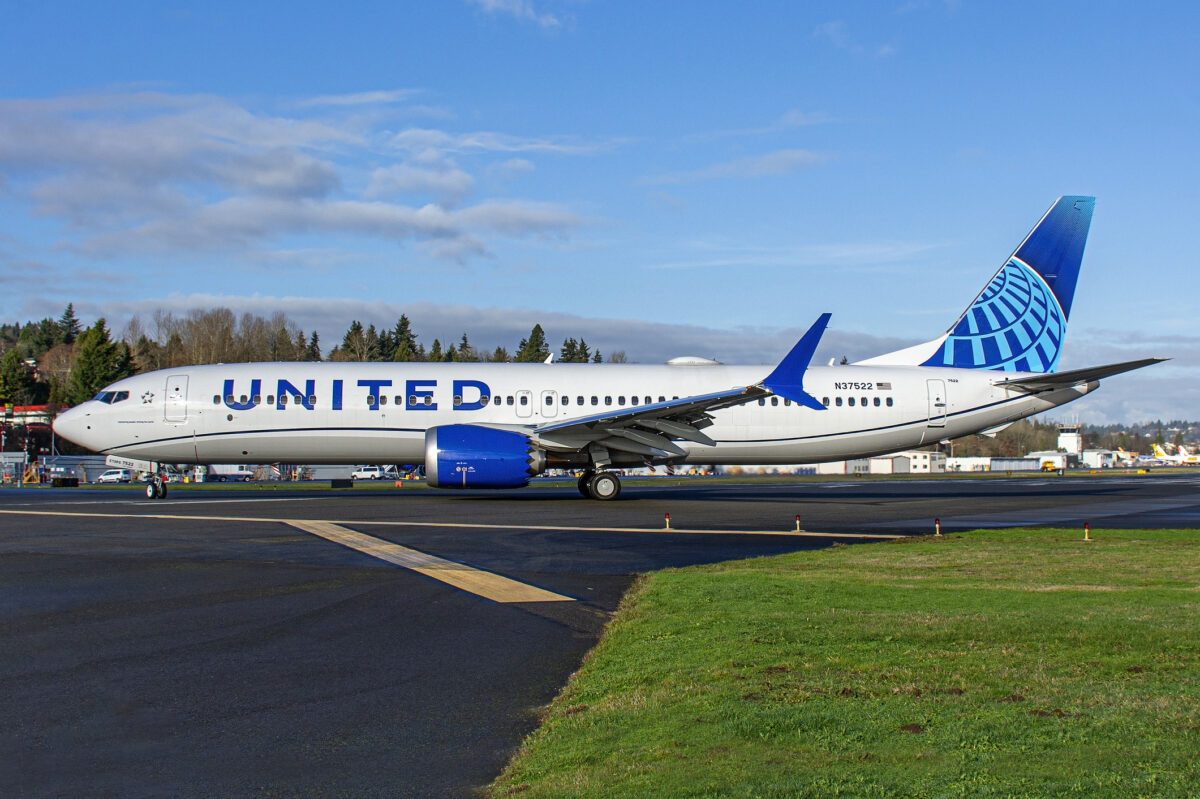
United Airlines has completed the replacement of its Guam-based Boeing 737-800 fleet with ten Boeing 737 MAX 8s, finishing a transition that was originally due to run through the end of 2026.

The airline confirmed the completed changeover on October 13. The new subfleet now operates all of United’s narrowbody flying from Guam (GUM), covering its Asian services, intra-Micronesia sectors and the multistop Island Hopper to Honolulu (HNL).
United unveiled the first aircraft assigned to the project in March, when two MAX 8s were already at Guam. At the time, the carrier expected to have the full ten-aircraft fleet in place by December. The remaining aircraft were introduced progressively across the network during the following seven months.
Read our stories in your inbox
Two aviation newsletters. Zero fluff.
A Dedicated 164-Seat Pacific Subfleet
The Guam aircraft have 164 seats, including 14 United First seats. That is two fewer seats than United’s standard 166-seat Boeing 737-800 layout, which has 16 seats in the forward cabin.
Each MAX 8 has United’s signature interior, including 13-inch high-definition screens in First and 10-inch screens in Economy. The aircraft also offer Bluetooth audio connections, USB charging, larger overhead bins and a greater number of extra-legroom seats.

The configuration retains an operational feature specific to United’s Pacific network. The forward Economy rows can be converted to accommodate a stretcher when the airline is carrying a patient requiring medical transportation. That capability is important on routes linking islands with Guam and Honolulu, where passengers may need access to medical services unavailable in their home communities.
The Boeing 737 MAX 8 is powered by CFM International LEAP-1B engines and has a published range of up to 3,500 nautical miles. Its combination of narrowbody capacity and range suits a Guam schedule that includes short inter-island sectors alongside longer overwater missions to Japan, the Philippines and Hawaii.
The fleet change gives United a standardized ten-aircraft group at GUM rather than a mix of incoming and outgoing equipment. That consistency extends to the passenger product, spare aircraft coverage and the specialized medevac configuration used within the region.
MAX 8 Now Covers the Full Guam Network
United began scheduled Guam MAX operations on select flights to Tokyo Narita (NRT) on April 30. The initial deployment also covered United’s Narita-based services to Ulaanbaatar and Koror, with the airline completing the conversion of its narrowbody Narita operation by late August.

The finished Guam subfleet now serves 15 destinations. United’s published Guam schedule includes Tokyo Narita and Tokyo Haneda (HND), Osaka Kansai (KIX), Nagoya (NGO), Taipei (TPE), Manila (MNL), Honolulu, Saipan (SPN), Yap (YAP) and Koror (ROR).
The MAX 8 has also taken over the Island Hopper and other Micronesian flying. The eastbound Island Hopper links Guam with Chuuk (TKK), Pohnpei (PNI), Kosrae (KSA), Kwajalein (KWA) and Majuro (MAJ) before continuing to Honolulu. Other schedules combine individual islands in different patterns depending on the day of operation.
Those missions place unusual demands on a narrowbody fleet. Aircraft operate across long stretches of ocean and into stations with limited engineering infrastructure, while maintaining connections among communities spread across several time zones. The same subfleet must also support higher-volume markets such as Japan and Manila.
United operates as many as 12 departures a day from Guam. It previously said its Japan schedule could reach 42 weekly flights across Narita, Haneda, Osaka and Nagoya, making the Japanese market a substantial part of the local operation even as the Guam aircraft continue beyond the principal Asian gateways.

Starlink Installation Begins on Guam Aircraft
Completion of the fleet transition coincides with the start of Starlink installations on the Guam MAX 8s. United said two of the ten aircraft have received the satellite connectivity system, making them among the first MAX 8s in its wider fleet to be fitted.
Starlink is available without charge to MileagePlus members in every cabin and supports simultaneous connections from multiple devices. Its low-Earth-orbit satellite network is particularly relevant to the Guam operation because much of the flying takes place over open ocean or through areas where conventional air-to-ground connectivity is unavailable.
The installation program also changes the onboard proposition announced when United introduced the Guam MAX 8 in March. The aircraft entered the operation with seatback entertainment and Wi-Fi available for purchase; the Starlink-equipped examples add complimentary high-speed connectivity for loyalty program members.
United plans to complete Starlink installations across its worldwide fleet before the end of 2027. As of October, the carrier said the service was available on about 47% of its daily flights.
Investment Extends Into the Terminal
The aircraft program forms part of a wider upgrade at Guam. United has also refreshed its check-in area at GUM, adding new-generation kiosks and changing the lobby layout to ease congestion.
The carrier first detailed the combined aircraft and terminal investment in September 2025, setting February 2026 as the target for the first MAX 8 arrival. Guam’s airport authority subsequently recorded the opening of the renovated lobby and United’s plan to replace the 737-800 fleet in its December 2025 airport newsletter.
United employs more than 1,000 people across Guam and Micronesia. The ten-aircraft commitment gives the carrier a modern, locally based fleet for a network that combines conventional international routes with essential links between remote Pacific communities.
Bottom Line
Completing the Guam changeover early matters beyond the age of the aircraft. United can now operate the entire narrowbody schedule from GUM with one passenger product and one dedicated MAX 8 configuration, including the adaptations required for medical transportation. That removes the transitional complexity of allocating older 737-800s and newer aircraft across a tightly interconnected island network.
Guam is also becoming an early test of how United’s newer cabin and connectivity investments work together. The MAX 8 brings seatback screens and Bluetooth throughout the aircraft, while Starlink addresses one of the clearest weaknesses of conventional inflight connectivity: long overwater sectors. The remaining eight installations will determine how quickly United can offer that combination consistently across the hub.
The fleet commitment reinforces Guam’s role as more than an endpoint in United’s system. Its aircraft link major Asian markets with small Micronesian stations and the U.S. mainland through Honolulu, often performing several very different types of mission within the same rotation. A standardized ten-aircraft subfleet gives United a stronger operating platform for protecting that network and deciding where additional Pacific capacity can be supported.
Keep reading FlyMag
Get the Daily Brief in the morning or the Route Watch weekly recap on Fridays. Or both.